501-918-3025
calsfoundation@cals.org
calsfoundation@cals.org
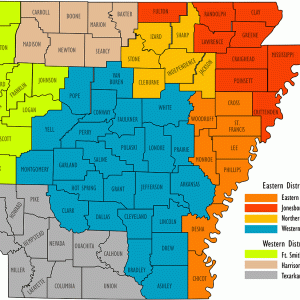
The United States District Court for the Eastern District of Arkansas is a federal trial court responsible for hearing civil and criminal cases arising under federal law. This court encompasses forty-one counties that cover the eastern half of the state. As a trial court, the Eastern District is where evidence is presented, witnesses testify, and verdicts are decided. Rulings may be appealed to the United States Court of Appeals for the Eighth Circuit; this circuit sets a binding precedent for the region. Established in 1851, the Eastern District Court has exercised broad jurisdiction over several matters of national significance. The court has most notably been responsible for rulings in civil rights, prison system reform, the separation of church and state, and public corruption. These various rulings have become embedded in Arkansas history and have helped define the enforcement of federal law across the country.
The federal judicial presence traces its origins to the state’s admission to the Union. (The Superior Court of Arkansas Territory, later the Arkansas Supreme Court, had been organized in 1819, but no federal court was yet present.) On June 15, 1836, Arkansas became the twenty-fifth state in the United States, and it was organized into a single judicial district. On March 3, 1851, as the state’s population and caseload grew, the United States Congress divided it into eastern and western districts. Arkansas was assigned to the Eighth Circuit in 1866 following the reorganization of federal judicial circuits after the Civil War. Judgeships were added incrementally over the following century, and since 1990, the Eastern District has held five active judgeships.
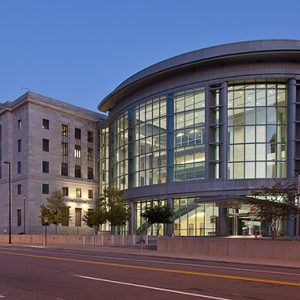
The district is organized into three geographic divisions. The Central Division is held in the Richard Sheppard Arnold United States Post Office and Courthouse in downtown Little Rock (Pulaski County). This division serves nineteen counties (including Pulaski). The courthouse was constructed under the direction of James A. Wetmore between 1931 and 1932 in the Greek Revival Style. The Delta Division serves eight counties at the Jacob Treiber Federal Building, United States Post Office and Courthouse in Helena-West Helena (Phillips County). This building was designed by Edward Brueggemann and Elmer A. Stuck & Associates in the International Style, with construction spanning 1959 to 1961. Finally, the Northern Division serves fourteen counties from the E. C. “Took” Gathings Federal Building and United States Courthouse in Jonesboro (Craighead County). The facility was completed in 1960, also in the International Style.
The Eastern District’s most renowned case arose from the 1957 Little Rock desegregation crisis. In the wake of the U.S. Supreme Court’s 1954 ruling in Brown v. Board of Education of Topeka, Kansas, the NAACP brought suit in the Eastern District on behalf of Black students being denied entry into Little Rock’s white schools. The case, Aaron v. Cooper, was assigned to Judge Ronald N. Davies, a visiting judge from North Dakota who had been sent to Little Rock to help clear an unrelated case backlog. Davies became an unlikely central figure whose rulings would directly test the supremacy of federal law in one of the most consequential civil rights conflicts in American history. In September 1957, Governor Orval Faubus deployed the National Guard to block nine Black students from entering Central High School. Davies decried the obstruction and requested Department of Justice intervention. A hearing was held in the Little Rock federal courthouse, with future U.S. Supreme Court Justice Thurgood Marshall appearing as NAACP counsel. Davies issued a preliminary injunction against Faubus. President Dwight Eisenhower later deployed the U.S. Army’s 101st Airborne Division to enforce it. On appeal, the Court affirmed in Cooper v. Aaron (1958). This ruling was signed by all nine justices, holding that no state may nullify or evade a federal court order.
In Holt v. Sarver (1969), Chief Judge J. Smith Henley ruled that the entirety of the Arkansas prison system constituted cruel and unusual punishment in violation of the Eighth Amendment. This was the first ruling in U.S. history in which an entire prison system was deemed unconstitutional. The ruling described conditions at the Cummins and Tucker prison farms as “a dark and evil world completely alien to the free world.” Upon appeal, the Eighth Circuit affirmed, and the Supreme Court confirmed key aspects of the resulting orders in Hutto v. Finney (1978). This case set a national precedent for prisoners’ rights and triggered comprehensive reform of the Arkansas Department of Corrections.
In McLean v. Arkansas Board of Education (1982), Judge William R. Overton struck down Arkansas Act 590, deeming it unconstitutional. Arkansas Act 590 was a state law requiring public schools to give equal classroom time to “creation science” alongside the theory of evolution. Overton ruled that creation science was a religious doctrine and that its instruction violated the Establishment Clause of the First Amendment.
The Eastern District also served as the venue for the Whitewater prosecutions of the 1990s. This case was one of the most nationally watched public corruption proceedings in Arkansas history. Judge George Howard Jr. presided over the trials of Jim and Susan McDougal, former business partners of President Bill Clinton and Hillary Clinton. Judge Howard called for video testimony from Clinton, a sitting president testifying in a federal criminal trial. The McDougals were convicted in 1996, along with thirteen others, for more than forty crimes. Several were pardoned by Clinton. The Clintons were not charged with any wrongdoing.
Judge George Howard Jr. is one of the most celebrated figures in the Eastern District’s modern history. A Pine Bluff (Jefferson County) native, World War II veteran, and civil rights attorney who litigated on behalf of the NAACP, Howard became the first African American federal district judge in Arkansas when President Jimmy Carter appointed him in 1980. The federal courthouse in Pine Bluff now bears his name. Another noteworthy judge is Tom Eisele, a Hot Springs (Garland County) native and World War II veteran appointed to the court in 1970 by President Richard Nixon. He oversaw several important cases relating to civil rights and prison reform.
Kristine G. Baker began serving as Chief Judge of the Eastern District in December 18, 2023. She was nominated to the court by President Barack Obama in 2011 and confirmed in 2012. Baker received her law degree with high honors from the University of Arkansas School of Law and clerked for then Chief Judge Susan Webber Wright of the Eastern District before entering private practice in commercial and First Amendment litigation. Jonathan D. Ross began serving as the United States Attorney for the Eastern District in 2021, the district’s top-ranking federal law enforcement official.
For additional information:
“28 U.S. Code § 83 – Arkansas. Legal Information Institute.” Cornell Law School, www.law.cornell.edu/uscode/text/28/83 (accessed July 30, 2026).
“Records of the United States District Courts in Arkansas.” National Archives, U.S. National Archives and Records Administration. https://www.archives.gov/kansas-city/finding-aids/rg021-arkansas-courts (accessed July 30, 2026).
Ross, Frances Mitchell, ed. United States District Courts and Judges of Arkansas, 1836–1960. Fayetteville: University of Arkansas Press, 2016.
U.S. District Court for the Eastern District of Arkansas. https://www.are.uscourts.gov/ (accessed July 30, 2026).
“U.S. District Courts for the Districts of Arkansas: Legislative History.” Federal Judicial Center. https://www.fjc.gov/history/courts/us-district-courts-districts-arkansas-legislative-history (accessed July 30, 2026).
Evan Middleton
Warden and Ludwig Law Firm


Comments
No comments on this entry yet.