
501-918-3025
calsfoundation@cals.org
calsfoundation@cals.org
The Orthodox Christian Church, also called Eastern Orthodox or Eastern Orthodoxy, traces its history to the first century as recorded in the New Testament of the Bible. The Orthodox Church has also helped explain and protect its faith through seven gatherings called Ecumenical Councils. Through these gatherings, bishops agreed on major doctrines and rules that make up the official teachings of the Church. The first of these councils was held in 325 CE, and the last was held in 787. In 1054, there was a formal break between the Greek-speaking East and Latin-speaking West over centuries-long theological, cultural, and political differences. The Orthodox Church is structured as a communion of fourteen self-governing bodies called “autocephalous” churches. Led by patriarchs who serve as presiding bishops, these churches, such as Greek and Russian, share the same faith and sacraments. They differ only in the liturgical languages used and in their local ethnic traditions.
Of the estimated 260 million Orthodox Christians worldwide, an estimated 1.8 million live in the United States. This growth in North America began in 1794 with Russian missionaries to Alaska’s Aleutian Islands. Not until the 1860s and 1870s did Orthodoxy expand in the continental United States with the Holy Trinity Russian Orthodox Cathedral in San Francisco, California, and the Holy Trinity Greek Orthodox Cathedral in New Orleans, Louisiana. The 1890s and early 1900s saw the first massive waves of Orthodox immigration to America. This was largely due to Eastern European and Middle Eastern immigrants fleeing poor economic and political conditions in their home countries. Many of those arriving came from what is present-day Albania, Bulgaria, Romania, Russia, Serbia, Ukraine, Syria, and Lebanon. When they arrived, as seen in Arkansas, they often organized parishes along these ethnic lines. These parishes, or local church communities, helped preserve the languages, traditions, and cultural identities of the old countries and helped retain these familiar ties for immigrants.
Russian Orthodox
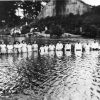
In 1899, Father John Kochurov (later declared a saint) traveled by rail from Chicago to the small Arkansas settlement of Slovaktown (now Slovak) in Prairie County. His mission was part of a larger effort to reach Uniates (also called Eastern Catholics, those who used an Orthodox liturgy but acknowledged the authority of the Roman Catholic pope). Five years earlier, in 1894, four Russian Orthodox families had arrived in this part of Prairie County with twenty-five other families—some Uniate and some Roman Catholic—from Austria-Hungary by way of Pennsylvania. This farming land was promoted and purchased for them at $15 per acre. The families also lived together for free in one multi-apartment building and had six farming huts and 125 farms.
During his brief pastoral visit, Kochurov held one night service in the apartment building, served communion, heard all-night confession, and led the Uniates’ reunion to Orthodoxy. He also instructed them, along with the existing Orthodox families, to gather on the weekends and holidays for shared prayer and reader services. After asking for a blessing from Bishop Tikhon (later Patriarch of Moscow and saint), they began building a church shortly after 1900. In this same year, the Catholic families built their own church and requested a permanent priest from their bishop, Bishop Edward Fitzgerald.
Around 1940, lightning struck the Orthodox church and damaged it beyond repair. Construction soon began on a new church, and the first service was held in it on Palm Sunday in 1942 with a priest from St. Louis, Missouri. By this decade, however, priests had visited so rarely that reader services alone kept the doors open. Many original members had died, and their children had gotten married outside the church. The church held its last service with a priest in 1948. Unused for eleven years, the building was given to St. Alban’s Episcopal Church twelve miles south in Stuttgart (Arkansas County) in 1959. Only the Russian Orthodox cemetery remains in Slovak today.
Greek Orthodox
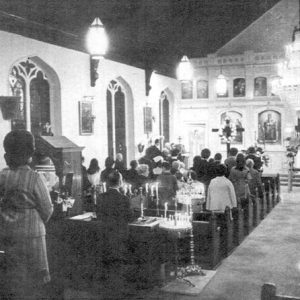
Greek Orthodox Christians arrived in Little Rock (Pulaski County) in 1892. By 1905, the community—calling itself the Homer Society—had grown enough to hold regular services and had become the largest gathering of Orthodox Christians in Arkansas. Following a common pattern in immigrant communities that lacked local clerical hierarchy, this group functioned under a trustee board of local lay leaders that managed the church’s affairs. But visiting priests often came from Memphis, Tennessee. Not yet having a church building, the community held its first Pascha (or Easter) service in April 1911 at Christ Episcopal Church. Local newspapers reported on it and noted with interest how the Greeks stood for the entire two-hour service—a standard practice for Orthodox Christians since the early church and even today.
Sources differ, but in either 1913 or 1917, the community welcomed its first full-time priest, Father Kallinikos Kanellas, who was one of the first Greek priests in America. Growth in the church led them to purchase the former Winfield Methodist Church at 1500 Center Street in Little Rock in 1919. The community, recognized by its 1920 state charter as Annunciation Greek Orthodox Church, had its first service in its new building on Palm Sunday in April 1921 with its new priest, Father Arsenios Priakos.
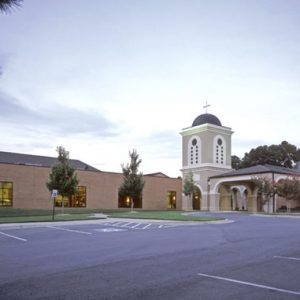
In the 1970s, the church purchased land at 1100 Napa Valley Drive and finished construction there in 1983. It remains the largest and oldest continuously operated Orthodox church in Arkansas.
Greek immigrants also settled in Hot Springs (Garland County) in the early 1900s and found business opportunities in the booming resort town known for its natural thermal springs. After holding services in a house for a time, a local group called the AHEPA Lodge (American Hellenic Educational Progressive Association) met in September 1954 to appoint a church trustee board and create plans to fundraise for a new church building. Five years later, in December 1959, the building at 502 Morrison Avenue was finished. Named Zoodochos Peghee, or “Life-Giving Spring,” the church in Hot Springs began with eighteen founding families and with Father Constantine Statheron as its first priest. Over the years, several priests served here, including Father Demetrios Constantinidis. He served for fifteen years and, reflecting the church’s diversity, gave sermons in Greek, English, and Serbian. Although the building was sold and ceased to be used as an Orthodox church, Zoodochos Peghee remains historically significant as Arkansas’s first church building built by a Greek community.
Serbian Orthodox
The Serbian presence in Arkansas stands as a more recent development in the state’s Orthodox history. Unlike previous Greek and Russian churches, Serbian churches began in the late twentieth century. St. Archangel Michael Serbian Orthodox Church was built in Hot Springs in the Byzantine architectural style in 1979 at 384 Mt. Riante Road. Its founders were Serbs who had mostly come from Chicago, Illinois, a few years earlier for the town’s thermal spas. Donated by Father Radomir Chkautović, this land provided space for what has become Arkansas’s oldest continuously operated Orthodox church in a single building.
The church has also had many visiting priests over the decades. Hieromonk Filotej Petrović served the longest from 2001 to 2009. Not until January 2024 did it welcome its first full-time priest, Father Tomislav Savić. Unlike many Serbian Orthodox churches in larger cities like Chicago where parishes are predominantly Serbian, this parish brings together Serbians as well as those with Bosnian, Croatian, Russian, Ukrainian, Romanian, and Greek backgrounds. To serve this diversity, the church holds weekly services in Serbian, English, and Church Slavonic, which is the traditional Slavic liturgical language.
The parish keeps Serbian traditions alive in Hot Springs, especially the celebration of Slava, which is unique to the Serbian Orthodox Church. Slava is a tradition in which each family honors its patron saint with a church service and the blessing of Slava bread and boiled wheat by the priest. Along with this 1,000-year-old tradition, St. Archangel Michael also hosts SerbFest, an annual fall festival to share Serbian food, music, and dance with the broader community. Next to the church, there is a playground, a dining and event hall, and Arkansas’s only Serbian Orthodox cemetery.
But St. Archangel Michael is not the parish’s only church. St. George Serbian Orthodox Church was built ten miles away in 1992 at 108 Donnie Court. Services are held there a few times a month in Serbian, English, and Church Slavonic. Like St. Archangel Michael, it did not have a full-time priest until 2024, when Father Tomislav was assigned to serve both churches.
Russian Orthodox Church Outside of Russia (ROCOR)
ROCOR was formed by Russian Orthodox Christians who fled Russia after the communist revolution in 1917. By 2026, there were two active ROCOR parishes in Arkansas following the ancient eastern tradition.
All Saints of America Orthodox Church in De Queen (Sevier County) began in 1995 and is the oldest ROCOR parish in Arkansas. It began in 1989 when George Brooks and his wife Iris moved from Atlanta, Georgia, to De Queen. As new converts to Orthodoxy, they found that the nearest church was three hours away. But by 1990, they had built St. Nicholas Orthodox Christian Chapel on their farm. It served as a mission with visiting priests until October 1995, when George Brooks was ordained as a priest. With Father George’s ordination, the mission at 193 Brooks Road became a full parish and was renamed All Saints of America Orthodox Church.
In July 1999, a traditional Russian dome was added to the top of the church building. In August 2002, the church added bells from the Pyatkov Bell Factory in the Ural Mountains in Russia, the site of traditional Russian bell crafting for over 300 years. And in December 2004, St. Mildred’s Manor was added as a guest house for visitors.
Seeker of the Lost Orthodox Christian Church in North Little Rock (Pulaski County) began in 2017 with Father David Carder as its priest, offering “Old” Calendar services in English and Church Slavonic. The church takes its name from a particular icon (or sacred image) of Mary, the Mother of God, called “Seeker of the Lost.” Father David commissioned a full translation from Church Slavonic into English of materials for the icon’s celebration service, and the church began celebrating this service in English once a year.
The church at 3 East 56th Place now serves primarily American converts, alongside immigrants from Russia, Ukraine, and Moldova.
Antiochian Orthodox
The Antiochian Orthodox Church spread to America when Syrian and Lebanese immigrants arrived in the late 1800s. By 2026, there were two Antiochian parishes in Arkansas.
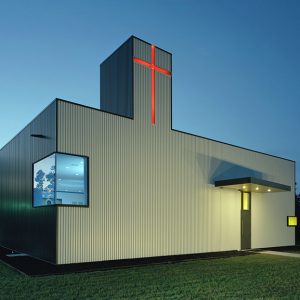
St. Nicholas Orthodox Church in Springdale (Washington and Benton Counties) was founded in 2001. Before that time, families in the area were traveling to Tulsa, Oklahoma, to attend Orthodox services, because there were none in northwestern Arkansas. Under the guidance of Father George Eber, the priest at St. Antony Orthodox Church in Tulsa, these families began gathering in homes for worship and fellowship. Soon after this, Father George began traveling to Springdale once a month for services in parishioners’ homes. These families later began meeting on Sundays once a month in a Methodist church in Fayetteville (Washington County) before moving to the chapel of St. Martin’s Episcopal Student Center on the University of Arkansas campus. In October 2001, Father John Atchison moved from Wyoming to become St. Nicholas’s first full-time priest. Under his guidance, the church rented and converted a former medical office building in downtown Springdale in 2002, using it for nearly eight years. But in 2006, a parishioner donated money that the church used to purchase three acres of land at 3171 S. 48th Street in front of Rotary Park. Marlon Blackwell, a prominent Fayetteville-based architect and professor, was hired to turn the property’s metal building into a church, which was completed in 2009. The church serves around one hundred families with around eighty-five percent being American converts and a small percentage having Greek and Slavic backgrounds.
Holy Trinity Orthodox Church in Little Rock began in 1997. Several families in the area wanted an all-English-speaking Orthodox church and sought guidance from Father Roman Braga at Holy Dormition Monastery in Rives Junction, Michigan. Father Roman encouraged them to reach out to Father Gordon Walker in Franklin, Tennessee.
The church held its first service in 1997 with Father Gordon. Catechism classes started soon after this, and the church then sought a full-time priest. Father Timothy Cremeens arrived with his family in August 1997 to fill this need. As the community grew, they moved temporarily, first to Mount St. Mary Academy, then again to a small church building on South Valentine Street in August 1998. Holy Trinity later moved to 1812 Watt Street.
Orthodox Church in America (OCA)
The OCA can be traced to Russian missionaries who came to Alaska in 1794. It was also granted autocephaly, or self-governance, by the Moscow Patriarchate in 1970. By 2026, there were two OCA parishes in Arkansas.
Ss. George and Alexandra Orthodox Church in Fort Smith (Sebastian County) began in 1994. It came largely out of the legacy of the former St. George Greek Orthodox Chapel in downtown Fort Smith, which had been unused since 1974. For a mix of Greek, Russian, and Syrian Orthodox Christians, the founders of Ss. George and Alexandra sought to revive Orthodoxy in the area by starting a church that would not be under any particular ethnic jurisdiction.
With Father John Maxwell serving as the priest, the church held services first at St. Edwards Mercy Hospital Chapel and then in a storefront space in Phoenix Village Mall. After that, the church moved to 7500 Mahogany Avenue in 2001 when it acquired a former Fort Chaffee military chapel. Ethnically, the parish is made up of Greeks, Russians, Ukrainians, Bulgarians, Romanians, Moldovans, Native Americans, African Americans, and Latinos. In 2023, the church established Fort Smith’s first Orthodox cemetery.
St. John of Chicago Orthodox Church in Rogers (Benton County) began in May 2011. Named after St. John Kochurov, who visited Slovak in 1899, the church held its first services in the basement of a parishioner’s home. In October of that year, it moved to a strip mall in the Prairie Creek (Benton County) area before purchasing a building at 1740 S. 9th Street in February 2015. The church serves primarily American converts, although many Ukrainians, Russians, and Greeks also attend.
Ukrainian Orthodox
St. Thomas the Apostle Orthodox Church sits at 1343 E. 9th Street in Mountain Home (Baxter County). It began in 2003 as an Anglican church but became Orthodox in 2015. Father Samuel Seamans, who had served the church since the beginning, was ordained as an Orthodox priest in 2017. After becoming Orthodox, it first joined the Antiochian Western Rite, or the rite of those Orthodox churches that use a western liturgy instead of the traditional eastern Byzantine liturgy, which is called Eastern Rite. After leaving the Antiochian Western Rite, in June 2020, the parish was received into the Ukrainian Orthodox Church of the USA, an Eastern Rite jurisdiction under the Ecumenical Patriarchate of Constantinople.
Starting in a small rented building, the church soon doubled its membership and then doubled again. This growth forced them to move to a new location and into a building four times larger than the original space. A retired priest also moved to the area and joined the parish, giving St. Thomas two priests.
For additional information:
“All Saints of America Orthodox Church.” Rural Arkansas, December 2004.
Bass, Gabriel. “Serbian Church Celebrates Culture, Faith, Community.” Hot Springs Sentinel-Record, October 7, 2024. https://www.hotsr.com/news/2024/oct/07/watch-serbian-church-celebrates-culture-faith/ (accessed January 16, 2026).
Brady, Joel. “Becoming What We Always Were: ‘Conversion’ of U.S. Greek Catholics to Russian Orthodoxy, 1890–1914.” U.S. Catholic Historian 32, no. 1 (2014): 23–48.
———. “Transnational Conversions: Greek Catholic Migrants and Russky Orthodox Conversion Movements in Austria-Hungary, Russia, and the Americas (1890–1914).” PhD diss., University of Pittsburgh, 2012.
Crisan, Cezara O. The Legitimation Crisis of the Orthodox Church in the United States: From Assimilation to Incorporation. Lanham, MD: Lexington Books, 2019.
Diocese of Miami and the Southeast. “The Light,” February 2022. https://domse.org/wp-content/uploads/2022/01/DOMSE_TheLight_Feb22.pdf (accessed January 16, 2026).
———. “The Light,” February 2023. https://domse.org/wp-content/uploads/2023/01/DOMSE_TheLight_Feb23.pdf (accessed January 16, 2026).
Elfter, James G. “History of Zoodochos Peghee.” The Record 7 (1966): 88–90.
Erickson, John H. Orthodox Christians in America: A Short History. New York: Oxford University Press, 2007.
Ferencz, Nicholas. American Orthodoxy and Parish Congregationalism. Piscataway, NJ: Gorgias Press, 2006.
FitzGerald, Thomas E. The Orthodox Church. London: Bloomsbury Publishing, 1998.
“Former Slovak Church Serves as Episcopalian Sunday Classroom.” Tele-Times and Stuttgart Centennial Chronology, supplement to The Daily Leader, May 16, 1980.
Freeman, Felton D. “Immigration to Arkansas.” Arkansas Historical Quarterly 7 (Autumn 1948): 210–220.
Fulton, Chris. “The Church in the Green Field.” Mountain Home Observer, November 4, 2022. https://mhobserver.com/the-church-in-the-green-field/ (accessed January 16, 2026).
Georgevich, Dragoslav, Nikolaj Maric, and Nicholas Moravcevich. Serbian Americans and Their Communities of Cleveland. Vol. 1. Cleveland, OH: Cleveland Ethnic Heritage Studies, Cleveland State University, 1977.
“History Links Greek Family, Church.” Hot Springs Sentinel-Record, February 9, 2003, 2G.
Hodges, Leroy. “Slavs on Southern Farms: An Account of the Bohemian, Slovak, and Polish Agricultural Settlements in the Southern States.” Washington DC: Government Printing Office, 1914. Online at https://curiosity.lib.harvard.edu/immigration-to-the-united-states-1789-1930/catalog/39-990052877920203941 (accessed January 16, 2026).
Hronas, James and Helen. “A History of the Annunciation Greek Orthodox Community of Little Rock, Arkansas.” Pulaski County Historical Review 39 (Fall 1991): 61–71.
Kitroeff, Alexander. The Greek Orthodox Church in America: A Modern History. DeKalb: Northern Illinois University Press, 2020.
“Local Church Acquires Bells from Russian Factory.” DeQueen Bee and DeQueen Daily Citizen, August 26, 2002.
McGuckin, John Anthony, ed. The Encyclopedia of Eastern Orthodox Christianity. Hoboken, NJ: Wiley-Blackwell, 2011.
The Monastery of St John the Forerunner of Mesa Potamos. Glorified in America: Laborers in the New World from Saint Alexis to Elder Ephraim. Translated by Katherine Psaropoulou-Brits. Jordanville, NY: Holy Trinity Publications, 2023.
Namee, Matthew. Lost Histories: The Good, the Bad, and the Strange in Early American Orthodoxy. Munster, IN: Ancient Faith Publishing, 2024.
“New Gracanica-Midwest Holds Special Assembly.” The Path of Orthodoxy 44, no. 9 (September 2009). https://www.serborth.org/files/September2009Path.pdf (accessed January 16, 2026).
Orthodox Christians in North America, 1794–1994. Brooklyn, OH: Orthodox Christian Publications Center (OCPC), 1995.
Presley, Fran. “Two Ordained by Orthodox Church.” Texarkana Gazette, May 27, 1998, 9A.
Riccardi-Swartz, Sarah. “Orthodox Christianity in the United States: A Challenge for the Study of American Religion.” Religion Compass 17 (May–June 2025). https://doi.org/10.1111/rec3.12461 (accessed January 16, 2026).
Samonides, William H. “Holy Week and Pascha in 1921 Little Rock.” Orthodox Observer 82, no. 1324 (April 2017): 20. https://s3.amazonaws.com/orthodoxobserver/2017/2017-04-observer-1324.pdf (accessed January 16, 2026).
Spasovic, Stanimir. The History of the Serbian Orthodox Church in America and Canada. 1941–1991. Belgrade, Serbia: Printing House of the Serbian Patriarchate, 1998.
Tarasar, Constance J., ed. Orthodox America, 1794–1976: Development of the Orthodox Church in America. Syosset, NY: Orthodox Church in America, Department of History and Archives, 1975.
Vukovic, Bishop Sava. History of the Serbian Orthodox Church in America and Canada, 1891-1941. Kragujevac, Serbia: Kalenic Press, 1998.
Ware, Kallistos. The Orthodox Church: An Introduction to Eastern Christianity. New York: Penguin Books, 2015.
Joseph K. Lackey
Hot Springs, Arkansas


Comments
No comments on this entry yet.