



501-918-3025
calsfoundation@cals.org
calsfoundation@cals.org
During the late nineteenth and early twentieth centuries, Arkansas had thousands of children working in fields, factories, and mills. The practice of child labor shaped the state’s economy, educational system, family structures, and entire society. Families often relied on the labor of all members, including children. And in a state whose economy was driven by the agriculture and timber industries, children were a widespread presence in cotton fields and sawmills. In the twenty-first century, Arkansas has seen labor laws enacted during the Progressive era loosen, and many employers have been found in violation of the strictures that remain.
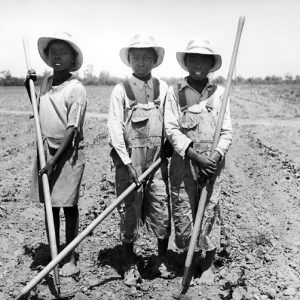
Children in rural Arkansas engaged in substantial labor, both formal and informal, performing essential farm and plantation tasks. Arkansas census records for 1910 indicate that 55.7 percent of males and 30.5 percent of females ages ten to fifteen were classified as gainfully employed, rates that substantially exceeded the national average of 18 percent. Children worked alongside their families in cotton fields in agricultural regions of Arkansas, while in urban areas, they were employed in textile mills, lumber yards, and food-processing plants.
American children in the eighteenth and nineteenth centuries, some as young as six, sometimes worked from before dawn until sunset, leading to severe physical and educational consequences. The Smithsonian Institution notes that these children endured long hours, resulting in physical and mental stunting due to a lack of education and rest. The many works of Lewis Hine, an American photographer who went around the United States capturing powerful images of children working in factories in the early twentieth century, depict child laborers who were underweight, suffered from stunted growth, and developed diseases related to their work environment, such as tuberculosis and bronchitis.
By 1900, roughly fifteen states had passed meaningful child labor laws, but southern states, including Arkansas, generally lagged in adopting and enforcing such protections due to their reliance on child labor in agriculture and early industrial sectors, such as textiles and mining. However, Arkansas emerged as an early reformer with a Progressive-era child labor law in 1914. Approved by an almost 75 percent margin, this citizen-initiated statute limited child labor, establishing work permits and restrictions on dangerous occupations. This law was largely supported by grassroots social reformers, such as Edgar Murphy, a clergyman born in Fort Smith (Sebastian County) who founded the National Child Labor Committee (NCLC) in 1904. The other major advocate for child labor restrictions was the Arkansas State Federation of Labor (ASFL). Some individual lawmakers publicly endorsed the measure, but the main driving force came from organized groups and the use of the initiative and referendum process, which allowed citizens to bypass the Arkansas General Assembly and bring the law directly to a vote.
On June 28, 1924, Arkansas became the first state to ratify the national Child Labor Amendment after the U.S. Supreme Court had ruled as unconstitutional the Keating-Owen Child Labor Act of 1916 and the Revenue Act of 1919 (also known as the Child Labor Tax Law), two laws that had attempted to stem the practice of child labor. However, too few states voted to ratify the Child Labor Amendment to make it law. Arguments in favor of ratification rested on the claim that states were too weak to protect children’s rights and that only a federal authority could do so. Arguments against ratification included that the federal government was overreaching and that it would interfere with the scope of child labor, a significant component of the agrarian economy of the southern states.
In 1938, the Fair Labor Standards Act (FLSA) established federal standards for child labor, including minimum age requirements and restrictions on hazardous work. U.S. Senators Joseph T. Robinson and Hattie Caraway voted in favor of the FLSA. However, most of Arkansas’s House delegation opposed the act, fearing it would harm their local economy, which relied on child labor. Five congressmen—William Joshua Driver, John Little McClellan, Wade Hampton Kitchens, Claude Albert Fuller, and William Ben Cravens—voted against it, while only David Dickson Terry supported it.
Personal Experiences of Child Workers
Historical accounts from the early twentieth century document the harsh realities faced by child laborers, particularly in agricultural settings. In the slave narratives collected by the Works Progress Association (WPA) in the 1930s, there are records of children helping their families on farms and in cotton fields to meet daily objectives. In one of the accounts, Charlie Vaden from Prairie County, whose mother died when he was five, was handed over to a white woman, Mrs. Frances Owen, who made him care for her grandchildren, Guy and Ira Brown, as well as work on her farm.
In the early 1920s, as a young girl in Newton County, Ruby Norton Watson lived with her parents in a stave-bolt camp, one of many temporary settlements that sprang up around Arkansas’s booming timber industry. She was required to perform domestic labor, making beds in the mill hands’ tents and sweeping floors each morning. The dangerous conditions children faced extended beyond their work duties. Watson’s account shows how children played on stacked staves, which could have been deadly if anything went wrong.
The timber industry’s exploitation of young workers included physically demanding labor. In an account describing Wayne Martin’s father’s experience, at about fifteen or sixteen, he was forced to work with crosscut saws, commonly known as “misery whips.” And boys like him often worked alongside much older men, who could be abusive.
Child Labor in the Twenty-First Century
Child labor, as defined by Arkansas Department of Labor and Licensing, refers to the regulated employment of minors from age fourteen, with legal protections that restrict unsafe work, excessive hours, and harmful working conditions to ensure minors’ safety, education, and development. The financial penalties imposed upon businesses by the Arkansas Department of Labor and Licensing increased by more than 600 percent between 2020 and 2023. This overall increase was driven by growth in violations rather than changes in penalty amounts per violation. The food service industry accounts for 78.4 percent of child labor cases investigated by the state of Arkansas, 62.9 percent of the violations, and 92.3 percent of the penalties imposed.
The U.S. Department of Labor disclosed that between October 2022 through July 2023, approximately 4,500 employed children were running afoul of federal child labor laws, resulting in employers being fined over $6.6 million in penalties. Just over half of Arkansas’s violations during 2020 through 2024 were for employing children beyond the maximum number of hours they could work. The next-largest proportion of violations, 38 percent, involved a lack of the previously required employment certificate for children under sixteen. In Arkansas, high-profile cases included federal investigations into child labor violations at two Tyson Foods, Inc., facilities.
During the 2023 session of the Arkansas General Assembly, legislators passed, and Governor Sarah Huckabee Sanders signed into law, HB 1410, the Youth Hiring Act (Act 195), which repealed the older Youth Hiring Act, removing the century-old compulsory state requirement for employers to verify a child’s age and obtain parental consent for workers under sixteen. This change came as part of a broader national trend, with more than ten states enacting or introducing legislation rolling back child labor protections. Republicans argued that it was important to shift the responsibility for compliance from the state to parents and employers to reduce external influence on a child’s decision to work. The main stated purpose of this act was to restore decision-making authority to parents regarding their children and to streamline the hiring process for children under sixteen.
Critics argued that removing work permit requirements would eliminate an important enforcement tool, potentially enabling “the exploitation of children and youth under the age of 16 to perform dangerous jobs, often in hazardous work conditions,” according to Dennis Lee, a spokesman for the Catholic Diocese of Little Rock. Many see this as a troubling lack of oversight that is particularly concerning for immigrant children, who are vulnerable to labor exploitation and trafficking. These children often work long hours or end up in dangerous jobs that violate federal and state labor laws. This vulnerability has become especially concerning as enforcement mechanisms are weakened.
The debate over child labor regulation in Arkansas reflects broader national tensions between economic pressures and child welfare concerns. Business interests argue that looser regulations promote workforce development and address labor shortages. Child advocates maintain that the loosening of protections puts young people at risk and potentially undermines educational attainment. The Youth Hiring Act was passed shortly after the U.S. Department of Labor fined, in February 2023, a sanitation contractor for employing more than 100 children in hazardous conditions at meatpacking plants, including facilities in Arkansas. Partially in response to backlash against the Youth Hiring Act, the legislature passed SB 390 (Act 687), creating misdemeanor and felony criminal penalties for child labor violations. During the 2025 legislative session, Representative Zack Gramlich, a Republican, introduced HB 1996, which, among other things, would “establish an educational alternative to civil penalties for certain violations related to child labor,” but this bill failed to pass.
In its November 2024 report, Arkansas Advocates for Children and Families documented a 266 percent increase in child labor violations between 2020 and 2023, and proposed several policy remedies, including:
These recommendations came as the Economic Policy Institute reported that business organizations like the National Restaurant Association and National Federation of Independent Business continued to advocate for reduced regulations, framing them as unnecessary barriers to youth employment.
In the 2023 Packers Sanitation Services, Inc., case, federal investigators documented children working overnight shifts cleaning dangerous machinery in slaughterhouses. The U.S. Department of Labor found that more than 100 children ages thirteen to seventeen were working in hazardous conditions in meat-processing plants across eight states, including Arkansas. These young workers were surrounded by hazards, including slippery floors, dangerous equipment, and harmful chemicals.
A Pulitzer Prize–winning investigation by Hannah Dreier found that migrant children often work dangerously long hours in hazardous conditions to support their families. The Department of Labor reported in April 2023 that child labor violations had increased by 69 percent since 2018, with many cases involving vulnerable immigrant children.
Comparative Analysis with Neighboring States
By 2026, Arkansas stood out among neighboring states with its loosening of child labor protections and its high rate of violations. Arkansas had a higher prevalence of federal child labor violations per million children than five of its six neighboring states, except for Tennessee. Missouri has maintained a work permit requirement for children under sixteen, like what Arkansas had before 2023. Although some Missouri lawmakers have proposed similar rollbacks to those enacted in Arkansas, these efforts have not been successful. Texas has not enacted significant rollbacks of child labor laws in recent years, though it continues to have a relatively high number of child labor violations, particularly in agricultural settings where federal exemptions allow for younger workers.
For additional information:
“Arkansas Child Labor, Act 1 (1914).” Ballotpedia. https://ballotpedia.org/Arkansas_Child_Labor%2C_Act_1_%281914%29 (accessed February 6, 2026).
Bridges, Ken. “History Minute: Arkansas Leads the Way in Banning Child Labor.” El Dorado News, July 20, 2022. https://www.eldoradonews.com/news/2022/jul/20/history-minute-arkansas-leads-the-way-in-banning/ (accessed February 6, 2026).
Dreier, Hannah. “Alone and Exploited, Migrant Children Work Brutal Jobs Across the U.S.” New York Times, February 25, 2023. https://www.nytimes.com/2023/02/25/us/unaccompanied-migrant-child-workers-exploitation.html (accessed February 6, 2026).
Filter, John A., and Betsy Wood. “States Are Weakening Their Child Labor Restrictions Nearly 8 Decades after the US Government Took Kids out of the Workforce.” The Conversation, May 4, 2023. https://theconversation.com/states-are-weakening-their-child-labor-restrictions-nearly-8-decades-after-the-us-government-took-kids-out-of-the-workforce-205175 (accessed February 6, 2026).
HB 1410 of 2023. Arkansas General Assembly. https://www.arkleg.state.ar.us/Bills/Detail?id=HB1410&ddBienniumSession=2023%2F2023R (accessed February 6, 2026).
HB 1996 of 2025. Arkansas General Assembly. https://www.arkleg.state.ar.us/Bills/Detail?id=hb1996&ddBienniumSession=2025%2F2025R&Search= (accessed February 6, 2026).
Heatherington, Kimberley. “Catholic Leaders Concerned Over New State Child Labor Law.” Arkansas Catholic, March 21, 2023. https://arkansas-catholic.org/2023/03/21/catholic-leaders-concerned-over-new-state-child-labor-law/ (accessed February 6, 2026).
Hiltzik, Michael. “America Vanquished the ‘Ancient Atrocity’ of Child Labor. Republicans Are Bringing It Back.” Los Angeles Times, April 28, 2023. https://www.latimes.com/business/story/2023-04-28/column-america-vanquished-the-ancient-atrocity-of-child-labor-republicans-are-bringing-it-back (accessed February 6, 2026).
Lankford, George E., ed. Bearing Witness: Memories of Arkansas Slavery: Narratives from the 1930s WPA Collections. 2nd ed. Fayetteville: University of Arkansas Press, 2006.
National Archives and Records Administration. “Teaching With Documents: Photographs of Lewis Hine: Documentation of Child Labor.” February 21, 2017. https://www.archives.gov/education/lessons/hine-photos (accessed February 6, 2026).
“Preventing Exploitative Child Labor in Arkansas.” Arkansas Advocates for Children & Families, November 18, 2024. https://www.aradvocates.org/publications/preventing-exploitative-child-labor-in-arkansas/ (accessed February 6, 2026).
Quincin, Ashley. “Arkansas Advocates Voice Concern as State Weakens Child Labor Protections.” Facing South, July 20, 2023. https://www.facingsouth.org/arkansas-weakens-child-labor-protections-sarah-sanders (accessed February 6, 2026).
Radde, Kaitlyn. “Arkansas Gov. Sanders Signs a Law That Makes It Easier to Employ Kids.” National Public Radio, March 10, 2023. https://www.npr.org/2023/03/10/1162531885/arkansas-child-labor-law-under-16-years-old-sarah-huckabee-sanders (accessed February 6, 2026).
“Ratifies New Amendment: Arkansas House First to Act on Proposed Child Labor Measure.” New York Times, June 28, 1924. https://www.nytimes.com/1924/06/28/archives/ratifies-new-amendment-arkansas-house-first-to-act-on-proposed.html (accessed February 6, 2026).
Rosa, Jeff Della. “Labor Law Limelight: State Law Eliminates Child Work Permit.” Northwest Arkansas Business Journal, July 31, 2023, pp. 1, 8.
SB 390 of 2023. Arkansas General Assembly. https://www.arkleg.state.ar.us/Bills/Detail?id=sb390&ddBienniumSession=2023%2F2023R&Search= (accessed February 6, 2026).
Sherer, Jennifer, and Nina Mast. “Child Labor Laws Under Attack: How Right-Wing Groups and Industry Are Rolling Back Protections for Child Workers.” Economic Policy Institute, August 10, 2023. https://www.epi.org/publication/child-labor-laws-under-attack (accessed February 6, 2026).
“Symposium: Children at Work.” Special issue, Arkansas Law Review 77, no. 2 (2024).
Vrbin, Tess. “Arkansas Child Labor Violations Spike; Advocates Urge Restoration of Work Permit for Kids Under 16.” Arkansas Advocate, November 18, 2024. https://arkansasadvocate.com/2024/11/18/arkansas-child-labor-violations-spike-advocates-urge-restoration-of-work-permit-for-kids-under-16/ (accessed February 6, 2026).
Wu, Yi. “Want to Solve Labor Shortages? Relaxing Child Labor Law Is Not the Answer.” Dickson Law Review 129 (Fall 2024): 351–374. Online at https://insight.dickinsonlaw.psu.edu/dlr/vol129/iss1/10/ (accessed February 6, 2026).
Oluseyi Noah Adebanjo
UA Little Rock Center for Arkansas History and Culture


Comments
No comments on this entry yet.