

 Leon Kendall Bostwick, Flu Victim
  Flu Patients
501-918-3025
calsfoundation@cals.org
calsfoundation@cals.org
Students will engage in the process of transcribing a piece of historical writing in order to understand what life was like during the Influenza Pandemic of 1918.
In 1918, an influenza outbreak, facilitated by the massive displacement of individuals participating in World War I, spread across the world. Believed to have begun in Haskell, Kansas, it spread from Camp Funston in March 1918 around the United States and to the rest of the world. Most countries participating in the war were infected quickly but were unwilling to report accurate details publicly for fear of damaging morale. Spain, however, was a neutral country, and thus began accurately reporting the gruesome details of the disease. Because of this, it came to be called the Spanish Flu.

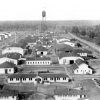
Camp Pike (later renamed Camp Joseph T. Robinson) in North Little Rock held 52,000 men. When the outbreak started, the camp was sealed and quarantined. More than a thousand men went to the infirmary a day from the disease. An order was given not to release the names of the dead in the hopes of preventing panic and containing the outbreak. Despite the quarantine measures, civilian cases began appearing throughout the Little Rock area.
U.S. Public Health Service officer for Arkansas J. C. Geiger downplayed threat to the state, despite himself being sick and his wife dying from the flu. Despite reassuring reports, the epidemic hit hard, catching Arkansas officials entirely unprepared. The disease spread through cities and rural areas alike. Many were too weak to draw water or make food; many sick families died of thirst or starvation. Country folk, known for helping each other during times of illness, were either too afraid or too sick themselves to support each other. Due to factors like lack of medical care, few telephones, low literacy, and poor record-keeping, many deaths went unreported, making an accurate death count unknown.
A higher mortality rate for Black Americans, likely due to the distinct lack of medical care, was noted even at the time. “No colored physicians available,” one national medical publication stated. Black deaths went almost completely unrecorded, even overseas. Black Americans with the Spanish Flu died in French hospitals, and no names or even number of deaths were recorded. Black sharecroppers on large farms and plantations went untreated and unrecorded. This was largely true of all poor Americans across the nation, but affected Black Americans disproportionately.
After 1,800 confirmed cases, despite Geiger’s reassurances, the Arkansas Board of Health put the state under quarantine in October 1918. Various county boards lifted restrictions later that year, though schools remained closed and children under 18 remained confined to their homes for an additional month.
After the war ended, the epidemic garnered much more press. By the time the pandemic ended in 1919, the recorded deaths totaled 100 million worldwide, 675,000 Americans, and 7,000 Arkansans. Of course, the true number is unknown and likely far higher.
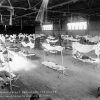
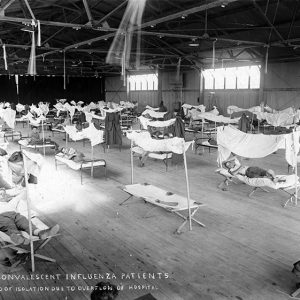
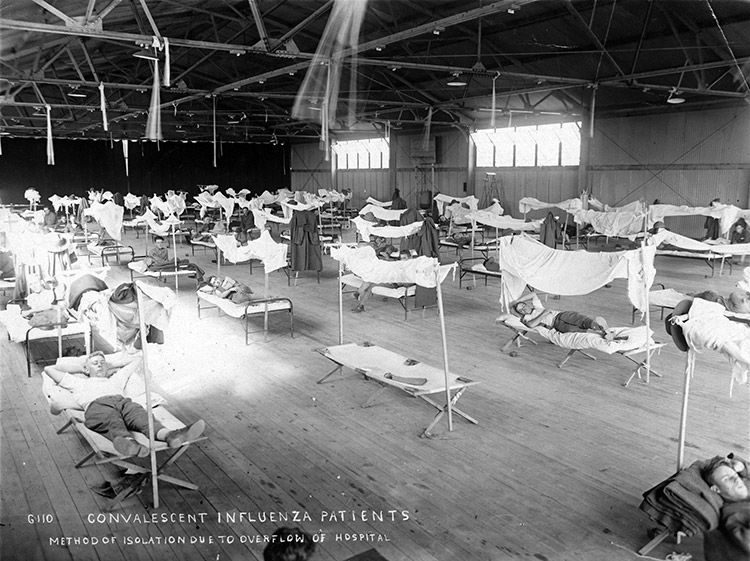
Show students the photo of soldiers at Eberts Training Field in Lonoke (Lonoke County) convalescing during the 1918 flu outbreak. Ask students to take in the photo and describe what they notice in it. This is a practice of being able to read photographs in an analytical context to glean information on the past. Some details students may notice include the cots lined up throughout the room, the warehouse-like environment, the fact that most cots seem occupied and the men have nothing to occupy them, the fact that all the men are white, etc. The epidemic was sudden, and thus conditions for the sick were hasty and unfavorable; this should be evident through photographic evidence. Help guide students toward these conclusions by asking questions like what conditions are clear based on the environment, what amenities do the sick have, etc.
Instruct students on the global context and details of the Spanish Flu outbreak. Refer to the Encyclopedia of Arkansas entry Flu Epidemic of 1918. Be sure by the end of instruction students are familiar with the following:
For this lesson, give students access to any of the materials in this set of thirty-three letters and postcards written to Curtis Jones on the Arkansas Studies Research Portal, linked at the end of this lesson plan below. The letters could be printed or accessed digitally.
This is an act of transcription, an important process when investigating and communicating about the past. Provide students with a cursive alphabet to aid in their reading (accessed at https://www.cursivealphabet.net/ or elsewhere).
Demonstrate the process using the first page of the document Letter: Jessie Jones to Curtis Jones, October 16, 1918, transcribed below:
| Little Rock AR
Oct 16 1918 My Darling Curtis Another day gone and no letter from my Sweetie it has been three weeks today since I had a letter from you I have only had two letters from you one written in England and one written on the boat But I am still waiting patiently for I know you have written these and you may be looking for mine but I hope you have gotten them for I have written you so many. We had a letter from Art today it was written on the boat He couldn’t say much only he was well and happy, And we have only had one letter from Del it was written on the boat I guess We love you we wait the [illegible] we will enjoy them, But Darling I am getting awful… |
After guiding students through this transcription and the first page of the letter, challenge students to see how much of the remaining pages of the letter they can understand. Have students write down their transcriptions. This could be an effective competition: put students into teams, and whoever can understand the letter the most accurately can be rewarded in some way.
At the end of the transcription activity, students can talk about what they practiced. What challenges did they face when transcribing? How helpful was it to have a transcription to reference as they read this old letter? What differences to contemporary language or writing did they notice? These are the very same challenges historians face. The purpose of this activity is to get students to appreciate the difficulties that come with studying and communicating about the past, but also how fulfilling it can be.
Students attempting to transcribe the letters acts as a kind of assessment, demonstrating understanding of both materials and historical practice. This is a challenge even for seasoned experts; thus, this may be better as a participation grade rather than a grade based on accuracy.
If students express interest in continuing to practice transcription, give them access to the entire Curtis Jones World War I collection (BC.MSS.14.06) (122 items) through the Arkansas Studies Research Portal. This could be an extension activity for another day or two, getting students to continue to develop their skills and understanding.
If students are less interested in transcription and more interested in the history of the Spanish Flu, have students compare and contrast the Influenza Epidemic of 1918 with another major disease outbreak in history, especially COVID-19 since they have had personal experience with it or have likely heard about it. Through their research, either as a short written response, full essay, presentation, poster, etc., have students discuss how each disease spread, how they impacted social and economic structures of their time, and how they differ from one another in various ways.


"*" indicates required fields