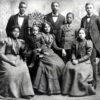

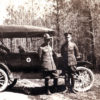

 African American WWI Draftees
 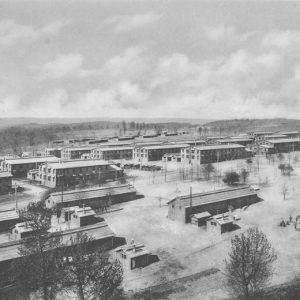 Camp Pike
  Field Kindley
 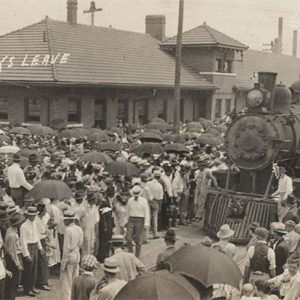 Paragould Recruits
  World War I Soldiers
  World War I Soldiers
501-918-3025
calsfoundation@cals.org
calsfoundation@cals.org
Students will explore World War I and its effects on Arkansas by engaging with both primary and secondary sources in order to understand the lived experiences of Arkansans and Arkansan soldiers in the war.
Students’ writing utensils, lined paper for students’ notes, printed or online copy of the CALS Encyclopedia of Arkansas entry World War I for each student and a printed or online copy of the Maxwell Lyons letter for each student
Several factors led to the start of the Great War, what we only later called World War I. Wide-stretching political alliances and growing nationalism highlighted tensions, and finally the assassination of Archduke Franz Ferdinand on June 28, 1914, ignited the conflict in Europe.
Over the next four years, fifteen nations sent 65 million soldiers to war; 8.5 million of them were killed, 21 million were injured, and 7.7 million were captured or missing.
Great advances in military technology including barbed wire, machine guns, poisoned gas, armored vehicles, submarines, and airplanes all contributed greatly to the war’s death toll and slow-moving battlefront. Warfare on open fields proved obsolete and deadly, leading to the development of trench warfare. Miles and miles of trenches were dug on the eastern and western fronts of the war. Progress was measured by the placement of the trenches; that progress was so slow it was measured by literal inches of movement over days or weeks at a time.

The United States insisted on staying out of the war entirely, being much more interested in the civil war in Mexico than in a war across the ocean. Despite staying out of the early part of the Great War, however, people in the United States were still affected by the happenings in Europe. In Arkansas for example: armies needed cotton for uniforms, increasing the prices paid for cotton; lead and zinc mining increased dramatically across the state; and a factory in Helena (Phillips County) employed hundreds to manufacture rifle stocks from local hardwood trees. Such high demand for resources, goods, and products was felt across the country, with the United States trading almost entirely with the Allied Powers. Even if the U.S. was uninvolved in the war on an official level, it nonetheless took sides with its economic policies.
While running for reelection in 1916, President Woodrow Wilson ran partially on the promise to keep the U.S. out of the Great War. However, after German submarines sunk American passenger ships near the British Isles, policy changed. On April 6, 1917, less than a month into his second term, Wilson officially committed the U.S. to the Allied Powers alongside France and Britain, thus formally entering the Great War.
The Arkansas National Guard was incorporated into the U.S. Army to bolster the number of troops, and young American men ages twenty-one to thirty were required to register for military service. By June 5, 1917, a total of 149,207 Arkansans alone had registered. After the age limit was increased to 45, the total went up to 199,857. Despite new job opportunities due to wartime, this wave of working-age enlistments caused a labor shortage in Arkansas. Colleges and universities struggled to remain open as their students went off to war.
Lands were claimed by the government to facilitate the training of soldiers, especially at Camp Pike (now Camp Joseph T. Robinson) in North Little Rock; bond drives were held to fundraise for the war; and the American Red Cross held activities across the entirety of the state including gathering both money, supplies, and clothes. Those few that spoke out against the war or the war support efforts were publicly shamed, humiliated, and in some cases beaten and run out of town.
The war formally ended with the signing of the Treaty of Versailles on June 28, 1919, though actual war efforts ended at different times across different regions; some commemorate the war’s end based on the armistice of November 11, 1918.
American casualties in the war were far fewer than those of other nations, in no small part due to the U.S. joining the war so late. From Arkansas, 71,862 served directly in the war; according to registration cards, 18,322 soldiers were Black and two were Native American. Of all of these soldiers, 2,183 died (over half from illness) and 1,751 were injured.
The massive relocation of huge groups of people spread the so-called Spanish flu across the U.S. and killed nearly 7,000 Arkansans in 1918, more than triple the number of soldiers who died in the war.
With the end of the war, soldiers returned home, back to their families, back to colleges and universities. The prices of cotton, lead, and zinc fell. Most of the lands claimed by the U.S. government were returned to their former owners. That said, the experiences of soldiers changed the culture of the state and the country, the new infrastructure and economic boom that wartime brought changed opportunities, and women and Americans of color fought hard to hold on to and continue to improve what new opportunities they found during this time.
For a major historical event like World War I, checking in for prior knowledge with students can both help the teacher know where to direct their own energy in the lesson as well as help students to connect prior knowledge to the lesson of the day.
As such, for this bellringer a simple knowledge-check quiz is both beneficial and easy to prepare. Open response should work fine, but for younger grades multiple choice options could boost engagement. For a higher-energy start to the lesson, make it a competition, with some sort of reward for whichever group can get the most correct answers. Present the following prompt and questions to students. Materials from the National World War I Museum and Memorial are a great resource for answering these questions: https://www.theworldwar.org/education-resources
1. The assassination of a political leader is often attributed to kicking off World War I. What was the name of this political leader? Where did he govern? Who assassinated him? (Use all three questions for more knowledgeable classes; for less experienced or younger grades, just the first is acceptable.) 2. What years did the Great War take place? (Alternatives for this question could be, “How many years did the war last?” or, “Toward the end of which decade did the Great War take place?”) 3. There were two major alliances, essentially two sides, in World War I. These alliances were called the “Allied Powers” and the “Central Powers.” How many members (nations) of each group can you name? 4. The United States did not participate in the Great War at first. What made the United States join the war, and what caused it to join? |
Instruct students on these major aspects of World War I:

Have students read the CALS Encyclopedia of Arkansas (EOA) entry on World War I, either via internet access or printouts prepped beforehand. As they read, have students focus on specifically how Arkansas was directly impacted by the events of the war. Students should either annotate as they read, discuss in groups as they read, or report out after reading what they learned. Some key points students should be looking for (feel free to use these as close-reading questions for students to answer):
Have students access Correspondence: Maxwell Lyons to his parents, October 13, 1918 from the Arkansas Studies Research Portal, either via internet access or printouts prepped prior to class. This letter from Maxwell Lyons to his family back in Arkansas reveals much about the time period and the impact the war had on Arkansans.
Have students attempt to read the handwritten letter from Maxwell Lyons. After a minute or two, transition to having students read the transcript provided below of that very letter. Students should pay attention to what details Maxwell Lyons chose to share, as well as the attitude he presents toward his family, fellow soldiers, and the war as a whole.
| Oct 13, 1918
Dear Folks, Since writing last we have been in the lines again, of all the places you have seen in the papers that the Americans were fighting at, pick out the keystone, the place that was of the most importance and that is where we were. We hiked for about twelve hours, then after resting overnight we hit them, the next morning. The first day we advanced about eight kilometers in the face of a strong enemy resistance. This was probably one of the toughest fights we have ever hit. Besides it was what we would call at home January weather. The second night, to [illegible] the climax, it hailed. Once I thought I had lost my rabbit’s foot, as a big piece of high explosives fell, about six inches long, hit me on the upper leg and [illegible] me down. However it was only a bruise. It stiffened my leg a bit for a short time and made me sore all over, but I was [illegible] at that. I made one run which was very “[illegible]”, We had heard from everyone four platoons but one, it was up to me to try and find it. The country over which we were fighting was an often plain, in unobstructed view of the enemy. As from across the field, the Huns found a bondage of artillery and machine-gun fire. A mountain goat had nothing on me as I jumped from shell hole to shell hole. For a while, I thought there was one battery following me as the shells were beating in front and behind me. However I found them and returned, the only [illegible] being a sensation the hand [illegible] shell fragment [illegible] was up my sleeve. Some of the fellows went through heavier fire then. I did [illegible] were lucky enough to come through. Some of us are just naturally lucky. Sam, I suppose is enjoying his military training at this time. I only hope that the war will be over before he gets here. One of us over here is enough, if he can get his commission and stay in the states. The war looks mighty good right now. A comparatively short time ought to finish it. All the prisoners which we have captured so far seem to believe that Deutschland is finished, and the papers are full of peace talks. The only thing to do however is to bring the Hun to a standstill and then give them peace, as it is, [illegible] is retreating all along the lines. Today was the first time I have ever received the gazette, four of them from August showed up. I was very glad to [illegible] the front western ad once more in the paper. The motto is also very appropriate. Angle [?] from Hot Springs is missing again. [Illegible]. He must have been unlucky again. No more to write this time. Love Your Son Maxwell |
Student evaluations should come in the form of written response or class discussion following students reading Maxwell Lyons’s letter. At this point, students have been given extensive information on the impact World War I had on Arkansas. One possible evaluation is to have students analyze Lyons’s letter for similarities between his words and the events going on in Arkansas at the time according to the EOA entry. Alternatively, students could write their own “letter to home” from the perspective of an Arkansas soldier in World War I, in which they include both details of the soldiers’ struggles and concerns for family regarding things that were happening in the state at the time. (More primary sources can be accessed in the Arkansas and the Great War digital collection from the CALS Butler Center for Arkansas Studies.)
There are many resources on the EOA and internet in general regarding soldiers of the Great War, their personal experiences, and some of the ways they overcame that trauma. One of the most prevalent coping strategies was, in fact, writing. Create a list of writings, either letters or short fiction or poetry (especially poetry; see Poets of World War I from the Poetry Foundation), from soldiers and others affected by World War I and have students analyze their meaning, their significance, and what they reveal about the time period and lived experiences.


"*" indicates required fields