

501-918-3025
calsfoundation@cals.org
calsfoundation@cals.org
Everett Coleman (Cole) Liles was a prominent mule trader based in Searcy (White County) from 1920 until his death in 1943. His mule barn became a foundational business in central Arkansas and was a model for local entrepreneurs whose steady, often unsung efforts were essential to the development and sustainability of the region’s communities.
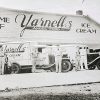
Cole Liles provided mules to farm families and businesses. The barn for Liles’s operation was built by his brother, Arthur O. Liles, in 1938 on what later became the site of Yarnell’s Ice Cream Company. Cole Liles’s business employed local workers and generated commerce for other merchants during a time of economic hardship before World War II. Notably, Liles supplied mules for the war effort, and four of his sons served in the military during the war.
In the 1920s, the U.S. mule population peaked at around six million. By 1930, due to increased tractor use, the number had dropped to about 5,375,000. Arkansas saw its mule population peak in the 1930s at over 350,000, decreasing to just under 114,000 by 1940. Despite the decline in total numbers, the mule trade became increasingly important before and during World War II. Liles’s mules were essential for food production on White County’s small, slow-to-mechanize farms. Gas rationing and labor shortages as men joined the armed forces increased reliance on mules. Liles also sold and transported mules through Kansas City, Texarkana (Miller County), and Memphis for use in the war.
On November 7, 1942, Liles’s financial records show a balance of $21,691, which grew to $41,336 by December 29, 1942 (over $1 million in 2026 dollars). His ledger shows financial dealings with four pharmacies, three shipping companies, local banks, the First Methodist Church in Searcy, three garages for truck repairs, two feed stores, and two suppliers for straw and hay. Liles worked with blacksmith Bud Gentry and veterinarian S. L. Gustafson, both of whom continued their professions into the 1960s. Additionally, two automotive shops he patronized—Truman Baker Chevrolet and Bolton-Vaughan GMC—are still open in the twenty-first century. His records also document payments for utilities, taxes, and the services of a local printing company, as well as payments to Bell Telephone and an insurance firm. Also shown are a donation to the Red Cross and five dollars for a car tag. Over five months, these expenses totaled $6,793, underscoring his significant contribution to the local economy.
Liles, who earned a reputation as a reliable and trustworthy businessman in White County and beyond, had a wide influence in the area. His ledger reveals that he paid and loaned money to nearly sixty men in the years leading up to World War II. He was committed to helping his employees provide for their families, routinely advancing pay for essentials such as firewood and corn. Despite garnering occasional losses when employees accepted advances and did not return, Liles consistently provided employment during hard times.
One cherished family story highlights Liles’s character and business practices. Around 1913, B. F. Smith and Sons in North Little Rock (Pulaski County) crafted a saddle for Liles, which he greatly valued. If mule buyers arrived at the barn without a saddle, Liles lent them his own for the journey home. Upon arrival, they would place the saddle in a burlap bag, tie it shut, address it to Cole Liles in Searcy, and mail it back.
For additional information:
E. C. Liles personal ledger, 1942. Copy held in the collection of the CALS Butler Center for Arkansas Studies, Bobby L. Roberts Library of Arkansas History & Art, Little Rock, Arkansas.
Michael A. Liles
Searcy, Arkansas
Jeff Liles
Rochester, New York


The backbone of communities throughout Depression-era Arkansas (and all of the Heartland) was the small businessman. Mr. Liles and those like him were pillars of the community who kept little towns alive during very hard times. The Depression, the great Dust Bowl, and other calamities of the 1930s would have collapsed lesser people. But the resiliency of the Greatest Generation kept us going.