
501-918-3025
calsfoundation@cals.org
calsfoundation@cals.org
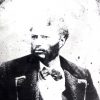
Archer Shepperson was emancipated at the end of the Civil War and was elected in 1873 to serve in the Arkansas General Assembly as a Republican. He returned to his hometown of Washington (Hempstead County) afterward, where he was a Black community leader and an advocate for education.
Archer (or Archie) Shepperson was born in Arkansas on February 7, 1850. He was likely enslaved by John Shepperson and his family, who moved from Virginia to Arkansas. Both Archer and his mother Margaret bore the Shepperson name. Nothing is known of his father. He first appears in the 1870 census living in Washington in the home of Anderson Green alongside Green’s family members and two other men. He was employed as a farm laborer, and the census also lists him as a “mulatto” and literate.
Shepperson had a wife and child listed in the 1870 census, although the family may not have had the means to live together at that point. The census listed his wife, Lucy Shepperson, as an Arkansan, aged nineteen, and working as a domestic servant. Their son, Charles Benjamin Shepperson, was noted on the census as four months old. Like Archer, his wife and son were listed as biracial. Charles Benjamin Shepperson was the first of nine children of the couple, eight of whom lived to adulthood.
Archer Shepperson may have obtained an education by participating in the schooling of the children of his enslaver, or from whoever bought or was managing the Shepperson slaves after John Shepperson and his family returned to Virginia. Another possibility is that he may have been a student in the Freedmen’s School established in Washington after the Civil War under the supervision of David C. Casey, a Union veteran who had moved to Arkadelphia (Clark County) by 1870.
On December 16, 1871, an event in Washington became a turning point in Shepperson’s life. Serving as a deputy sheriff when the sheriff, one Captain Vance, was out of town, Shepperson stepped in and quelled a potential violent outburst between a Black militia group and local citizens. The situation developed when “some misunderstanding or difficulty arose” between the two groups while the militia was performing a weekly drill on the streets of Washington. Shepperson “promptly interfered, locked up one of the hostile parties, disarmed another and quieted things generally in quick time.” The Washington Telegraph praised his actions and brought him to the attention of his community. That community elected him to the Arkansas House of Representatives, and he served in 1873–1874.
As a member of the legislature, Shepperson voted along Republican lines. He expressed his views openly and agreed with white elites in Washington on issues such as supporting railroads and not cutting away another portion of Hempstead County to form Howard County, though it put him in open conflict with one of his close colleagues, W. A. Marshall.
Shepperson returned from the legislature to utilize his skills and experience, serving on the Board of Supervisors of Hempstead County. In his second year on the board of supervisors, Shepperson served as the president and supervised the construction of the 1874 courthouse in Washington. He used his excellent farming skills (commented upon in the August 20, 1875, issue of the Arkansas Gazette) to grow crops to support his growing family, which consisted of four of their eventual nine children by 1880. Though not a trained teacher, Shepperson listed his occupation in the 1880 census as schoolteacher, and he assumed the leadership of the Black school in Washington for years. Along with Bob Samuels, another local Black Republican figure, he used his skills as a former deputy sheriff and leader in the Black community to help quell the violence of the Howard County Race Riot in the summer of 1883. Shortly afterward, he was in Little Rock (Pulaski County) as an agent of the Colored Methodist Episcopal Church to solicit funds to create the Haygood Seminary and provide a higher level of education in the Black community. Shepperson also remained active in the Republican Party, being selected to the State Central Committee of the Third District in 1888, but its influence declined after Reconstruction ended.
Shepperson died on October 17, 1905. Four years later, the Colored Teachers Institute met at Haygood Seminary and voted to erect a stone marker on his grave.
For additional information:
“The Colored Legislators.” Arkansas Gazette, February 1, 1873, p. 2.
“Crop and Weather Notes.” Arkansas Gazette, August 20, 1875, p. 4.
“Resolutions of Respect.” Washington Telegraph, February 2, 1906, p. 1.
“This vs. That.” Washington Telegraph, December 20, 1872, p. 2.
Wintory, Blake J. “African-American Legislators in the Arkansas General Assembly, 1868–1893.” Arkansas Historical Quarterly 65 (Winter 2006): 385–434.
“A Worthy Enterprise.” Arkansas Gazette, December 8, 1883, p. 5.
Peggy S. Lloyd
Southwest Arkansas Regional Archives


Comments
No comments on this entry yet.