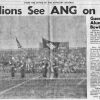
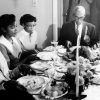
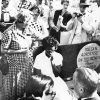



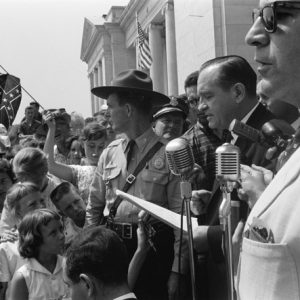
 Desegregation of Central High School Protest Rally
 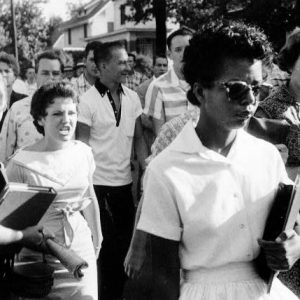 Elizabeth Eckford Denied Entrance to Central High
 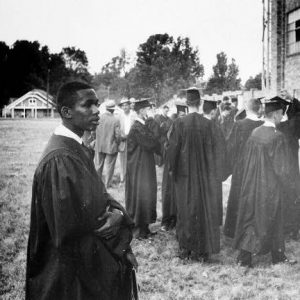 Ernest Green
  Little Rock Nine Way
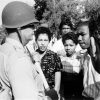
 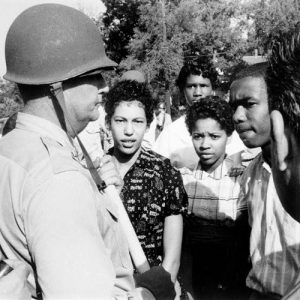 National Guardsman Confronts Students at Central High
 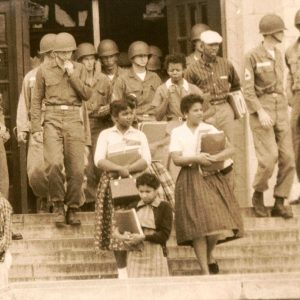 Students and Soldiers
501-918-3025
calsfoundation@cals.org
calsfoundation@cals.org
Students will understand the persuasive techniques of ethos, logos, and pathos in order to analyze the rhetoric segregationists used against the Little Rock Nine and integration.
Students’ writing utensils, lined paper for students’ notes, internet access (for CALS Encyclopedia of Arkansas resources and Orval Faubus’s 1958 “Speech on School Integration”), and relevant printouts as needed for each student
Following the 1954 U.S. Supreme Court decision in the Brown v. Board of Education, on May 24, 1955, the Little Rock School Board adopted a plan for gradual integration known as the Blossom Plan (or Little Rock Phase Program). Schools across the state began gradually desegregating. Desegregation in Little Rock’s schools would begin in the fall of 1957 starting with Central High School and would gradually extend to lower grades over time. Under the Blossom Plan, students would be permitted to transfer from any school where their race was the minority, thus still maintaining the racially segregated status quo while still seeming to follow the federal integration order. The National Association for the Advancement of Colored People (NAACP) responded to the Blossom Plan by filing a lawsuit over the continuation of segregation despite federal orders; however, the plan was upheld by federal courts.
On September 4, 1957, the students known as the Little Rock Nine attempted to enter Little Rock Central High School. However, Governor Orval Faubus mobilized the Arkansas National Guard to prevent their entrance to the building, directly disobeying federal orders. When the first of the Little Rock Nine, Elizabeth Eckford, arrived on campus she was met with an angry mob of white segregationist protestors. After being turned away at the school door, she walked through the crowd, being spat on on her way to the bus stop to return home. Other members of the Nine arrived and were even supported by an integrated group of local ministers, but they were turned away from the door as well.
Despite being barred from attending school by the governor’s actions, the Little Rock Nine nonetheless tried to keep up with their school work as best they could at home. More than two weeks passed; finally, federal courts ordered Faubus to cease his interference with court orders, thus the National Guard was removed from the building. On September 23, the Nine entered the school for the first time, yet the angry mob of protestors remained, chanting, “Two, four, six, eight, we ain’t gonna integrate!” The segregationist protestors chased and beat Black reporters trying to document the events. Police, fearing the actions of the increasingly violent mob, once again removed the Nine from the building and sent them home.

President Dwight Eisenhower called the actions of the mob “disgraceful,” and mobilized the U.S. Army’s 101st Airborne Division, the “Screaming Eagles” of Fort Campbell, Kentucky, and federalized the Arkansas National Guard to try and take control of the situation. On September 25, 1957, the Nine were escorted by federal troops into Central High for their first full day of classes.
As the Nine suffered repeated physical and verbal harassment at Central High, military guards were needed to escort them to classes. However, the guards could not go everywhere with them, leading to continued harassment in private spaces like restrooms or locker rooms. In November the 101st Airborne soldiers returned to Fort Campbell, leaving the National Guard in charge again and causing a surge in student efforts to harass the Nine into leaving Central High. Despite this consistent harassment, not taking any classes together, and being barred from participating in extracurricular activities, the Nine continued to return to school each day to acquire their education.

Minnijean Brown was the only member of the Nine to directly respond to the daily torment. After dropping her lunch tray onto two white boys who were harassing her and then referring to a white girl who hit her as “white trash,” she was suspended then expelled. “I just can’t take everything they throw at me without fighting back,” she later said on the experience. Brown moved to New York and went on to graduate from New Lincoln High School in 1959. The other eight students remained until the end of the school year. On May 27, 1958, Ernest Green became Central High’s first Black graduate. The graduation ceremony was attended by Dr. Martin Luther King Jr.
After voters opted to close every one of Little Rock’s high schools during the 1958–59 school year to prevent further desegregation efforts, the remaining members of the Nine were forced to attend other schools or take correspondence classes.
The Little Rock Nine were recognized on August 30, 2005, with statues dedicated to them on the ground of the Arkansas State Capitol in Little Rock, and again in 2007 when the group was inducted into the Arkansas Black Hall of Fame. Women of the Nine were named sponsors for the USS Arkansas nuclear submarine in 2018. In 2022, on the sixty-fifth anniversary of Central High’s desegregation, South Park Street was renamed Little Rock Nine Way.
Even today, members of the Little Rock Nine continue to speak out and fight for equal representation and the teaching of Black history in Arkansas schools.
To begin this lesson, it is vital students understand at least the basics of ethos, logos, and pathos. After defining these three terms (see definitions above), show students the following three excerpts from Governor Orval Faubus’s 1958 “Speech on School Integration” and ask them to determine whether each one is an example of ethos, logos, or pathos. This activity could be written response, class discussion, or a show-of-hands vote.

For students less familiar with these terms, provide a bank of the answers so that students may match quotes to ethos, logos, or pathos. For students still struggling, eliminate one of the quotes to reduce challenge. For students more confident in determining ethos, logos, or pathos, ask students to explain their reasoning for their determination of each quote. Feel free also to shorten each quote or simplify the language depending on student needs.
“Last year, I stated during the September crisis that I was not elected Governor of Arkansas to surrender all our rights as citizens to an all-powerful federal autocracy….It is my responsibility, and it is my purpose and determination, to defend the constitutional rights of the people of Arkansas to the full extent of my ability.”
This quote is a strong example of ethos; Faubus reminds the audience of his elected (publicly determined) status as Governor, highlights his character as being unwilling to “surrender all our rights,” (notice the evocative word “all”), and refers to the greater desegregation crisis as him trying to “defend the constitutional rights” of Arkansans.
“To you who oppose the great majority of Arkansas people in this fight, I urge you to think—lest in your consuming desire to gain your ends, among them the destruction of Orval Faubus, you destroy also the very principles of government that enable you and all others to live as a free people, and to rear your children under the high standards of living and freedom which prevail in this state and nation.”
Here we find a scalding example of pathos as Faubus likens proponents of integration to destructive forces, forces out to tear down him, the government, the people, and the children. By framing integration as a destructive force, Faubus stokes mistrust and anger at its supporters.
“This plan I now explain to you in detail. This plan is within the law. Even the Supreme Court, in the so-called school integration cases, has not ruled to the contrary. This plan is based upon our own State Constitution, written and adopted in 1874, and Arkansas Statutes enacted in 1875. First. The federal government has no authority to require any state to operate public schools. Second. The federal government has no authority to tell a state government for what purposes it may levy taxes, or how the tax money may be expended. Third. In all the cases involving the public schools and integration, the federal courts have said only that an agency of the state cannot maintain segregated schools. This ruling does not apply in any way to private schools. Private schools are not affected by these decisions, even though the schools receive aid from state and federal sources.”
Here we see Faubus describe an allegedly accurate description of state laws in regard to federal authority, taxes, public and private schools, thus appealing to logos. Under the assumption that a political figure would not blatantly lie or misrepresent legal information (unfortunately a false assumption), many audience members would hear this and defer to the governor’s logic and trust in his plan that, once again allegedly, is in the best interest of the majority of Arkansans. It’s likely this will confuse students, and thus they should be directed back to the definition of logos: an appeal to logic does not equate an appeal to truth.
Referring to the various resources linked from the Encyclopedia of Arkansas (see links on right side), as well as the Historical Background section above (adapted from the EOA’s entry on the Little Rock Nine), instruct students on the context of the Central High Desegregation Crisis, the Little Rock Nine, and the actions of both Governor Faubus and President Eisenhower.
Some important details to highlight for students:
Access a transcription of the entirety of Governor Orval Faubus’s 1958 “Speech on School Integration.”
Have students read this speech, providing excerpts to students that require shortened texts. As students read, they should practice marking the text strategies, highlighting and annotating examples of ethos, logos, or pathos. There are some examples of each of these persuasive strategies, though there are far more instances of ethos and pathos, which should be communicated to students. Anticipated reading time is 20 minutes, but of course use your understanding of students’ reading abilities to gauge and modify this projected time. Students may be in groups of up to four to read and identify persuasive strategies together.
Before reading, have students scan the text by identifying where the bellringer’s quotes are located within the text. This both allows students to connect learning from throughout the lesson, preview the text prior to reading which is shown to enhance understanding and retention, and demonstrate expectations for this activity.
Be sure to monitor student understanding throughout their reading time, providing examples and challenging students on segments of the text with strategies they overlooked.
After students have read the text and identified numerous instances of persuasive strategies, open a class discussion on which strategies were used the most throughout this speech. Have students tally the number of instances each group had of each persuasive strategy. Mark these tallies in front of the class to demonstrate the clear disparity between each strategy.
At this point, students have an understanding of the historical context, actions of those involved, and the language that Faubus used to ignite his supporters’ fear and aggressive response. Thus, after tallying the instances of each strategy, challenge students to determine why Faubus used more of some strategies and less of others. Connect Faubus’s use ethos, logos, and pathos to the anti-integrationists’ response to desegregation. If students are struggling to understand the connection, ask provocative questions such as how Faubus’s attempts to instill fear could have indeed stoked that fear in his supporters, how he discredits the trustworthiness of both journalism and the federal government so that his supporters will only trust his words, etc.
After class discussion, students should craft a written response describing the basics of who the Little Rock Nine were, how Governor Faubus caused and responded to the situation, and how Faubus’s actions caused the violent response from his supporters.
For extensions on this lesson, have students pick one of the members of the Little Rock Nine and have them read the EOA entry on them. As they read, have students take note of their member’s accomplishments and write a response to the EOA entry describing what inspired them or what lessons are important to remember about that person’s life.


"*" indicates required fields