501-918-3025
calsfoundation@cals.org
calsfoundation@cals.org
Although soybeans have not played as much of a role in Arkansas’s history and culture over the years as cotton and rice, they are the state’s largest crop. In 2025, a total of 2,590,000 acres in the state were planted with soybeans, producing a crop valued at nearly $1.5 billion.
Soybeans are native to east Asia, having been grown in China and Manchuria for thousands of years. Cultivation of soybeans had spread to India by the 1600s, and European explorers and traders were aware of the plant. Soybeans were first cultivated in North America when they were planted in the British colony of Georgia in 1765. Until the twentieth century, though, soybeans were not popular in the United States, and there is no record of soybean planting in Arkansas before that time.
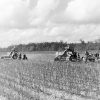
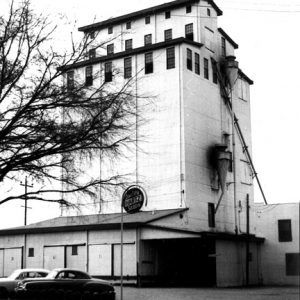
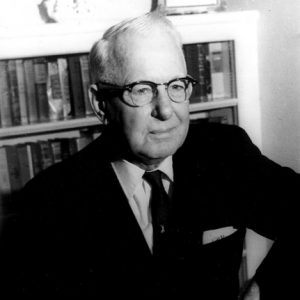
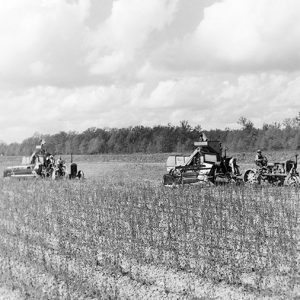
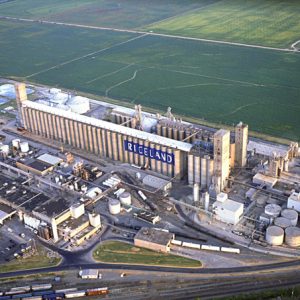
William Campbell, who lived eight miles southwest of Augusta (Woodruff County), read about soybeans during the winter of 1923–1924 and ordered a bushel of the beans from China. He planted the beans using a mule-drawn plow and harvested them into a mule-drawn wagon specially bought for the purpose. He then sold his harvest to other farmers interested in trying the new plant. A year or two later, Jacob Hartz Sr. of Stuttgart (Arkansas County) obtained soybeans from Illinois for his fields and those of his neighbors and customers. The plants were tilled into the soil as fertilizer and were harvested as hay and forage to feed livestock. The Rose City Oil Mill in North Little Rock (Pulaski County) is one of the first known facilities to process soybeans for oil, having converted a cotton seed oil mill for soybeans. By the mid-1930s, Hartz and his business partner had built one of the largest soybean processing plants in the United States.
Soybean production gradually increased in Arkansas as well as in many other states. The crop was used largely to feed livestock and poultry. Soybeans are also beneficial for restoring nitrogen to the soil, so many farmers rotated soybean production with their rice, corn, and cotton fields to enrich the land. Soybean production surged during World War II as further uses were discovered for the oil. During the 1950s, soybeans became Arkansas’s top crop in acreage and profitability, a status the soybean has not since relinquished.
Early soybean crops in Arkansas seemed invulnerable to native pests, but soybeans eventually became prone to disease and infestation, particularly from nematodes. The Japanese beetle, accidentally introduced to North America in the twentieth century, also harms the health of soybeans, as do various other infestations. Soybean fields were also susceptible to invasion from various weeds, but a new strain of soybeans, produced in the 1990s, was designed to survive the herbicide commonly used to reduce weeds. This innovation vastly improved the production of soybeans.
Livestock and poultry feed remains the top use of soybeans grown in Arkansas, claiming a large majority of the harvested crop. Other uses of soybeans include vegetable oil, margarine, tofu, soymilk, and soy sauce, as well as biodiesel fuel, paint, plastic, and tires. Processed soybeans are an excellent source of dietary protein and fiber, as well as iron, manganese, phosphorus, and several B vitamins. As some people are allergic to soybeans, they are one of nine common food ingredients that must be identified on food labels.
By the end of 2025, Arkansas ranked eleventh among the states in soybean production. Illinois was the leader, with more than ten million acres of soybeans, compared to Arkansas’s 2.6 million acres; in 2026, Arkansas’s acreage in soybeans climbed to 3.2 million acres. Internationally, the United States is second to Brazil in soybean production and soybean exports. Roughly half of the soybean products exported from the United States are sold to east Asian nations, including China, Japan, South Korea, Indonesia, and Vietnam.
For additional information:
Baker, Brandon, Michael Emerson, Katherine Brown, and Travis R. Faske. “Multi-Year Evaluation of Seed-Applied Nematicides for Managing Meloidogyne incognita on Susceptible and Partially Resistant Soybean Cultivars in Arkansas.” Plant Disease, May 20, 2026. https://doi.org/10.1094/PDIS-03-26-0573-RE (accessed July 8, 2026).
Cook, Louise Bailey, “A Little Soybean History.” Rivers and Roads and Points in Between 11 (Winter 1983): 26.
Covington, Karson Kellar. “Impacts of Rice-Soybean Crop Production Systems on Water Quality and Methane Flux in Northeast Arkansas.” MS thesis, Arkansas State University, 2026.
Field, Hunter. “Soytennial: Arkansas’ Quiet Giant at 100.” Arkansas Business, March 30–April 5, 2026, pp. 1, 10–12.
Kittrell, Mrs. John B. “That Versatile Crop—The Soybean.” Rivers and Roads and Points in Between 11 (Winter 1983): 23–26.
McGeeney, Ryan. “Tariffs, Both Real and Threatened, Will Likely Complicate Agricultural Production, Marketing.” University of Arkansas Cooperative Extension Service. https://www.uaex.uada.edu/media-resources/news/2025/march/03-10-2025-Ark-ag-tariffs.aspx (accessed July 8, 2026).
United States Department of Agriculture, National Agricultural Statistics Service. “2025 State Agriculture Overview: Arkansas.” https://www.nass.usda.gov/Quick_Stats/Ag_Overview/stateOverview.php?state=ARKANSAS (accessed July 8, 2026).
Steve Teske
CALS Butler Center for Arkansas Studies


Comments
No comments on this entry yet.