
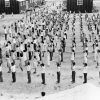




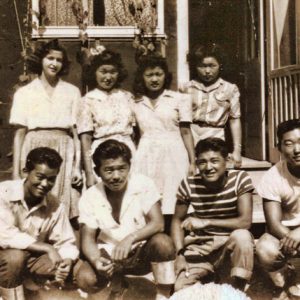
 Rohwer Relocation Center
 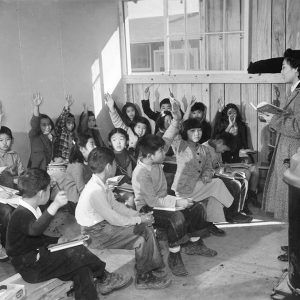 Rohwer School
 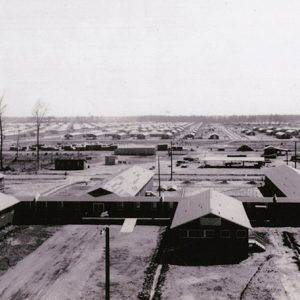 Rohwer Aerial View
  George Takei
  George Takei
 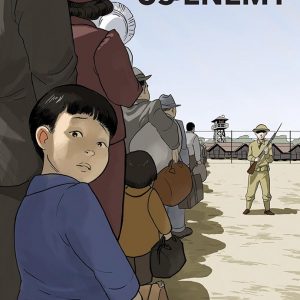 They Called Us Enemy
501-918-3025
calsfoundation@cals.org
calsfoundation@cals.org
Students will be able to describe how primary sources and secondary sources make up the historical record and explain the benefits and limitations of each.
Students’ writing utensils, lined paper for students’ notes, internet access (for CALS Encyclopedia of Arkansas resources and video interview with George Takei), and relevant printouts as needed for each student

This lesson is intended as a follow-up to the EOA Lesson Plan Japanese Internment in Arkansas during World War II. For more information on the events and experiences surrounding Japanese internment, refer to that lesson plan and the EOA entry Japanese American Relocation Camps before proceeding with this one.
As a check for prior understanding, students should think about and attempt to answer the question: What’s more useful for learning history, primary sources or secondary sources?
To help students to answer this question, give some examples of each. Primary sources are from the time period or individual that experienced the events, thus include letters, diaries, art, literature, physical artifacts, photographs, and videos. Secondary sources interpret those primary sources in some way and were made after the events being discussed, so things like encyclopedias, textbooks, biographies, books, and articles.
Once students have come up with their answers, either on their own or in groups, discuss as a class and write on the board students’ answers and reasoning. The goal of this bellringer is to challenge students on whether or not they can see value in both primary and secondary sources; there is no right answer to this question. Primary and secondary sources are both incredible resources for studying, learning, recording, sharing, and creating history. However, there are pros and cons to each kind of source, as will be explored in direct instruction.
In this direct instruction you will guide students to determine the pros and cons of primary and secondary sources.
| Pros | Cons | |
| Primary Sources: | Original material, less risk of misinterpretation or making incorrect assumptions | Could be incomplete or inaccessible, e.g. damaged or illegible written documents, audio in a foreign language, etc.
Forced to rely on your own knowledge and interpretation with nothing else to guide you. |
| Secondary Sources: | Expand on primary sources, adding helpful context and meaning.
Act as supporting information, allowing for greater insight than solely using primary sources allows. |
Forced to engage with history through the biases of whoever made the secondary source. Even if a source tries to stay neutral, all sources are biased.
Thus, secondary sources are bad as the sole provider of evidence, but good for commentary and interpretation. |
There are likely plenty of other pros and cons to each kind of source. As a part of direct instruction, feel free to have students either: a) expand this list of pros and cons, b) create a new column with examples of primary and secondary sources, or c) practice identifying primary versus secondary sources by having students find actual examples of each online and/or in the school library.
If this lesson is being used as a follow-up to the lesson Japanese Internment in Arkansas during World War II, then for this section students should read the EOA entry Japanese American Relocation Camps. As they read, students should discuss in groups and take notes over the experiences that the Japanese Americans had to go through: what were they forced to do, where were they taken, how did they feel, what did they leave behind, how were they treated, etc. Also have students take note of the list of resources at the bottom of the EOA entry, which are mostly secondary sources such as books, articles, movies, and websites.
Student notes don’t have to be extensive, as most of the information should be review at this point, but the notes are nonetheless essential for the primary source activity and evaluation.

Show students the interview with George Takei titled Interview with George Takei on Japanese American internment [1 of 5] on the Arkansas Studies Research Portal.
As students watch this 27-minute clip, they should take notes over Takei’s personal experiences during the beginnings of internment. How did he feel, what did he think was happening, where did the family go, what did they bring, where did they sleep, etc.
The purpose of this activity, as will be seen in the evaluation section, is to compare and contrast not only how the primary source describes the situation compared to the secondary source.
There are also many primary sources such as artwork and Rohwer student autobiographies in the Rosalie Santine Gould–Mabel Jamison Vogel Collection, held by the Butler Center for Arkansas Studies at the Central Arkansas Library System. The collection finding aid and digitized material are online in the Arkansas Studies Research Portal.
In open class discussion, students should answer two questions and explain their answers thoroughly: 1) Which source, primary or secondary, did you learn the most information from? 2) Which source, primary or secondary, made you empathize the most with the experiences of Japanese Americans being interred?
The expected answer is that students learned the most information from the secondary source, but empathized the most with the primary source. This perfectly encapsulates the benefits of using both primary and secondary sources when studying history, and once again shows that both are good in distinct ways.
If students don’t come to this conclusion, take some time to unpack their understanding of the lesson, these questions, and the sources to ensure proper understanding. If understanding is present but their feelings still differ, then explore their opinion with the class as a discussion of differing opinions holding unique insights and value.

Five interviews with George Takei covering about two hours of are available on the Arkansas Studies Research Portal, provided by the University of Arkansas at Little Rock. Have students watch any or all of these clips; use these for discussion activities, guided comprehension questions, deep dives into particular parts of Japanese internment, or as a basis for a research activity in which students are shown the importance of interviews for historical record and then can pick historical figures to watch interviews with and write a response to.
Alternatively, if a copy of George Takei’s book They Called Us Enemy is accessible, have students read chosen sections and analyze how the text and graphics present Takei’s experiences.


"*" indicates required fields