501-918-3025
calsfoundation@cals.org
calsfoundation@cals.org
The Tornado Outbreak of February 5, 2008, is also known as the Super Tuesday Outbreak due to it taking place on “Super Tuesday”—the day when presidential primary elections were held in twenty-five U.S. states and territories. This outbreak set the national record for most prolific tornado outbreak in February by producing eighty-seven tornadoes, twelve of which would impact Arkansas. Across the United States, fifty-seven people would lose their lives, including fourteen Arkansans. This was the deadliest tornado outbreak in the United States since 1997, a title it would hold until surpassed by the 2011 Super Outbreak.
The Setup
In the early hours of February 5, a strong storm system approached the southeastern United States from the Great Plains. Ahead of this system, temperatures and dew points rose to unseasonable highs. Record high temperatures were recorded at Jonesboro (Craighead County), Little Rock (Pulaski County), North Little Rock (Pulaski County), West Memphis (Crittenden County), El Dorado (Union County), and Monticello (Drew County). This warmth and moisture served to destabilize the atmosphere and fueled the development of thunderstorms. A strong jet stream caused winds aloft to blow to the east, while winds at the surface were from the southeast. This sharp change in wind direction resulted in wind shear favoring rotating supercell thunderstorms capable of producing significant tornadoes.
At 6:39 a.m., the Storm Prediction Center (SPC) issued a high risk of severe storms for most of Arkansas—the first time that such a risk had been issued in February since 1998. By 10:16 a.m., this risk was extended to cover the entire state as well as all or portions of other states in the south-central United States. At noon, the SPC issued the day’s first tornado watch, which covered mostly southeastern Oklahoma and northeastern Texas, but also some counties in far southwestern Arkansas. Forty minutes later, another tornado watch would be added, which included the rest of western Arkansas as well as a significant portion of the north-central part of the state. At 2:10 p.m., the SPC issued a Particularly Dangerous Situation (PDS) tornado watch for central and southern Arkansas as well as northern Louisiana. An hour later, a second PDS tornado watch would be issued for eastern Arkansas and portions of surrounding states.
The first tornado of the outbreak would touch down at 3:26 p.m. on the south side of Hamburg (Ashley County), causing damage to the high school. Weak tornadoes in Chicot County and Phillips County would soon follow.
Atkins-Clinton-Mountain View-Highland Tornado
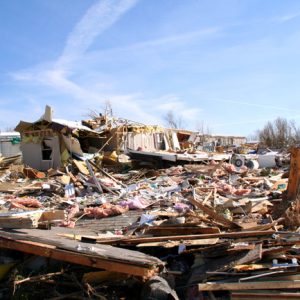
Around 4:50 p.m., a storm southeast of Centerville (Yell County) began to show signs of rotating and produced a tornado that touched down southwest of New Neely (Yell County), causing minor damage at EF0 to EF1 strength. The tornado tracked into Pope County, rapidly intensifying to EF3 strength as it struck Lucky Landing, a marina on Lake Atkins, killing one person and destroying multiple vehicles, boats, and mobile homes. Continuing to the north-northeast, the tornado crossed Interstate 40, where it blew several vehicles off the road and destroyed or damaged several mobile homes in the area. The tornado struck the southern and eastern sides of Atkins (Pope County), killing three people and destroying or heavily damaging sixty-five homes. As it moved through rural Pope County, the tornado toppled metal truss towers, destroyed chicken houses, and damaged more structures. One person seeking shelter in a metal shipping container was killed.
Remaining at EF3 strength, the tornado crossed into Conway County. Near Cleveland (Conway County), two more people were killed, thirty-two houses and mobile homes were destroyed, and chicken houses were obliterated, causing the loss of 80,000 chickens. The tornado intensified to EF4 strength as it entered Van Buren County. On the south side of Clinton (Van Buren County), three people were killed as the tornado leveled homes and businesses. The tornado was still at EF4 strength as it entered Stone County and struck the eastern side of Mountain View (Stone County). The tornado caused heavy roof and wall damage to the Stone County Medical Center. It destroyed several doctors’ offices as well as businesses, including a car dealership. One person was killed near Mountain View.
The tornado weakened slightly to a high-end EF3 as it crossed the White River, impacting the rural community of Zion (Izard County), killing two people. Hundreds of cattle were killed in this area as well. Maintaining EF3 strength, the tornado moved out of Izard County and struck the town of Highland (Sharp County). At least forty businesses along U.S. Route 412 were damaged or destroyed. The town’s fire station was destroyed along with most of the equipment inside. Highland High School also took damage. The tornado rapidly weakened and dissipated northeast of Highland.
Surveys by the National Weather Service found that the damage across seven counties had been caused by one continuous tornado with a track estimated at 122 miles in length—the longest single tornado track recorded in Arkansas since detailed record-keeping began in 1950. At least 200 homes and businesses were destroyed, causing $119.31 million in damages. Thirteen people were killed, and 140 more were injured.
Other tornadoes
While the long-track EF4 was still on the ground, another deadly tornado touched down in northern Arkansas. This EF2 tornado began near Rea Valley (Marion County) and moved directly through the town of Gassville (Baxter County). The tornado struck a mobile home park, killing one resident, destroying twelve mobile homes, and causing major damage to fifteen more. Twenty-one frame homes were destroyed by this tornado, which also caused significant damage to many commercial buildings in Gassville. This tornado dissipated about three miles west-southwest of Mountain Home (Baxter County).
Five additional EF0 tornadoes touched down later that evening, impacting areas near Casa (Perry County), Colt (St. Francis County), Junction City (Union County), Clarendon (Monroe County), and Moro (Lee County). An EF1 tornado caused minor damage as it tracked between Vilonia (Faulkner County) and El Paso (White County), while a second touched down northwest of Pocahontas (Randolph County) before tracking into Missouri.
Aftermath
On February 7, 2008, a federal disaster declaration was made for ten counties in Arkansas. Charitable groups such as the American Red Cross and Salvation Army mobilized in Arkansas and across the region. The National Weather Service in North Little Rock conducted detailed surveys along the path of the long-track tornado to determine if it had been one tornado or a series of tornadoes produced by the same storm. In some areas, aerial surveys were required, as there was no other way to access the remote and rugged terrain crossed by the tornado. In 2026, this remained the longest-tracked tornado in Arkansas history as well as one of the longest-tracked in American history.
For additional information:
“In a Blink, Lives, Landscape Torn.” Arkansas Democrat-Gazette, February 7, 2008, pp. 1A, 8A.
LaRoe, Ginny. “Damage Assessors Fan Out Over 10 Counties.” Arkansas Democrat-Gazette, February 8, 2008, pp. 1A, 10A.
NWS Little Rock, AR – Severe Weather on February 5, 2008. https://www.weather.gov/lzk/svr0208yr.htm (accessed May 1, 2026).
Park, Carolyne. “South’s Storm Toll Up to 54. Arkansas Democrat-Gazette, February 7, 2008, pp. 1A, 6A.
———. “Tornadoes Rip State, Kill 13.” Arkansas Democrat-Gazette, February 6, 2008, pp. 1A, 5A.
Service Assessment: Super Tuesday Tornado Outbreak of February 5–6, 2008. https://repository.library.noaa.gov/view/noaa/6991 (accessed May 1, 2026).
Emilee Baker
Pangburn, Arkansas


Comments
No comments on this entry yet.