501-918-3025
calsfoundation@cals.org
calsfoundation@cals.org
Timothy Reves was a Baptist preacher who became a Confederate irregular soldier operating in northeastern Arkansas and southeastern Missouri during the Civil War.
Timothy Reves (sometimes spelled Reeves or Reaves) was born in Ashe County, North Carolina, on April 28, 1821. He moved to Doniphan, Missouri, in the 1840s and became a farmer and Baptist preacher in Ripley County, Missouri. Reves was married at least three times and had at least five children: the 1850 federal census shows him married to a woman named Mary and having a son and two daughters, the 1860 census has him married to a woman named Margaret with an additional son and daughter, and finally the 1870 census shows him married to a woman named Adaline. In 1860, he was recorded as owning $2,500 in real estate and $1,200 in personal property.
Reves was made chaplain of the Third Missouri Cavalry, First Division, Missouri State Guard in 1861, and in 1862 he raised a company of scouts for “local defense.” He was wounded in a skirmish with the Fifth Illinois Cavalry Regiment at Pitman’s Ferry (Randolph County) on April 1, 1862. A Union soldier stationed in Missouri wrote in December 1862 that “after the war commenced the Rev. Timothy Reaves developed into one of the meanest leaders of an irregular band of thieves and pretended rebels that the mountains of Missouri and Arkansas harbored.”
A Confederate report stated that Reves’s company “has been acting in Southeast Missouri as independent scouts from November 1862 until August 2, 1863. The captain and company have been highly praised by the commanders of Lt. Gen. [Theophilus] Holmes’ Army for the services rendered them as scouts, gaining information on the movements of the enemy.”
Reves’s command frequently clashed with the Third Missouri State Militia Cavalry (US), and on December 25, 1863, the militiamen under Major James Wilson attacked a gathering of the irregular troopers, killing thirty-three men and capturing more than 100. A Union officer reported in January 1864 that “Reves is said to be hiding about the border with 11 men, very depressed in spirits.”
In late January, a scouting expedition of the Third Missouri came into Arkansas at Cherokee Bay (Randolph County) and “chased Reves for miles, and run him into the river,” and in May a scout of the Third Missouri State Militia Cavalry and Sixth Missouri Cavalry (US) heading to Gainesville (Greene County) attacked Reves’s camp and “ate a dinner that was prepared for him on Black River.”
During the summer of 1864, Brigadier General Joseph O. Shelby worked to gather the scattered bands of irregular troops and bushwhackers north of the Arkansas River to create organized companies. On June 7, he ordered Reves to “increase your command as much as possible. Place every man in the service from sixteen to fifty” while ordering independent bands in the area to consolidate, and “should any refuse resort to any means you deem necessary to enforce the order.”
This led to “the increase of Reves’ Cavalry Battalion to a regiment in the summer of 1864,” with Reves becoming colonel of the Fifteenth Missouri Cavalry (CS). The regiment took part in Major General Sterling Price’s disastrous Missouri Raid in late 1864. Major Wilson and six men of the Third Missouri State Militia Cavalry were captured during the September 27, 1864, Battle of Pilot Knob in Missouri and were turned over to Reves.
A Confederate soldier later wrote that “as soon as Major Wilson saw Colonel Reeves he exclaimed ‘I am a dead man. Colonel Reeves will kill me’” and “Colonel Reeves took Major Wilson and the six privates out a short distance and executed them.” Six randomly selected Confederate prisoners at the Gratiot Street prison in St. Louis, Missouri, were later executed in retaliation.
Reves returned to his old haunts after Price’s raid failed, and on January 10, 1865, a Union officer reported that Colonel John E. Phelps and the Second Arkansas Cavalry (US), moving through Powhatan (Lawrence County) and Pocahontas (Randolph County) as they headed into Missouri, “came near capturing Reves. He killed one captain that was with him; captured his quartermaster. Reves escaped, half dressed, by getting into the swamp and swimming Black River.”
As the Civil War wound to a close, Brigadier General M. Jeff Thompson arranged with Union officers to surrender his command at Wittsburg (Cross County) and Jacksonport (Jackson County) in June 1865. At the latter location, Lieutenant Colonel C. W. Davis refused to grant Reves a parole. Thompson wrote that the Federal officer “would not agree to parole, considering him an outlaw for shooting Major Williams and five [actually six] men on the Price Raid.” The Confederate general, though, considered Reves “as good a man and soldier as any in the command.”
Reves eventually returned to Missouri, living in Carter County from 1865 to 1871 (he recorded owning $1,500 in real estate and $2,000 in personal property in 1870) and then moving back to Ripley County, where he again farmed and served as a Baptist preacher, establishing churches in Butler, Carter, Ripley, and Wayne counties.
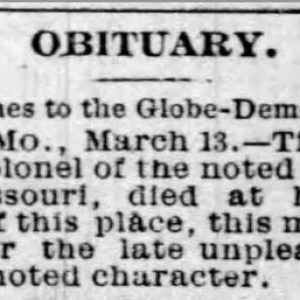
He died on March 10, 1885, and was buried on his farm six miles northeast of Doniphan. A short obituary in a St. Louis newspaper called Reves “Colonel of the noted bushwhackers of South Missouri,” stating that “during and after the late unpleasantness Col. Reves was a noted character.”
For additional information:
Allardice, Bruce S. Confederate Colonels: A Biographical Register. Columbia: University of Missouri Press, 2008.
Blevins, Brooks. A History of the Ozarks, Vol. 2: The Conflicted Ozarks. Urbana: University of Illinois Press, 2019.
Hewett, Janet B., et al., eds. Supplement to the Official Records of the Union and Confederate Armies. Vol. 38. Wilmington, NC: Broadfoot Publishing Co., 1996.
Kohl, Rhonda M. The Prairie Boys Go to War: The Fifth Illinois Cavalry, 1861–1865. Carbondale: Southern Illinois University Press, 2013.
Marshall, A. O. Army Life: From a Soldier’s Journal. Edited by Robert G. Schultz. Fayetteville: University of Arkansas Press, 2009.
“Obituary.” St. Louis Globe-Democrat, March 14, 1885, p. 7.
Peterson, Cyrus A. “Narrative of the Capture and Murder of Major James Wilson.” St. Louis, Missouri: A. R. Fleming Printing Company, 1906. Online at https://archive.org/details/narrativeofcaptu00pete (accessed October 3, 2025).
“Rev Timothy Reeves.” Find a Grave. https://www.findagrave.com/memorial/5179587/timothy-reeves (accessed October 3, 2025).
Sifakis, Stewart. Compendium of the Confederate Armies: Kentucky, Maryland, Missouri, the Confederate Units and the Indian Units. New York: Facts On File, 1995.
Stanton, Donal J., Goodwin F. Berquist, and Paul C. Bowers, eds. M. Jeff Thompson Memoirs. Dayton, OH: Morningside, 1988.
The War of the Rebellion: A Compilation of the Official Records of the Union and Confederate Armies. Vol. 34, part 2, p. 160, part 4, p. 652–653; Vol. 48, part I, p. 475. Washington DC: Government Printing Office, 1891, 1896.
Wolf, E. K. “How Major Wolf’s Life Was Saved.” Confederate Veteran 18 (August 1910): 380–381.
Mark K. Christ
Little Rock, Arkansas


Comments
No comments on this entry yet.