

501-918-3025
calsfoundation@cals.org
calsfoundation@cals.org
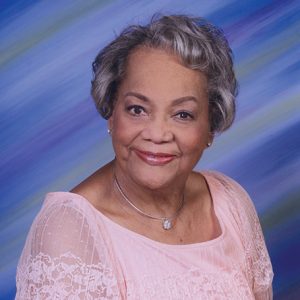
Raye Jean Jordan Montague was an internationally registered professional engineer (RPE) with the U.S. Navy who is credited with the first computer-generated rough draft of a U.S. naval ship. The U.S. Navy’s first female program manager of ships (PMS-309), Information Systems Improvement Program, she held a civilian equivalent rank of captain. She was inducted into the Arkansas Black Hall of Fame in 2013 and the Arkansas Women’s Hall of Fame in 2018. In 2017, with the movie Hidden Figures having awakened an awareness of the previously unacknowledged contributions of Black engineers and mathematicians in the American defense and space industries, Montague was featured on the television show Good Morning America and dubbed a “real-life hidden figure.”
Raye Jordan was born on January 21, 1935, in Little Rock (Pulaski County) to Rayford Jordan and Flossie Graves Jordan. She attended St. Bartholomew School before moving to Merrill High School in Pine Bluff (Jefferson County), graduating in 1952. She attended Arkansas AM&N (now the University of Arkansas at Pine Bluff), wanting to study engineering, though because no Arkansas colleges were awarding such degrees to African-American women in the 1950s, she took a degree in business, graduating in 1956.
She was married three times: to Weldon A. Means in 1955, to David H. Montague in 1965, and to James Parrott in 1973. After her marriage to Parrott ended, she returned to the name Montague, the same last name as her only child, David R. Montague.
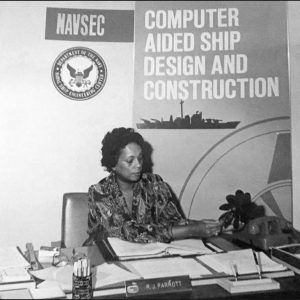
In 1956, Montague began her career with the navy at the old David Taylor Model Basin (now the Naval Surface Warfare Center) in Carderock, Maryland, as a digital computer systems operator. She later advanced to the position of computer systems analyst at the Naval Ship Engineering Center and served as the program director for the Naval Sea Systems Command (NAVSEA) Integrated Design, Manufacturing, and Maintenance Program as well as the division head for the Computer-Aided Design and Computer-Aided Manufacturing (CAD/CAM) Program. On January 22, 1984, she accepted the newly created position of deputy program manager of the navy’s Information Systems Improvement Program.
Montague’s career spanned the development of computer technologies, from the UNIVAC I, the world’s first commercially available computer, down to modern computers. She successfully revised the first automated system for selecting and printing ship specifications and produced the first draft for the FFG-7 frigate (the Oliver Hazard Perry–class, or Perry-class, ship) in eighteen hours. This was the first ship to be built that was designed by computer.
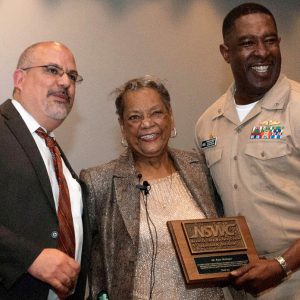
In 1972, Montague was awarded the U.S. Navy’s Meritorious Civilian Service Award, the navy’s third-highest honorary award. She was the first female professional engineer to receive the Society of Manufacturing Engineers Achievement Award (1978) and the National Computer Graphics Association Award for the Advancement of Computer Graphics (1988). She also received a host of other honors from military branches, industry, and academia. Montague worked on the USS Dwight D. Eisenhower (CVN-69) and the navy’s first landing craft helicopter-assault ship (LHA). The last project with which she was affiliated was the Seawolf-class submarine (SSN-21).
Montague retired in 1990. In 2006, after fifty years spent in the metropolitan Washington DC area, she returned to Arkansas, living in west Little Rock, where she remained active with LifeQuest, The Links Inc., the Alpha Kappa Alpha sorority, and the American Contract Bridge League. She also mentored inmates through a community re-entry program through the University of Arkansas at Little Rock (UA Little Rock) as well as students at the eStem Elementary Public Charter School in Little Rock.
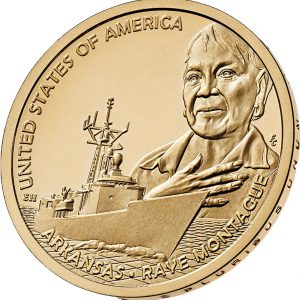
Montague died on October 9, 2018, of congestive heart failure. Her son coauthored a book about her life, published in 2021. She was also the subject of a 2020 children’s book, The Girl with a Mind for Math: The Story of Raye Montague. In 2024, the Maritime Technology Information Center of the Naval Surface Warfare Center, Carderock Division was renamed the Raye Montague Center for Maritime Technology. The following year, the United States Mint released a one-dollar coin honoring Montague as part of its American Innovation Program.
For additional information:
“Against the Odds: The Story of Raye Montague.” U.S. Navy. https://www.youtube.com/watch?v=1ejoOFulfmQ&ab_channel=U.S.Navy (accessed February 6, 2023).
Bowers, Paige, and David Montague. Overnight Code: The Life of Raye Montague, the Woman Who Revolutionized Naval Engineering. Chicago: Chicago Review Press, 2021.
Montague, Raye. “Interview with Raye Montague.” January 29, 2009. Audio at Butler Center for Arkansas Studies, Bobby L. Roberts Library of Arkansas History & Art, Central Arkansas Library System: Raye Montague Interview (accessed January 8, 2021).
Owen, Rhonda. “Raye Jean Jordan Montague.” Arkansas Democrat-Gazette, December 16, 2012, pp. 1D, 5D, 8D.
“Pine Bluff, Little Rock Native Honored by Navy Department.” Southern Mediator Journal, February 2, 1973, pp. 1–2.
“Raye Parrott Receives 1978 Manufacturing Engineering Achievement Award.” The Observer, October 12, 1978, pp. 1, 7.
Seelye, Katharine Q. “Raye Montague, the Navy’s ‘Hidden Figure’ Ship Designer, Dies at 83.” New York Times, October 18, 2018. Online at https://www.nytimes.com/2018/10/18/obituaries/raye-montague-a-navy-hidden-figure-ship-designer-dies-at-83.html (accessed February 6, 2023).
Betty Sorensen Adams
Little Rock, Arkansas


“She successfully revised the first automated system for selecting and printing ship specifications and produced the first draft for the FFG-7 frigate (the Oliver Hazard Perry–class, or Perry-class, ship) in eighteen hours.”
That “automated system” was called was called DD07. It was the seventh version of the “ship synthesis model” computer program developed years earlier by NAVSEC naval architects that automated the design approach of Mr. James L. Mills, the Navy’s most experienced surface combatant naval architect of the time. After joining NAVSEC in 1971 fresh out of naval arch school, I observed Mr. Mills use an old hand-crank calculator to (literally) crank out a new destroyer design in a single day. The beauty of DD07 is that an engineer using it, even an inexperienced one like me, could generate dozens or even hundreds of designs in the time it took Mr. Mills to generate one. This allowed finding the optimum (lowest displacement) design capable of carrying a given payload at a given speed with a given endurance.
The claim that “she successfully revised” the program for the FFG-7 has to be true because that was part of the process of using DD07. The program incorporated heuristics from past destroyer designs plus many design practice assumptions, some of which would vary from one design to the next. As a result, the program usually required modifying and recompiling the FORTRAN code before using it on any given project.
The statement “This was the first ship designed by computer” requires clarification. It should read “This [FFG-7] was the first ship *ever built* designed by computer.” [Editor’s note: We have made that change in the entry.] Since the seventh version of the destroyer synthesis model was used in the design, clearly many other designs, including ones using earlier versions, preceded it. However, none of those were ever built. During the 1970s, DD07 was used to optimize the design of many different surface combatants, including a particularly exciting one called the “Strike Cruiser” that had characteristics hauntingly similar to the proposed “Trump Battleship (BBG).” None of those were ever built either–in the case of the Strike Cruiser because the cost was comparable to a large carrier (CVN), and the powers-that-be decided the CVN had more “bang for the buck.” My expectation is that a similar fate awaits the Trump BBG.
During my time at NAVSEC, I recall the name Raye Montague being spoken of with respect. Being new and never having met the person, I always assumed they were talking about a guy. It was only recently, after running across articles such as this one, that I learned Raye Montague was a lady. Had I known at the time, and being aware of the likes of Navy women such as Grace Hopper, I would not have been surprised in the least. Plus, my own supervisor was a black man.