



501-918-3025
calsfoundation@cals.org
calsfoundation@cals.org
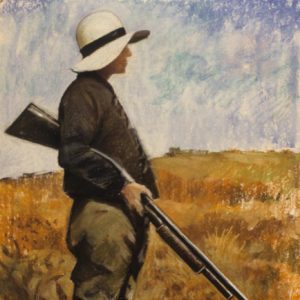
In February 2019, the Arkansas General Assembly approved a measure designating the shotgun as the state’s official firearm. Act 685 of 2019’s regular session was authored by state Senator Trent Garner, representing the Twenty-seventh District. The act acknowledged the long history and significance of waterfowling in Arkansas’s history, culture, and economy, and pointed to both the long history of the shotgun’s use in Arkansas and its importance in wildfowl harvesting.
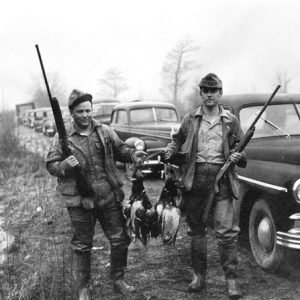
Garner justified his advocacy of this designation by pointing out the tradition of hunting in his state: “Arkansas is internationally known for the quality of our hunting,…especially duck hunting. While there are many different ways to harvest game, almost every hunter has a shotgun in their collection….Whether you are shooting ducks in a green-timber hole, hunting deer on a cold morning or calling turkey from the edge of a pasture, the shotgun is a versatile tool that can be used in many different types of hunts.” Garner asserted that many of his constituents supported the idea: “the Bowie knife and the shotgun reflect our values, and adding them to the list of official state symbols will tell the world who we are and what we value.”
A shotgun may be defined for the nonspecialist as a smoothbore (that is, not rifled) long arm intended to fire clusters of groups of small projectiles, styled “shot,” at game or targets. In its earliest form, the shotgun (usually referred to as a “gun” or “fowling piece” or “fowler”) was simply a civilian variant on the common military musket (also smooth-bored). By the end of the seventeenth century, distinct fowling pieces appeared: one was described in 1671 as featuring a barrel “5 ½ or six feet long.” Early fowlers were clumsy and slow to handle, limiting their usefulness to ground-gunning, a technique today regarded as particularly unsporting. Their field utility was also limited by early matchlock and wheel-lock ignition systems, which were unreliable in the cold, wet weather best suited to fowling.
But in the late seventeenth century, flintlock ignition—reliable and relatively moisture-resistant—appeared, followed by stronger and lighter pattern-welded Damascus steel barrels and percussion ignition, dependable in all weather. Double-barreled fowlers appeared in the late eighteenth century, giving hunters the possibility of a quick second shot. By the mid-nineteenth century, the modern double-barreled gun design was established and was quickly adapted to breech-loading, with the appearance of cartridges after mid-century. By 1900, repeating shotguns appeared—lever action, pump, and autoloading—which offered more and quicker follow-up shots, but these did not displace the older-style single- and double-barreled guns.
Many early American settlers brought long arms with them, generally smooth-bored muskets or fowling pieces. These were used for subsistence and also for self-defense; a charge of shot had a better chance of finding its winged or legged target than a single ball projectile. During the nineteenth century, these resident hunters were joined by adventurers and sport hunters; the latter came to dominate hunting in Arkansas’s eastern wetlands in the late nineteenth century, along with market hunters intent on sending barrels of wild game out of state.
Enthusiasts extoll the merits of one design over another, or the qualities of particular gun makers’ work, but one individual gun is tied in fame and memory to Arkansas’s waterfowling heritage: a 12-gauge side-by-side hammerless gun known by the unlikely name of “Bo Whoop.” It was carried by Memphis journalist, bird-hunting devotee, and author Theophilus “Nash” Buckingham (1880–1971); its name evoked the heavy double gun’s distinctive voice when fired.
Bo Whoop was a nine pound, nine-ounce A. H. Fox “Super Fox” double, sporting custom thirty-two-inch barrels by master Philadelphia gunsmith Burt Becker. Its steel side plates were engraved with a leafy scroll and game birds design, while the Fox company’s emblem, a fox with its nose in the air, was engraved on the floorplate. The barrels were full choked (that is, configured to deliver tight patterns of shot at long range). Buckingham took delivery of this custom gun in 1927, and it was his constant companion as he hunted in the greenwood wetlands of eastern Arkansas, hunts he made famous in short stories and magazine columns.
On December 1, 1948, Buckingham and a friend were checked by a game warden after a duck hunt near Clarendon (Monroe County). The warden, familiar with Buckingham’s writing, asked if he could see the famous shotgun. Buckingham obliged, and conversation ensued, during which time the gun was placed on the fender of the car and forgotten when the hunters drove away. Buckingham remembered the gun a few miles down the road, and they turned around, but when they reached the spot, Bo Whoop, perhaps the most famous shotgun in America, was gone.
Buckingham searched long for his prized double but met no success; he finished his days of duck hunting with another Fox double gun. Bo Whoop itself reappeared in 2005, when a customer carried it into a South Carolina gun shop to have its stock repaired. The gunsmith recognized the gun for what it was (the barrels bore both Buckingham’s and Becker’s names) and offered to buy it for $20,000, but the owner declined. A few years later, however, the gun sold at auction for a staggering $201,250. The buyer then donated it to the Ducks Unlimited conservation organization for display in its Memphis, Tennessee, headquarters, after one final hunt in 2016.
Arkansas bird hunting in the twenty-first century is dominated by shotguns that bear little outward resemblance to traditional sporting fowlers such as Bo Whoop. Pump-action and autoloading and over/under double-barreled guns outsell side-by-side doubles; the best-selling shotgun in America is believed to be the pump-action Remington 870, with over eleven million sold, although this figure includes target and law enforcement-suited variants.
Arkansas is not known as a center of shotgun manufacture, although several instate firms offer or have previously performed “combat” or “tactical” modifications for shotguns such as the Remington 870. The Remington Ammunition Company (no longer associated with the arms manufacturer) operates a factory near Lonoke (Lonoke County), which produces sporting and military ammunition, including shot shells.
The state itself has proved to be a supportive environment for shotguns and waterfowling in general: its official state soil (the Stuttgart series) provides an ideal environment for growing the state grain (rice); this grain attracts the state’s official state duck (the Mallard), which, when harvested with a shotgun, may be retrieved by the state’s official canine (the Labrador).
For additional information:
Boothroyd, Geoffrey. The Shotgun: History and Development. London: A&C Black Publishers Ltd., 1985.
Buckingham, Nash. “Mr. Buck”: The Autobiography of Nash Buckingham; The Life and Times of the True “Shootinest Gent’man, ed. Dyrk Halstead and Steve Smith. Traverse City, MI: Countrysport Press, 1990.
Burke, Monte. “The Legend of Bo Whoop.” Garden & Gun, June/July 2010. https://gardenandgun.com/the-legend-of-bo-whoop (accessed October 13, 2026).
Foster, Buckley T. So Great Was the Slaughter: Market Hunters, Sportsmen, and Wildlife Conservation in Arkansas. Tuscaloosa: University of Alabama Press, 2025.
Greener, William Wellington. The Gun and its Development, 9th ed. London: Cassell & Co., Ltd., 1910 (facsimile edition: Skyhorse, 2013).
———. Modern Breechloaders, Sporting and Military. London: Cassell, Petter and Galpin, 1871 (facsimile edition: Carpenter Press, 2013).
Peterson, Harold L. Arms and Armor in Colonial America, 1526–1783. Harrisburg, PA: Stackpole. 1956.
“SB 6 of 2019.” Arkansas General Assembly. https://arkleg.state.ar.us/Home/FTPDocument?path=%2FACTS%2F2019R%2FPublic%2FACT685.pdf (accessed October 13, 2026).
Smith, David. “Senator Wants to Designate a State Gun and a State Knife.” Wide Open Spaces, August 23, 2017. https://www.wideopenspaces.com/senator-wants-to-designate-state-gun-and-state-knife/ (accessed October 13, 2026).
Wickline, Michael. “Shotgun as Official Firearm Gets Salute.” Arkansas Democrat-Gazette, March 21, 2019. https://www.arkansasonline.com/news/2019/mar/21/shotgun-official-firearm-gets-salute-arkansas-sena/ (accessed October 13, 2026).
Avis Merganser
Little Rock, Arkansas


Comments
No comments on this entry yet.