


501-918-3025
calsfoundation@cals.org
calsfoundation@cals.org
American law enforcement, which is authorized by the constitutional concept of police powers, functions to obtain compliance with society’s established laws, rules, and regulations. Working as a subset of law enforcement, policing involves maintaining public safety and welfare as it relates to criminal behavior. Police officers are authorized to prevent, detect, and investigate crimes and apprehend alleged offenders.
Early American Law Enforcement
Based upon the traditional English system of sheriffs, constables, magistrates (aka justices of the peace), and night watches, colonial American law enforcement was informal and local. Male community volunteers formed the watches, patrolling the cities for crime and disorder.
In the 1830s and 1840s, as New York, Boston, and other northeastern American cities experienced rapid industrialization, urbanization, and immigration, city leaders established modern police forces modeled on the London Metropolitan Police. Established in 1829, the London Met was a permanent agency that employed full-time, paid officers who were organized paramilitary style and patrolled fixed “beats” to prevent crime. Although the London Met established a detective branch in 1842, improved investigation of crimes awaited the scientific advancements of the twentieth century.
Early Law Enforcement in Arkansas (1803–1865)
Following the Louisiana Purchase of 1803, law enforcement in the land that became Arkansas was limited at best as compared to other parts of the country. As Arkansas’s first U.S. marshal, serving from 1820 to 1831, George Washington Scott was an early federal law enforcement presence whose duties included protecting the federal judiciary, serving warrants, and transporting federal prisoners.
Beginning during the territorial period, Arkansas’s local government was based on the county system. Counties were divided into townships, in which the voters elected a constable and justices of the peace. Under the first state constitution of 1836, elected sheriffs, who were the chief county law enforcement officers, served single two-year terms.
Despite these early efforts, Arkansas was plagued with crime, dueling, and vigilantism, earning a reputation as a lawless and violent frontier. Arkansas and the unorganized Indian Territory (present-day Oklahoma) were popular hideouts for violent criminals.
The state did establish one early form of law enforcement in 1825—slave patrols. Established by white leaders in the southern slave states, slave patrols were small local groups of armed and mounted white men that functioned as a racialized form of law enforcement. As enforcers of the slave codes, slave patrollers’ duties included capturing runaways and punishing alleged offenders, though as historian Kelly Houston Jones has documented, some slave patrols perpetrated murders that could be considered lynchings as they pursued runaways.
County and Municipal Law Enforcement (1874–1930)
In 1859, the Little Rock (Pulaski County) city council established a police department, but it did not survive the disruption of the Civil War. Arkansas’s 1874 constitution reflected the fact that many white Arkansans emerged from the Civil War and Reconstruction deeply distrustful of government authority (especially as that authority put them on equal footing with African Americans). County government was composed of nine officials, including a sheriff, who were elected to two-year terms. Sheriffs maintained order, managed jails, and collected taxes in counties without a separate tax collector.
As they were barely mentioned in Arkansas’s 1874 constitution, municipal powers were defined by legislation. First-class cities have more than 2,500 residents, second-class cities have 500 to 2,500 residents, and incorporated towns have 499 or fewer inhabitants. A first-class city may establish a police department, and the smaller municipalities may appoint or elect a city or town marshal. Mayors appoint police and fire chiefs.
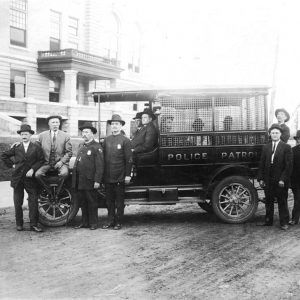
Reestablished in 1866, the Little Rock Police Department (LRPD), which is the state’s oldest city police force, grew from fifteen to forty-two officers between 1876 and 1892. Until about 1920, a few Black men served as officers in the LRPD, mostly patrolling in Black neighborhoods. As racial lines hardened in the late nineteenth century, however, white Arkansans disenfranchised Blacks and passed racial segregation laws. The police enforced segregation laws and harshly punished Black-on-white crimes while largely ignoring Black-on-Black or white-on-Black crimes to reinforce white supremacy. An African American officer did not return to the LRPD until 1942.
Professionalization and Technological Change (1900–1930)
To professionalize policing, early twentieth-century Progressive reformers looked to depoliticize police departments, curb corruption, and raise personnel standards. Beginning in 1905, police chief August Vollmer of Berkeley, California, was a highly influential proponent of police professionalization, one who advocated for college-educated police officers and instituted such advancements as automobile patrols.
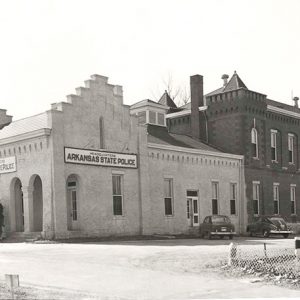
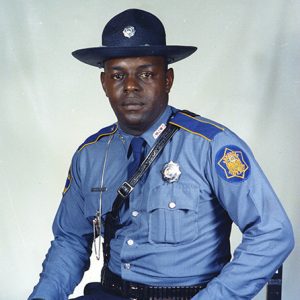
By reducing service response times and improving patrol coverage, the early twentieth-century introductions of the telephone, the patrol car, and the two-way radio revolutionized policing. The LRPD purchased its first automobile in 1911 and implemented two-way radios in 1934. In 1935, the need for road safety and increasing concerns about crime during and after Prohibition led to the creation of the Arkansas State Police.
Established in 1975, the ten-member Commission on Law Enforcement Standards and Training (CLEST) is a division of the Arkansas Department of Public Safety. The commissioners—who represent law enforcement, criminal justice education, and the public—set the minimum professional training and employment standards for law enforcement officers.
Basic Qualifications and Training
Police recruits in Arkansas must be U.S. citizens of good character who are at least twenty-one years old and possess a high school diploma or a GED. They are required to have no criminal record, be licensed drivers, and meet all the required physical and mental health specifications.
Newly hired recruits must successfully complete a CLEST-approved basic law enforcement training course within nine months or, with an approved extension, within twelve months of their date of employment. To become fully certified officers after basic training, trainees must serve a year of probationary employment with their department.
Arkansas Law Enforcement Training Academy
The Arkansas Law Enforcement Training Academy (ALETA) opened in 1965 as the state’s flagship professional training facility for law enforcement officers. In 1968, the academy moved from its temporary location at Hardison Hall in Petit Jean State Park to the site of the former Shumaker Naval Ordnance Depot (which later became Highland Industrial Park) in East Camden (Ouachita County).
The northwest ALETA in Springdale (Washington and Benton counties) began operating in 1997, and the central ALETA in Benton (Saline County) began operating in 2017.
The ALETA’s four-week Pre-Academy Preparation Program introduces recruits to the physical conditioning regimen, firearms, and departmental policies. The subsequent thirteen-week basic training course includes instruction in criminal law and investigation, firearms, defensive tactics, and traffic accident investigation. Satisfactory completion of the basic training course requires that trainees achieve scores of at least 70 percent in academic instruction and 80 percent in the firearms course.
Additional Police Training Facilities
Black River Technical College in Pocahontas (Randolph County) offers basic police training. The LRPD and the North Little Rock (Pulaski County) police department maintain their own academies. The Arkansas Criminal Justice Institute, which is part of the University of Arkansas System, offers training in specialized fields of law enforcement.
Arkansas Crime Information Center
The database of the Arkansas Crime Information Center (ACIC) is linked with the Federal Bureau of Investigation’s National Crime Information Center (NCIC), which provides federal, state, and local law enforcement with access to criminal history and stolen property files. Except for the crime statistics, only criminal justice officials can access the ACIC’s data.
For additional information:
Besett, Cody. “The Arkansas Highway Police: Arkansas’s First State Police.” MA thesis, University of Arkansas at Little Rock, 2019.
Coffman, Dempsie. Arkansas State Troopers: A Breed Apart. Philadelphia: Xlibris, 2005.
“Final Report, U.S. Department of Justice Office of Law Enforcement Assistance, Project Number 369.” U.S. Department of Justice Office of Justice Programs. https://www.ojp.gov/pdffiles1/Digitization/000298NCJRS.pdf (accessed September 16, 2026).
Jones, Kelly Houston. “‘Doubtless Guilty’: Lynching and Slaves in Antebellum Arkansas.” In Bullets and Fire: Lynching and Authority in Arkansas, 1840–1950, edited by Guy Lancaster. Fayetteville: University of Arkansas Press, 2018.
Lindsey, Michael G. The Big Hat Law: Arkansas and Its State Police, 1935–2000. Little Rock: Butler Center Books, 2008.
Melanie K. Welch
Mayflower, Arkansas


Comments
No comments on this entry yet.