501-918-3025
calsfoundation@cals.org
calsfoundation@cals.org
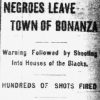
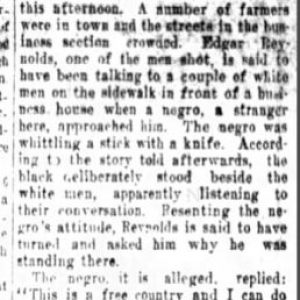
The El Dorado Race Riot that began on February 26, 1910, was reportedly sparked by a gun battle between an unidentified African American man and three white men—Deputy Sheriff H. E. Reynolds, Oscar P. Reynolds, and Roscoe Montgomery—outside of an El Dorado (Union County) barbershop owned by Black businessman Oscar “China Parker” Warren. Newspaper accounts vary widely as to the cause of the altercation, though most reports agree that there was some type of verbal interaction between the unidentified Black man and the group of white men, in which the former reportedly spoke to the white men in a “very insolent manner.” The Texarkana Courier reported that “one of the white men brushed against the black man, who said in response, ‘Don’t step on me, white man,’” and started to pull out his gun.
The Forrest City (St. Francis County) newspaper Forrest City Forrester gave a different account in which a Black man named Chaney fired on the three white men from the window of a Black-owned restaurant. In this accounting, Oscar Reynolds was reported to have had an earlier altercation with a Black man, but everything had apparently been smoothed out. The three men were later surprised by Chaney, who began firing upon them without provocation as they walked down the sidewalk. Roscoe Montgomery was fatally wounded by gunfire in the exchange, while Sheriff Reynolds sustained a gunshot wound to his foot, and Oscar Reynolds was apparently unhurt. Chaney and additional unknown assailants appear to have fled unscathed from the barbershop after the altercation. However, newspaper reports suggest that considerable blood was found at the scene, and Sheriff Reynolds was reported to have shot two Black men.
Shortly after the shooting, an armed mob formed and began shooting at and vandalizing the storefronts of the primarily Black business district. Newspaper accounts differ as to what happened next. The Forrester reported that, after extensive searching by an armed posse, the man known as Chaney was eventually found, shot, and then arrested. The Forrester also reported that there was no evidence of any violence done by whites. The Sentinel Record, a Hot Springs (Garland County) newspaper, reported a contradictory story in which the “white mob was startled when blacks in the homes and businesses began firing back at the mob.” This action seemed to anger the mob, which went on to destroy more Black-owned homes and property.
The local company of the National Guard was called out to restore order. A large percentage of the Black population of El Dorado left the area at least temporarily, with many evacuating to the neighboring community of Camden (Ouachita County). Newspaper accounts are silent as to the amount of property damage sustained that night. Additionally, it is unknown whether any other Black citizens were harmed or killed by the mob that evening.
For additional information:
“El Dorado Has a Lively Race Riot.” Mena Evening Star, February 28, 1910.
“Rage Riots at Eldorado.” Sentinel Record, February 27, 1910.
“Riot at Eldorado.” Forrest City Forrester, March 4, 1910.
“Three White Men Shot by Negroes.” Arkansas Gazette, February 27, 1910.
“White Men Shot at Eldorado in Duel between the Races.” Texarkana Courier, February 27, 1910.
Emily Kearns
Little Rock, Arkansas


I was born and raised in El Dorado, Arkansas, graduated from EHS. This story does not sit right with me and reminds me of the Elaine Massacre (if you’ve never read up, I encourage you to do so) in which Black farmers formed a union to negotiate unfair practices imposed upon them by their white counterparts. Black people outnumbered whites 10-1 in this area yet white people owned most of the land, overcharged our people for seed, feed, and other supplies, never providing an invoice. When the white farmers (KKK) heard of this, they stormed this group, slaughtered hundreds, and tried to cover it up by spreading lies in the media that our people were planning to kill all White people. If it wasn’t for an investigator with the NAACP by the name of Walter F. White, the truth would never have been known and twelve innocent men would have faced death by electrocution. There are too many unknowns here, such as this “unknown” Black man and other “unknown” assailants. I don’t understand why more research wasn’t completed, interviews with the descendants, something. All in all, I call BS on one of our people being the culprit, especially right after the Civil War and with countless other stories of white people killing out people and burning down our businesses just because we dared to exist in a place they forcibly brought us to.
I was born in El Dorado and still live nearby. This is the first I have read about this or have even heard about it. Thank you for the information.
My mother is from Union County and I have never heard of this. It was before she was born but still interesting. I am researching the 1919 Elaine Riot in Phillips County that my father’s family is supposedly connected to.