

501-918-3025
calsfoundation@cals.org
calsfoundation@cals.org
The Boone County Historical and Railroad Society, Inc., owns and operates the Boone County Heritage Museum in Harrison (Boone County) and publishes the Boone County Historian and Oak Leaves, journals that focus on local and regional history. The society evolved from earlier Harrison historical societies and from the Missouri and Arkansas Railroad Society, Inc., once located in Beaver (Carroll County).
The first historical society in Boone County was created on June 24, 1955, as the Boone County Historical Society. Its first officers were Ralph R. Rea (president), Dr. Troy Coffman (vice president), and Dr. G. Allen Robinson (secretary-treasurer). Membership fees were one dollar per year. Members met annually, although in 1958, the organization attempted to meet twice a year. It ceased to function around 1960.
On May 16, 1978, Boone County historian Roger V. Logan Jr. and other community members revived the historical society and named it the Boone County Historical and Genealogical Society, Inc. Among the officers elected were Roger V. Logan Jr. (president), Betty Cox (vice president), and Anna Holt (treasurer). The group met monthly at various places in Harrison. Members collected historical documents, photographs, and other items, and stored them in the basement of Harrison’s old Federal building. The organization began publishing the Boone County Historian and published one issue in 1978, then making it a quarterly publication the following year.
According to Logan, in early 1987, the Missouri and Arkansas Railroad Museum, Inc., located in Beaver, sought a new proprietor for its papers and photographs and was willing to donate $6,000 to its new owner. The railroad museum had received the funds as payment for a five-year lease on its steam locomotive, which at that time may have been serving as a tourist attraction in Branson, Missouri.
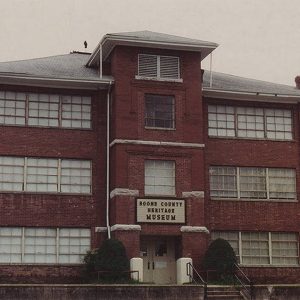
Seeing an opportunity, the Boone County Historical and Genealogical Society asked the Harrison School Board if it could turn the former Harrison High School into a museum. The parties came to an agreement, and the Boone County Heritage Museum was formed on June 25, 1987. Acquiring this building allowed the historical society to merge with the Missouri and Arkansas Railroad Museum, Inc., and take possession of its assets, including the steam locomotive. (Sometime after the merger, this locomotive may have been transferred to the Rusty Wheels Old Engine Club near Valley Springs in Boone County; its subsequent disposition is uncertain.) The new organization was named the Boone County Historical and Railroad Society, Inc. Members and other community volunteers donated materials and months of labor to refurbish the interior of the building. Also in 1987, the Boone County Historian was expanded to include Oak Leaves, which focuses on local and regional railroad history; the two publications are separate journals that are presented together in one binding.
The Boone County Heritage Museum is primarily housed in three stories of the former Harrison High School building. Each room has a theme and a descriptive name. Visitors who find it difficult to climb stairs or stand can use audio-visual equipment located on the first floor to view the contents of all rooms, as well as nearly 150 short video clips of Boone County’s history.
The first floor contains the museum’s office and two rooms. The Railroad Room holds hundreds of artifacts from the Missouri and North Arkansas Railroad. This room is sponsored by Greenville and Western Railway Co, LLC, but all of the items are owned by the Boone County Heritage Museum. Visitors can use a kiosk to trace the railroad’s route and identify towns located along the route. Artifacts from the Civil War are displayed in the War Between the States Room. A timeline from 1860 through December 1865 informs visitors about the war in Carroll County (of which Boone County was a part until 1869) and surrounding counties during the war. Many items in this room were used in Boone County during the war and include bullets, relics, and three large kettles. Soldiers boiled saltpeter and bat guano together in these kettles to create a low-grade gunpowder. Also on display are reproductions of a tent, models of Confederate and Union soldiers dressed in uniforms, and soldiers’ equipment. A reproduction flag of the local Confederate company Joe Wright Guards is on display. The seamstresses for the original flag were Josephine Boneparte Wright Greenlee, who was Joe Wright and Joseph M. Bailey’s sister, and Malinda Jane Bailey Rosson, who married Confederate captain John Rosson. Josephine later married George James Crump. Other reproductions of Confederate flags can also be viewed in this room.
The second floor comprises four rooms. The Boone County School Room has artifacts from Boone County’s schools, including letter jackets and school yearbooks. The Explore Harrison Room preserves memorabilia from Dogpatch USA and is popular for local tourism. The Early Harrison Interior Room replicates an early Boone County home, complete with furniture, lamps, dishes, and other household items. The Medical Room, sponsored by the North Arkansas Regional Medical Center, honors early Boone County doctors and dentists. Their medical bags, books, and instruments are on display, and a patient’s bed can be examined.
The third floor has three rooms. The Kiwanis, Lions, and Rotary Clubs of Harrison sponsor the Civics Room, and each organization has a display of its club’s activities. The Masonic Lodge and Shrine each have a showcase for their memorabilia. The Industrial Room includes exhibits of Boone County’s past and current industries, including a unique selection of Duncan Parking Meters. The All-Wars Room contains Boone County veterans’ uniforms and photographs, and it features displays from World War I to the Vietnam War.
In 2017, the Boone County Historical and Railroad Society, Inc., purchased a second building from the Harrison Public School District and named it the Forrest Building, after a local benefactor, John Forrest. Located directly behind and to the west of the Boone County Heritage Museum, the Forrest Building houses the museum’s library, an Archival Room, and a room devoted to the Mountain Meadows Massacre. The library contains numerous Boone County history books and hundreds of genealogy files. The Archival Room holds old county records, overflow books, and additional items. The Mountain Meadows Massacre Room has a circa 1857 covered wagon with four oxen. The oxen are fiberglass replicas, and each are approximately three-fourths the size of a live ox. Items needed to journey from Arkansas to Oregon are also on display. Visitors can read the names of all people killed in the massacre as well as the names of the seventeen surviving children. Books and other written materials about the massacre are available, and a colorful mural on the exterior of the Forrest Building depicts a scene of the pioneers’ fateful journey.
Anyone may become a member of the Boone County Historical and Railroad Society, Inc., by visiting the Boone County Heritage Museum or the society’s website. The museum is open from 10:00 a.m. to 4:00 p.m. every Friday and on the first Saturday of the month; it is additionally open on Thursdays from 10:00 a.m. to 4:00 p.m. from April through October. The Boone County Museum is staffed by volunteers and managed by a volunteer board of directors. It is funded by donations, subscriptions to the Boone County Historian/Oak Leaves publication, and sales of books and other publications produced by local authors as well as the museum.
For additional information:
Boone County Historical and Railroad Society, Inc. https://bchrs.org/ (accessed March 19, 2026).
Logan, Roger V., Jr. History of Boone County, Arkansas. Paducah, KY: Turner Publishing Company, 1998, pp. 75, 81, 112.
Schnedler, Jack. “Boone County Bonanza.” Arkansas Democrat-Gazette, September 20, 2022, pp. 1E, 6E. Online at https://www.arkansasonline.com/news/2022/sep/20/boone-county-bonanza/ (accessed March 19, 2026).
Nita Gould
Tulsa, Oklahoma


Comments
No comments on this entry yet.