Paleoindian Period to the Dalton Period, 12,000-7,900 BCE
Students will engage with the historical time periods, focusing on the Paleoindian Period to the Dalton Period, 12,000-7,900 BCE, as well as the archaeological and historical process, becoming familiar with how archaeologists and historians discover information about the past.
Grades:6-12
Duration:45-85 minutes
Content Areas:U.S. History, Arkansas History
Objective(s)
Students will construct meaningful questions and answers regarding ancient time periods using primary and secondary sources; Students will engage secondary sources in order to glean insight into the practice of archaeology; Students will analyze primary and secondary sources to understand how technology developed in ancient times.
Key Vocabulary
Primary Sources: first-hand information from those who experienced a time or event. Includes memoirs, interviews, letters, and public documents
Secondary Sources: second-hand information; works that have been collected, interpreted, or published by someone other than the original source
Paleoindian Period: Around 12,000 to 8,000 BCE (before current era), a period dominated by hunter-gatherer groups and stone technology like the Clovis point
Dalton Period: Around 8,500 to 7,900 BCE, defined by specific technological developments, a changing climate, and expanding forests
Indigenous: The people originally inhabiting or existing in a land at the earliest recorded point in time, especially before the arrival of colonists
Prehistory: The period of time prior to written records
Archaeology: The study of human history and prehistory through the excavation of sites and the analysis of artifacts and other physical remains
Necessary Materials
Pen or pencil; lined paper; internet access if available; relevant printouts if needed
Historical Background
Historians describe the time period before written record as “prehistory.” This period of time is difficult to analyze because there are, of course, no written accounts. When exactly prehistory begins depends on the region, but the general cutoff is about 12,000 years ago, when the last Ice Age ended. Most things dating to before that time have been lost to weathering or erosion.
Fortunately, the efforts of archaeologists give us insight into this mysterious time period. Through excavation and study of surviving artifacts, we now know more than we ever have before about the people that lived throughout prehistory as well as their lifestyles and technology.
In the area that is now the United States, the earliest distinct eras historians have agreed on are known as the Paleoindian Period and the Dalton Period. The Paleoindian Period began in roughly 12,000 BCE and lasted until 8,000 BCE This then led into the Dalton Period, from roughly 8,500 to 7,900 BCE.
The Paleoindian Period was defined by nomadic groups of hunter-gatherers and stone technology and tools like the Clovis point, named for where it was first discovered. The Dalton Period, named after archaeologist Judge Signa Poage Dalton, represented the improvement of technologies found in the Paleoindian Period and acted as a transitional period in prehistory. Thanks to the discovery of the Sloan Site by Mary Ann Sloan in June 1968, as well as over 750 Dalton sites in northeastern Arkansas alone, we know more about the Dalton people than ever before.
Activities
BELLRINGER
Ask students to think carefully before answering this question:
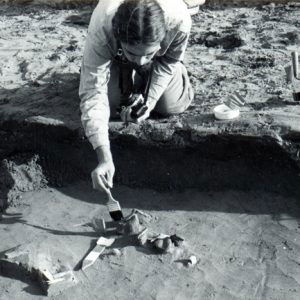
What is this person doing?
Michael Million at the Sloan site (Greene County); 1974.
Keep the question open and challenge students to think critically. Possible answers include digging, cleaning, sitting, perhaps even painting. Students should discuss possible answers aloud in pairs or at tables.
Afterward, the teacher should engage those students who said “digging” with the probing question, “What is he digging with?” The answer being a brush. “Why would he be brushing dirt?” Guide students to the conclusion that they are cleaning something. “What could be buried that he is cleaning?” This leads us into a discussion on archaeology and the delicate nature of the work.
Direct Instruction
Teacher delivers direct instruction on the time periods of the area now known as the United States before 7900 BCE, also known as prehistory. By the end of direct instruction, students should know:
What archaeology is, what archaeologists do, and how their discoveries impact our understanding of history.
The distinct time periods and the approximate years of the Paleoindian Period and the Dalton Period.
What groups of humans existed in each period, including their lifestyle, food sources, and technology, as well as how the environment affected them and vice versa, and how they interacted with each other.
How the ecological or geological makeup of the region was defined or changed during each period, including what structures the humans of each period built, how, and why.
Details about Judge Signa Poage Dalton and the Dalton sites, particularly the Sloan Site in Greene County, Arkansas.
Engaging Secondary Sources
Have students read the CALS Encyclopedia of Arkansas (EOA) entry on the Sloan Site via internet access or printed copies. Students should practice marking the text strategies to identify any important individuals involved in the archaeological discovery, what tools they discovered there, and how those tools were used. Feel free to construct explicit guided reading questions for students to answer as well.
This activity has students engage with the historical time periods as well as the archaeological and historical process, becoming familiar with how archaeologists and historians discover information and how hands-on the work can truly be.
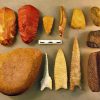
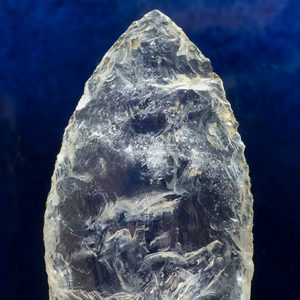
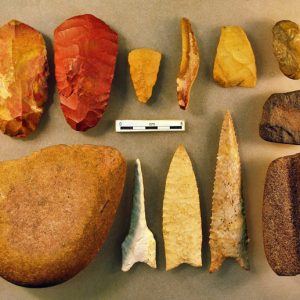
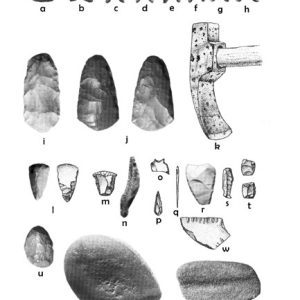
Paleoindian quartz crystal Clovis point discovered by Forest Sargent in the Ouachita Mountains. It is one of the oldest Arkansas-made implements still in existence.Dalton tools from the Sloan site (Greene County); 2010.
Ask students to look through both the Paleoindian Period and Dalton Period entries on the Encyclopedia of Arkansas, as well as use their own judgement based on the images. Students’ task is to describe the similarities and differences between the Dalton tools and the Clovis point. They may take important details and descriptions from both EOA entries; however, they should produce at least two similarities and differences from original analysis of the photographs. The purpose of this activity is to be a miniature research and synthesis assignment, both searching for and finding The purpose of this activity is to be a miniature research and synthesis assignment, both searching for and finding important information in the text. By encouraging students to analyze the photographs of these artifacts personally, it also challenges students to become historical actors in their own right and introduces them to the concept of historical change over time.
Evaluation
Students will produce notes from direct instruction, annotation from their reading on the Sloan Site, and a synthesis of information regarding the Clovis Point and Dalton tools. They engage with change over time as well as the chronological development of ancient technologies. By engaging with these evaluations, students construct meaningful questions about ancient historical time periods and develop original answers to those questions.
Extensions
Either introduce students to or have students research other technologies from the Dalton period. Challenge students to discover the answer to questions like: Why was the Dalton Period so distinct? Why did it end when it did? How did Dalton technology improve on Paleoindian technology?
Research can then be synthesized into a slideshow presentation, poster, or short essay. Use of multimedia like photographs of artifacts would be best suited for a slideshow or poster, at the teacher’s discretion.
Honor or memorial gifts are an everlasting way to pay tribute to someone who has touched your life. Give a donation in someone’s name to mark a special occasion, honor a friend or colleague or remember a beloved family member. When a tribute gift is given the honoree will receive a letter acknowledging your generosity and a bookplate will be placed in a book. For more information, contact 501-918-3025 or calsfoundation@cals.org.
The CALS Foundation is a 501(c)(3) organization. Donations made to the CALS Foundation are tax-deductible for United States federal income tax purposes. Read our Privacy Policy.


 Clovis Point
  Dalton Tools
  Dalton Period Artifacts
  Sloan Site


"*" indicates required fields