

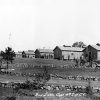




 CCC Company 747
 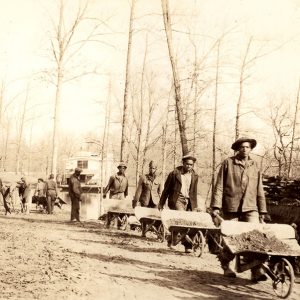 CCC Enrollees
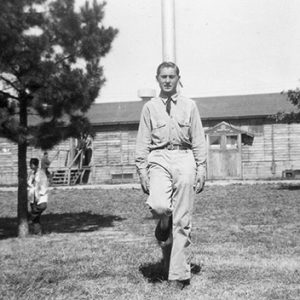
  CCC Men
 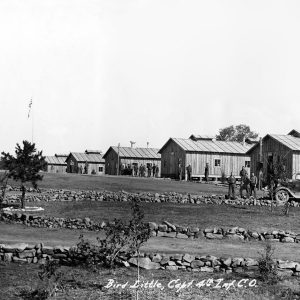 Civilian Conservation Corps Camp
 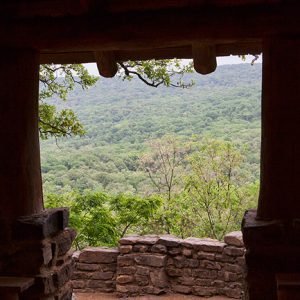 Devil's Den State Park
 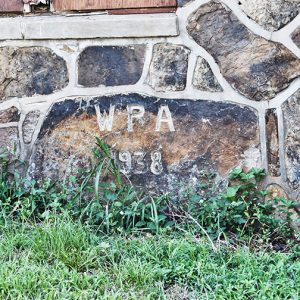 Menifee Gymnasium

501-918-3025
calsfoundation@cals.org
calsfoundation@cals.org
Students will be able to analyze, assess, and critique aspects of the New Deal by focusing on multiple New Deal agencies and their success in addressing public needs.

The Civilian Conservation Corps (CCC) was a New Deal program that began in 1933 in order to achieve two goals: to provide outdoor employment to young men badly in need of work during the Great Depression, and to accomplish some much needed work protecting, improving, and developing the nation’s natural resources. In September 1933, there were 1,468 camps housing 200 men each across the country. In September 1935, there were 2,635 camps. Due to the improving economy, by January 1, 1942 there were only 800 camps. During this time, seventy-seven companies completed 106 projects in Arkansas.
An important reason Arkansas got its share of federal New Deal programs was due to the state’s two U.S. senators, both Democrats: Hattie Wyatt Caraway and Joseph Taylor Robinson. Both served Arkansas in the Senate during the Great Depression (Caraway from 1932 to 1944, and Robinson from 1913 until his death in 1937). Both were strong supporters of the New Deal and worked to bring relief programs to Arkansas.
Reserve officers from the army ran the camps, which provided food, clothing, shelter, education, and much needed morale. The Department of Labor selected young men through state agencies and welfare offices. Enrollees had to be between eighteen and twenty-five (later adjusted to seventeen to twenty-eight), U.S. citizens, out of school, and seeking employment. Enrollees could volunteer for six-month periods and re-enroll each six months for up to two years. Later, separate camps were opened for veterans; duties were assigned according to age and physical condition without restriction on age or marital status. Arkansas had four such veteran camps.

From planting trees, building parks, developing hiking trails, conserving land, and building bridges, there were more than 100 types of work completed by the CCC. Enrollees overall gained weight, had improved health and morale, and developed good work habits, skills, and attitudes. Many achieved successful careers in business and industry after the experience. More than 200,000 Arkansans participated in the CCC across the country during the CCC’s existence. After nine years and three million enrollees, the CCC was dissolved on July 1, 1942, with many of the men enlisting for World War II.
One CCC camp stands distinct from most of the other Arkansas camps in two key ways: first, the men were housed on government quarter boats on the Lower White River rather than in barracks or tents; and second, the enrollees were African Americans. In this segregated camp, white supervisors, foremen, and machine operators were housed on nearby boats, separate from the Black enrollees. Camp BF-2, also called Camp Legrue, was established by Company 3776 at Jacks Bay in Arkansas County. It was occupied from January 1936 to May 1938. Camp Legrue was one of the three camps assigned to the Lower White River for protection and conservation of migratory birds and other wildlife. It was located ten miles south of the main camp to facilitate projects located in that southern portion and reduce travel time. As was typical of CCC camps, alongside the job and safety training there were various educational, welfare, and religious programs, as well as dances and even a camp newspaper the Lagrue Legend. BF-2 went on to provide support relief during the Flood of 1937, supplying trucks and manpower to help move refugees out of dangerous areas and into relief camps.

If students have already learned about the circumstances leading to the Great Depression, then for this bellringer have students respond in their own words to the following:
If students are less familiar with the Great Depression, then describe the circumstances to them and have students produce a written response. Outline how the people lost their finances because of bank closures, no money meant no homes, and because everyone was affected that meant businesses couldn’t afford to pay them. Now students should brainstorm on paper how they, if they controlled the U.S. government, would address these particular concerns; how could the government possibly address loss of income, loss of housing, and lack of employment?
After students complete this bellringer, discuss as a class student responses, tying those responses to real world instances of the U.S. aid to those affected by the Depression. For example, if a student says the government could provide some kind of job to those unemployed, respond by describing the real world examples of employment opportunities created by the New Deal.
This lesson is intended to focus on one particular aspect of the New Deal and how it went on to provide relief to those in need. As such, supplementary information could be beneficial to answer student questions.
During direct instruction, ensure students become familiar with:
Students read the EOA entry on the New Deal. After reading, students should research a different “alphabet soup” agency created by the New Deal and describe how it tried to uplift citizens compared to the CCC, whether it was effective or not, and how did that agency conclude its activity. (The National Youth Administration might be a particularly interesting one for students to focus on, as it encompassed people around their age and had both male and female participants.)

This activity could be a written response, poster or slideshow, and should emphasize the compare and contrast aspect of the CCC to whatever other agency the student chooses. Some other agencies include:
The students’ research activity comparing and contrasting the Civilian Conservation Corps to other New Deal agencies asks students to assess the success of New Deal, compare and contrast one program to another (which requires them to craft an argument that looks into the finer details of each New Deal agency), and explore how these agencies came to a close and assess how that reflects their success and legacy.

Students have now looked into at least two New Deal agencies crafted to help the American people during the Great Depression, giving them a working understanding of their structure and purpose.
As one extension, ask students to craft a pitch for their own agency. Students’ agencies should include the acronym and its meaning, what services it provides, how it would address concerns during the Great Depression, and at what point the program would be considered completed.
As another extension, ask students if they have encountered physical remnants of CCC or other agency work still visible in the twentieth century, such as when hiking in state parks. Have them write a few paragraphs about what they saw and how they think it would have been to be involved in the kind of labor that went into these projects.


"*" indicates required fields