
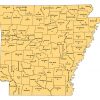
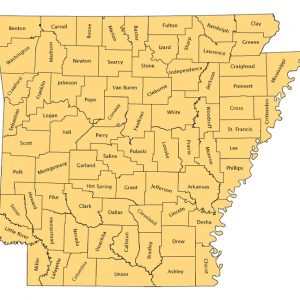
 Arkansas Counties Map
 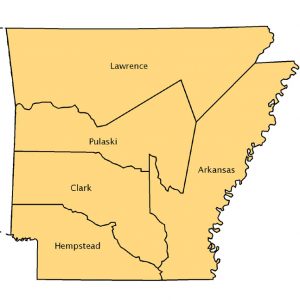 Arkansas Counties Map, 1819
 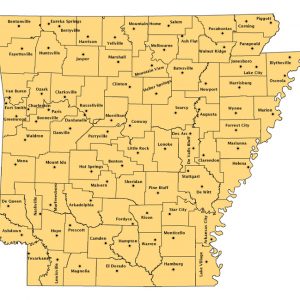 County Seats Map

501-918-3025
calsfoundation@cals.org
calsfoundation@cals.org
Students will conduct research using the CALS Encyclopedia of Arkansas (EOA) in order to demonstrate understanding of Arkansas counties, county structures, and history.
Counties are the administrative and political sub-units of a state. Each county government is based within a community designated as the county seat and typically consists of a county judge (who serves as the chief executive officer), a county clerk, a circuit clerk, an assessor, a sheriff, a coroner, and the legislative body known as the quorum court. Some counties have other positions such as county superintendent, surveyor, or collector. Some counties possess dual county seats, if geography historically made it harder for county residents to travel to a single county seat in one day.

When Arkansas became a U.S. territory in 1819, there were only five counties: Arkansas, Lawrence, Pulaski, Clark, and Hempstead. As the state’s population grew, these big counties were divided into smaller and smaller units, creating the seventy-five counties that make up Arkansas today. The Arkansas Constitution specifies that no county then established “shall be reduced to an area of less than six hundred square miles, nor to less than five thousand inhabitants,” and neither “shall any new county be established with less than six hundred square miles and five thousand inhabitants.”
In 1968, the Association of Arkansas Counties (AAC) was created to allow county and district officials to better meet, collaborate, and engage in continuing education through general research, through public education programs, and by conducting seminars for county governments in Arkansas. The AAC is made up of 1,400 members and is itself a member of the National Association of Counties. There are nine affiliation associations within the AAC, including ones for: county judges, sheriffs, assessors, quorum court officers, circuit clerks, collectors, treasurers, county clerks, and coroners. Each group contributes two of its own members to the AAC board of directors. The AAC provides a calendar of events and FAQs for each of the nine groups, and it holds an association-wide conference annually.

As a bellringer, ask students to describe the county that they live in.
Do they know their county’s name? What are the major towns and cities located within their county? Do they know what their county is best known for, or where the county seat is, or who their county judge is? Go around the room when students have completed the exercise to see how many of these details students could answer.
Briefly describe to students the general structure of a county government and how those elements work together within the state. Be sure by the end of instruction students are familiar with each of the following:
Students will peruse the County Explorer tab on the EOA. Ask students to investigate three separate counties (ones where they do not live and do not attend school), and find the following information about each county:

This mini research activity serves both to familiarize students with counties in their own state, familiarize themselves with the structure and purpose of counties, practice basic research skills for further development later on, and engage with helpful tools available through the EOA. Their short research writeups can serve as a graded assessment checking for understanding and skill development.
As an extension for this activity, tell students that they will create new county names based on independent research and support these new identities through an oral report. Have students write a persuasive essay detailing why their county name should be changed and supporting the new name they have chosen for the county.
Suggested Writing Prompt: You are interested in changing the name of a county. Persuade your reader that your county name should be changed and support your new name of choice. Before you begin to write, think about why you believe the county name should be changed. What positive effects could a name change have on this location? Now, write about why this county’s name should be changed. Be sure to give reasons why you believe it should be changed and give enough detail so that readers will understand your new name choice and point of view. Students could make a brief, timed presentation to the class in support of their county name change.
As another extension for this activity, the EOA County Explorer feature allows teachers access to a blank Arkansas counties map, as well as a fully completed Arkansas counties map. Either for a grade or an incentive, have students study these maps before taking a blind quiz where they have to label as many of the counties as they can accurately on the blank map. This could be done over any length of time desired, and possibly done multiple times to reinforce student knowledge.


"*" indicates required fields