



501-918-3025
calsfoundation@cals.org
calsfoundation@cals.org
The Woman’s City Club in Little Rock (Pulaski County) adopted its articles of incorporation in 1927. In its bylaws, the group was said to be founded in order to “create and maintain an organized center of thought and activity among the women of Arkansas, non-partisan and non-sectarian; to aid in promotion of their mutual interests; in the advancement of science, education, philanthropy, literature, and art; to provide a place of meeting for the comfort, culture, and pleasure of its members.”
In the early twentieth century, many women’s clubs were formed across the nation to focus on such issues as child welfare, civic improvement, education, and public health, along with providing fellowship for women. As in Little Rock, similar organizations in other cities such as Boston, Chicago, and Cincinnati were also called “Woman’s City Club.”
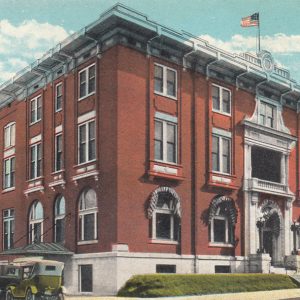
The Woman’s City Club (WCC) of Little Rock conducted a fundraising drive and sought a permanent home for its activities, which it found in a three-story building at 401 Scott Street in downtown Little Rock. The building had been designed by noted Little Rock architect Theo Sanders and was constructed by the Benevolent and Protective Order of Elks (BPOE) around 1912 as a men’s social club. In 1928, the WCC purchased the building from the Elks. Its cornerstone reads: “The Woman’s City Club, Organized 1928,” despite incorporation records showing the year 1927 as when the club was officially organized. The cornerstone seems instead to reflect the year the building was purchased. According to WCC records at the University of Arkansas at Little Rock’s Center for Arkansas History and Culture, the cost of the building was $65,000.
The approximately 14,000-square-foot building was large enough to accommodate a number of purposes. Under the ownership of the WCC, the first floor held card rooms, a kitchen, meeting rooms, a parlor, and a writing room. On the second floor was a grand ballroom where community theater productions and annual cotillions were held. To supplement finances, the third floor’s eight rooms and common bath were rented as accommodations for single women. Spots in the basement were available for lease to such ventures as artists’ studios, dance classes, piano instruction, and a hair salon. The Catholic Woman’s Exchange, the Little Rock Council of Girl Scouts, and a publication called The Homemaker also rented space in the building.
The WCC had regular meetings each month for its members. There were also standing groups and committees such as a choral group, a citizenship committee, duplicate bridge, education, fine arts, garden club, literary guild, and public welfare. Members were provided with a regular bulletin, directory, and yearbook, and there was a club historian. The WCC sponsored bridge tournaments, dances, guest speakers, luncheons, musicals, style shows, and an annual President’s Reception.
Along with yearly dues, WCC members were able to purchase stock in the organization for $25 per share. According to the club’s records, membership reached its peak in the 1940s, with almost 1,000 members. By the 1970s, that number had dropped to about 700 and continued to fall. The decline in participation may be attributed to an increase in working women who did not have the time to participate in clubs, as well as resignations by longtime members due to age or health issues. In 1984, when WCC membership stood at 285, a vote was taken on whether to sell the building to local developers. Of the 98 members who voted, 63 approved the sale and 30 were opposed, with five unaccounted for. However, approval was needed from two-thirds of the total membership, or 188. In addition, opponents filed a lawsuit against the sale. After the Pulaski County Chancery Court declared the sale void due to lack of a two-thirds majority, the developers tried again, but in 1986, they withdrew their offer to purchase the building.
With membership in the WCC falling below 200 in the 1990s, the club’s remaining stockholders voted to sell the building to the Junior League of Little Rock in 2001 for an undisclosed sum. Upon completion of the sale, after almost seventy-five years in existence, the Woman’s City Club of Little Rock effectively dissolved. On a glass panel over the front door of the building, the words “Woman’s City Club” remained. In April 2025, Arkansas Money & Politics reported that the Junior League announced its intention to sell the former Woman’s City Club building. In February 2026, the Junior League listed the building for sale for $2.7 million.
For additional information:
“Building History.” Junior League of Little Rock. https://www.jllr.org/rentals/building-history/ (accessed February 12, 2026).
DeClerk, Sarah. “Junior League of Little Rock Plans to Sell Historic Building.” Arkansas Money & Politics, April 22, 2025. https://armoneyandpolitics.com/junior-league-sell-historic-building/ (accessed February 12, 2026).
Sasser, Sydney. “Women’s City Club Building Listed.” Arkansas Democrat-Gazette, February 11, 2026, pp. 1D, 2D. Online at https://www.arkansasonline.com/news/2026/feb/10/junior-league-of-little-rock-lists-historic/ (accessed February 12, 2026).
Silva, Rachel. “Sandwiching in History: B. P. O. Elks Club (now the Junior League of Little Rock) 401 S. Scott Street, Little Rock, January 4, 2013.” Division of Arkansas Heritage. https://www.arkansasheritage.com/docs/default-source/ahpp-documents/sandwiching-tour-scripts/bpoe-elks-club-tour-script-2013.pdf?sfvrsn=c9f68766_4 (accessed February 12, 2026).
“Woman’s City Club.” Architizer, Inc. https://architizer.com/projects/womans-city-club/ (accessed February 12, 2026).
“Woman’s City Club Records, 1927–2012.” University of Arkansas at Little Rock Center for Arkansas History and Culture, Little Rock, Arkansas. Finding aid online at https://arstudies.contentdm.oclc.org/digital/collection/findingaids/id/9989/ (accessed February 12, 2026).
Zakrzewski, Katie. “Digs of the Deal: Junior League of Little Rock.” Arkansas Money & Politics, December 13, 2022. https://armoneyandpolitics.com/digs-of-the-deal-junior-league-of-little-rock/ (accessed February 12, 2026).
Nancy Hendricks
Garland County Historical Society


Comments
No comments on this entry yet.