


501-918-3025
calsfoundation@cals.org
calsfoundation@cals.org
The Stuttgart Germania was a four-page, weekly German-language newspaper published in Stuttgart (Arkansas County) from approximately 1894 to 1914, although there are questions surrounding the publishing dates.
The city’s founder, Adam Buerkle, apparently published a paper in the 1880s, but no record of it exists in Ayer’s American Newspaper Annual. According to Chronicling America (a project of the Library of Congress), Adam Buerkle’s relatives Martin Buerkle Sr., Martin Buerkle Jr., and Louis K. Buerkle edited the Germania after 1900. However, the newspaper self-reported to Ayer’s in 1895 that there were two editors and publishers, “Buerkle” and (possibly C. W.) “Smith,” and continued to list M. Buerkle Jr. until the paper ceased publication. Further, the editor discussed turning seventy-six years old in 1908 and having eight children, which are biographical details indicating Martin Buerkle Jr., who was born in 1832.
The exact publication dates of the Germania are in question. Some published sources list 1898–1913, but the earliest entries in Ayer’s Annual claim production from 1894 and continuing until 1914; the 1908 issues also indicate “Jahrgang 13,” meaning the 13th year of the newspaper’s run. Subscriptions ranged from $1.50 to $2.00 (international) with a self-reported circulation of 640 to 900; the population of the entire town was 2,740 in 1910. The paper had subscribers from other states such as Illinois and Minnesota as well as correspondents from other area communities such as Crockett’s Bluff (Arkansas County), Gillett (Arkansas County), and Ulm (Prairie County).
There are few extant copies of this newspaper, but nine issues are preserved at the Arkansas State Archives. Although two other German newspapers were publishing in the state at the time, this one made the grandiose claim that “The Germania is the only German newspaper between Little Rock and St. Louis in the middle of an ambitious and intelligent population.” The editor nevertheless was on good terms with George Doerner, publisher of the Arkansas Staats-Zeitung, who visited him in Stuttgart. The Germania additionally offered printing services in German and English as well as book binding and repair.
Typical of other German American newspapers of the time, the Germania covered international, national, and local news (including rice farming and hunting stories), along with market and weather reports. It offered a serialized novel by popular German author Hedwig Courths-Mahler and a weekly humor column written by “Lizzie Hanfstengel” (hemp stalk), a fictional female reader who offered her thoughts in a mix of dialect, poor grammar, and Americanisms. The newspaper also partnered with Die Deutsche Hausfrau (The German Housewife), another German American publication, to sell subscriptions and summarized each month’s new content. The paper was unsupportive of women engaging in politics, particularly as prohibitionists.
The fight against prohibition of alcohol in the state and nation, framed as an issue of personal freedom and the focus of multiple articles in each issue, was the main concern of the paper. An editorial from February 6 complained that the “despots” who ran the state would once again rely on the “idiocy of the residents of Arkansas” in implementing further restrictions; the writer was especially concerned that laws against alcohol consumption on Sunday could prevent the practice of taking communion wine (“Ein Sternlein”). The editor regularly highlighted prominent prohibitionists and clergymen who had been publicly outed for marital infidelity and assorted other bad behaviors.
Politically, the Germania leaned Democratic and covered the successful campaign of the editor’s son, Louis K. Buerkle, as a Democrat for the Arkansas General Assembly. Yet it also published a list of delegates for the Republican county convention. The editor was in favor of workers’ rights and against systemic income inequality. The paper exhibited racism typical of other southern papers of this period, including against local Black Arkansans, and hinted at a Jewish power conspiracy in Russia in a particularly vitriolic piece.
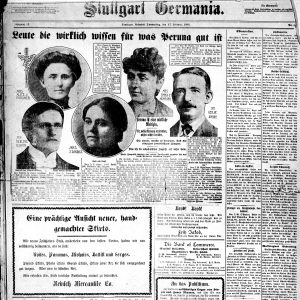
Advertisements took up much of the space on the front page and throughout the paper; the patent medicine “Peruna” was always featured predominantly, with photos and testimonials from patients. Other ads included those typical of the town’s rural nature such as farmland, farm equipment and repairs, hunting equipment, animal feed, and drilling to procure water for rice fields, but also those indicative of a middle-class readership such as ads for wallpaper, travel, mercantile, dentists, doctors, lawyers, jewelers, banks, plant nurseries, bakeries, and restaurants.
For additional information:
Dougan, Michael. Community Diaries: Arkansas Newspapering, 1819–2002. Little Rock: August House, 2003.
“Ein Sternlein in düstrer Nacht.” Stuttgart Germania, February 6, 1908, p. 1.
“Germania (German).” N. W. Ayer & Son’s American Newspaper Annual and Directory 1892. Philadelphia: N. W. Ayer & Son, 1892.
Stuttgart Germania (Stuttgart, Ark.) 18??-19??. Chronicling America, Library of Congress. https://www.loc.gov/item/sn90050234 (accessed December 30, 2025).
Kathleen Condray
University of Arkansas, Fayetteville


Comments
No comments on this entry yet.