501-918-3025
calsfoundation@cals.org
calsfoundation@cals.org
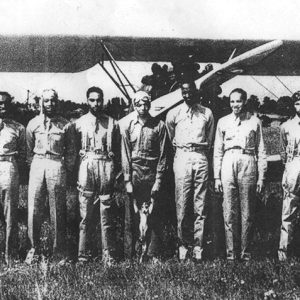
First Lieutenant Shelby Foster Westbrook was a decorated fighter pilot in the all-Black 99th Pursuit Squadron of the unit famously remembered as the Tuskegee Airmen, and after World War II, he pursued a career in electronics with W. R. Grace & Co., designing various types of control circuits and co-inventing a patented processing system still in use.
Shelby Westbrook was born in Marked Tree (Poinsett County) on January 15, 1922, the youngest of seven children of Livingston Westbrook and Lillian Brooks Westbrook. His father worked as a laborer in a sawmill. Both parents died in 1934, and Westbrook had to move to Toledo, Ohio, at age twelve to live with his older brother, Hubert. He attended integrated schools in Toledo, graduating in 1939 from Libbey High School. Determined not to end up as a “foot soldier,” Westbrook specifically sought out the Army Air Corps when the draft became a reality during World War II.
In March 1943, even though he had never been in an airplane, Westbrook enrolled in aviation cadet training at Tuskegee Army Airfield. His aptitude was immediate. He graduated as a second lieutenant (Class 44-B) on February 8, 1944, just eleven months later, and was sent to Selfridge Air Field, in Detroit, Michigan, to take training in single-engine fighter planes.
Westbrook was attached to the 99th Fighter Squadron of the 332nd Fighter Group and sent to Italy in July 1944. He flew sixty combat missions over twelve countries in Europe between July 1944 and May 1945. He is most famously associated with the P-51 Mustang fighter plane.
On his thirty-first mission, his engine failed, forcing him to bail out over Yugoslavia. He was rescued by Marshal Tito’s Partisans and spent thirty days evading capture before returning to duty. On October 4, 1944, he shot down a German Bf 109 fighter plane. His bravery earned him the Distinguished Flying Cross, the Air Medal with five clusters, and the French Legion of Honor (awarded in 2013). In 2007, he was among the Tuskegee Airmen who collectively received the Congressional Gold Medal.
Westbrook returned to the United States in 1945. Despite his distinguished war record, Shelby faced racial discrimination when he tried to become a commercial pilot after the war. This led him to pivot his career toward technology. He moved to Chicago, and using his GI Bill benefits, he earned a BS in electronics from the American Television Institute of Technology. He spent eighteen years as an electrical engineer at W. R. Grace & Co. in Chicago, where he designed electronic control circuits for packaging machinery.
Westbrook married Lulu Belle Leonard in 1952. They lived in the same house on the South Side of Chicago for more than five decades until her death in 2006. They did not have any children.
Westbrook died on August 17, 2016. He and Lulu Belle are interred at the Abraham Lincoln National Cemetery in Elmwood, Illinois.
For additional information:
“Shelby F. Westbrook: Tuskegee Airman/Electrical Engineer.” Chicago “DODO” Chapter of Tuskegee Airmen, Inc. https://taichicago.org/shelby-f-westbrook-tuskegee-airman-electrical-engineer/ (accessed July 9, 2026).
Shelby Westbrook Papers. Chicago Public Library, Chicago, Illinois. Finding aid online at https://www.chipublib.org/fa-shelby-westbrook-papers/ (accessed July 9, 2026).
Richard Holbert
Little Rock, Arkansas


Comments
No comments on this entry yet.