
501-918-3025
calsfoundation@cals.org
calsfoundation@cals.org
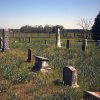
Signage at Scull Cemetery, located on Old Post Road north of Arkansas Post National Memorial in Arkansas County, makes a sweeping but unsubstantiated claim: “1778 / Oldest Cemetery in Arkansas.”
This stems from the belief that Pierre Laclède, co-founder of the city of St. Louis, Missouri, is buried there. Despite a legend that Laclède died at Arkansas Post in 1778, in actuality he died aboard his trading boat near the confluence of the Arkansas River with the Mississippi River. At that time, Arkansas Post was situated just seven miles up the Arkansas River, but the year after Laclède’s death it moved roughly thirty miles farther upstream to an earlier location, where it remains. Laclède was buried on a bench of land at the rivers’ confluence, near what later became the town of Napoleon (Desha County), in what would become the Napoleon graveyard. This site still exists but is now accessible only by boat.
In 2015, two members of the Grand Prairie Historical Society had a tombstone made for Pierre Laclède and placed it in Scull Cemetery. This was followed by cleaning up the grounds, erecting a flagpole, and enumerating the graves. In September, 2018, the cemetery’s new marble sign was dedicated.
Rather than being the oldest, Scull is the second and newer of two cemeteries in the vicinity of the Arkansas Post. The first, shown on a map drawn by Father Edmond Saulnier in 1832, was near the bank of the Arkansas River and adjacent to land owned by Hewes Scull. This was identified on the map as: “The old cemetery undermined by a gulley.” In the half century since the Post’s final move, river flooding had likely eroded the bank near these graves. G. W. Featherstonhaugh described the area in the late 1830s: “The banks of the river, which are about eighty feet high here, are crumbling down with a rapidity that must, more or less, attract the attention of the settlers and somewhat alarm them.”
Saulnier’s map also contains an unnamed second cemetery, approximately where Scull is situated today. Neither brothers James and Hewes Scull nor their families, early residents of the Post, owned the land where this newer cemetery is located.
The earliest documented burial in Scull Cemetery is that of Henry Wharton Conway, killed in a duel with Robert Crittenden in 1827. His obelisk, which contained a lengthy inscription written by his brother, Governor James Conway, had been reduced to “a pile of rubble” by the time Boyd W. Johnson visited the site in 1963. (A tree had smashed the marker, and souvenir hunters are thought to have carried away pieces, leaving a fragment with “H.C.” carved on it.) A modern granite military marker was later installed for Conway’s grave noting his service as a first lieutenant in the army in the War of 1812.
Perhaps due to the cemetery’s overgrown condition, Johnson located just fourteen marked burials, the oldest having an 1872 death date (which could not be found in later years). The Historical Society’s enumeration, published in 2018, lists sixty-four burials, the oldest one in 1873, and the most recent in 2014.
Laclède’s modern tombstone should be viewed as a memorial rather than proof of burial, but it, along with the signage, has caused widespread dissemination of the claim that Scull Cemetery is the state’s oldest. Online searches for Arkansas’s oldest cemetery cite Scull, as do pamphlets available at Arkansas Visitor Centers. Compounding this error, online archive Find a Grave lists Hewes Scull and wife Athenais Bogy Scull, both of whom died at the Post (in 1833 and 1829, respectively), as being buried in this cemetery despite a lack of evidence.
For additional information:
Arnold, Morris S. “Arkansas Post in 1832.” Grand Prairie Historical Bulletin 61 (October 2018): 2–8.
Bearss, Edwin C., and Lenard E. Brown. Arkansas Post National Memorial; Structural History; Post of Arkansas, 1804–1863 and Civil War Troop Movement Maps, January, 1863. Washington DC: United States Department of the Interior, National Parks Service, Office of History and Historic Architecture, Eastern Service Center, April 1971. Online at https://npshistory.com/publications/arpo/structural-history.pdf (accessed September 1, 2026).
Bohnert, Dyan. “Local Preservationists Restore Scull Cemetery.” Grand Prairie Historical Bulletin 61 (October 2018): 24–31.
Bowden, Bill. “Kingston Author’s New Book Debunks Arkansas’ Graveyard Myths.” Arkansas Democrat-Gazette, December 13, 2025, p. 3B. Online at https://www.arkansasonline.com/news/2025/dec/13/kingston-authors-new-book-debunks-arkansas/ (accessed September 1, 2026).
Burnett, Abby. Though Silent They Speak: Arkansas Gravestones and Graveyards. Jackson: University Press of Mississippi, 2025.
Featherstonhaugh, G. W. Excursion Through the Slave States, From Washington on the Potomac to the Frontier of Mexico; With Sketches of the Popular Manners and Geological Notices, Vol. II. New York: Harper, 1844.
Johnson, Boyd W., ed. “A Visit to an Old Cemetery.” Grand Prairie Historical Bulletin 6 (April 1963): 23.
Abby Burnett
Kingston, Arkansas


Comments
No comments on this entry yet.