


501-918-3025
calsfoundation@cals.org
calsfoundation@cals.org
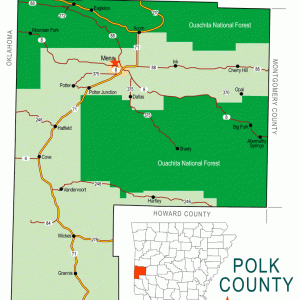
Ink is a rural community in Polk County located approximately five miles east of Mena (Polk County) along Arkansas State Highway 88.
Three theories exist on the origins of the town’s name. The most common (and most humorous) theory states that residents were asked to provide suggestions for the town’s name with instructions to “write in ink.” Legend holds that many of the residents took the instructions literally and wrote in the name Ink. The remaining two theories appear in similar frequency. One credits the first postmaster, who wanted to name the town Inky. In the postal service’s effort to reduce confusion and avoid duplicating other town or post office names, Inky was denied, and Ink took its place. This theory, at least in Arkansas, can be debunked by consulting Arkansas Post Offices From Memdag to Norsk: A Historical Directory 1832–1990, which states that the original post office name was to be Melon. Furthermore, no other post office in Arkansas ever bore the name Inky. The final theory lends the town’s name to spilled ink—sometimes on the floor of the community general store, other times in the middle of the road. The latter was reportedly used as a geographical marker for identifying the community’s location. Despite the various theories, the true origin of the town’s name remains uncertain.
The earliest records on the community of Ink are those pertaining to the church and the school, both named Concord. Though details about the official establishment of the church are not known, it is listed as one of eleven churches in the 1870 Ouachita Association minutes. Originally called the Missionary Baptist Church at Concord, the church is a member of the Southern Baptist Convention (SBC). The Concord School, listed as School District No. 7 in county records, was established in 1884. Originally, a log cabin housed both the church and the school. Later, a two-room stone schoolhouse was constructed. That structure, which is no longer in use, still stands in the twenty-first century.
In 1887, the Ink post office was established. It closed after operating for eighty years, with the mail routed to nearby Mena.
The cemetery, which lies between the schoolhouse and the church, was reportedly established in 1889. Although a sign posted in the cemetery lists 1889 as the year John McMahen donated nine acres to the school and the church and for the creation of the cemetery, county records show the transaction to be recorded in October of the previous year. It is also important to note that the land was previously in the public domain and held graves predating the official cemetery designation. According to the cemetery sign, the oldest marked grave dates to 1878, though the location includes approximately 350 unmarked graves.
By 1895, the church was referred to as Concord Baptist Church, and its first church services were held in the schoolhouse. According to the church’s centennial anniversary booklet, the church appeared in an article in Arkansas Baptist News claiming the church’s official organization to be one year prior.
A few residents are credited with donating land to the church and cemetery from 1888 to 1901, including John McMahen and James T. Cottman (sometimes listed as J. F. Cottman). However, only McMahen’s and Cottman’s transactions are recorded at the Polk County Courthouse for this time frame. The most intriguing element of the cemetery is the seven-foot rock pyramid that sits near the sidewalk and the church parking lot. The pyramid, which was likely constructed in 1933, serves as a funerary monument, with the deceased’s headstone embedded within the monument.
Shortly after the turn of the century, the church constructed its own building, and the school consolidated with nearby Cherry Hill (School District No. 100) around 1930.
By 1949, the Cherry Hill school had consolidated with the Mena Special School District. In 1951, the Mena School Board voted to return the Ink school property to the community. That same year, the Concord Cemetery Association was founded. Eventually, the old school building at Ink became a community building and meeting house, and the cemetery committee held its annual meetings there. It also hosted church plays, as it had a stage, as well as various events such as fundraisers and the fire department’s pie socials.
During the 1970s, the church saw several improvements, as listed in the church minutes—the addition of air conditioning units, the building of a fellowship hall and a well, the acquisition of a bus and a parsonage, and an official vote to change the church’s name to Concord Baptist Church to reflect existing church deeds. In 1985, the church held a Centennial Celebration under its current name. A few years later, the church fell into disrepair and was torn down. The existing building was constructed in its place.
Between 1980 and 2013, community residents donated land to the church and cemetery, including Edward M. and Margaret Rose and Danny and Beverly Hansbrough. (The earliest record lists trustees but no donors.)
Though few businesses remain in Ink in the twenty-first century, it was once home to a general store (which operated concurrently with the post office), a Massey Ferguson dealership, the Ink Snack Bar, a car shop, a jewelry store that primarily sold pieces of silver and turquoise, a sawmill, and a small cement batch plant.
The present-day community hosts a rural fire department; a propane refueling station (which sits on the site that formerly held the post office and general store); and the office and shop of Ouachita Rock (owned by Danny and Beverly Hansbrough), which crushes gravel products for roads and other uses.
For additional information:
“Concord Cemetery.” Find a Grave. https://www.findagrave.com/cemetery/53507/concord-cemetery (accessed April 2, 2026).
“How Ink, Arkansas Got Its Name.” Polk County Library, n.d.
“How the Town of Ink, Arkansas Got Its Name.” Arkansas Travelogue. http://arkansasroadstories.com/ink.html (accessed April 2, 2026).
McConnell, Lillian. “Arkansas Town Was Told To ‘Write In Ink.’” Washington County Enterprise-Leader, January 19, 2011. https://wcel.nwaonline.com/news/2011/jan/19/arkansas-town-was-told-write-ink-20110119/ (accessed April 2, 2026).
Williams, Troy, and Leon Toon, eds. History of Polk County. Dallas, TX: Curtis Media Corp., 1988.
Mysti L. Gates
University of Arkansas Rich Mountain


Comments
No comments on this entry yet.