501-918-3025
calsfoundation@cals.org
calsfoundation@cals.org
George W. Padgett, William Brown, Patrick McGowan, and brothers Amos and Abler (or Abner) Manley were hanged at Fort Smith (Sebastian County) on September 9, 1881, for murders committed in the Indian Territory (present-day Oklahoma).
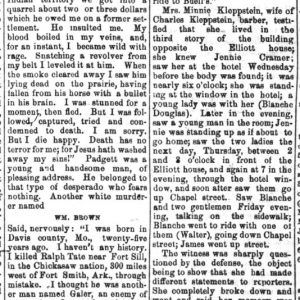
Texas-born George W. Padgett, age twenty-two, was employed by William H. Stephens on a cattle drive during which he noticed that several cattle had brands showing they belonged to a man named Wagoner for whom Padgett had previously worked. He and Stephens got into an argument over the cattle on July 26, 1880, and as the unarmed Stephens rode away, Padgett yelled, “Damn you, I’ll shoot you anyhow,” and shot him in the back, mortally wounding him. Padgett was taken to the U.S. District Court for the Western District of Arkansas in Fort Smith and convicted of first-degree murder on February 17, 1881.
William Brown, twenty-seven, was born in Davis County, Missouri. He was working for a hay contractor near Fort Sill in the Chickasaw Nation when he had a foot race with a man named Moore. Brown won the race, after which the violent-tempered Moore beat him in a fistfight. Brown then got a gun and shot and killed his friend, seventeen-year-old Ralph C. Tate. Different accounts say that Brown shot the first man he saw after getting the gun or mistakenly killed Tate while waiting in ambush for Moore. Either way, he fled to Texas and was hunted down by his victim’s father, G. W. Tate, who brought him in chains to Fort Smith. He was convicted on March 3, 1881, after the jury deliberated for an hour.
Patrick McGowan, thirty-five, owned 300 acres in Indian Territory with Sam Latta, but they argued about how to use the land. Latta bought McGowan’s share, but they remained angry at each other. A man named William Hunter, sixty, also disliked Latta and convinced McGowan to kill him, lacking the courage to do so himself. The two rode together to within two miles of Latta’s farm, where they separated. McGowan shot Latta as he was picking peaches, and his sister “rushed from the house only to pillow in her lap the head of her dying brother and hear the murderer launch his curses upon his bleeding victim.” McGowan was convicted on May 17, 1881, after the jury deliberated for about one hour.
The Creek Indian Manley brothers brutally murdered Eli McVay on December 3, 1880. They were not convicted at their first trial for the crime because a juror opposed capital punishment. They were convicted of first-degree murder at their second trial in June 1881.
On June 16, 1881, Judge Isaac Parker sentenced all five of the men to hang on September 9, 1881, and “all took their doom without betrayal of any emotion.” Though they hoped to have their sentences commuted by President James Garfield, they learned on September 5 that no commutation would be granted.
The five men left the jail just before 10:00 a.m. on September 9, 1881, and Brown fainted on the way to the gallows, blaming the hot sun after he was revived with water in the face. They were seated on a long bench on the gallows, with Padgett next to McGowan, then Brown and the Manleys.
Speaking from the scaffold, Padgett claimed his shooting was done in self-defense, and “they brought false witnesses to swear against me.” McGowan also claimed self-defense, saying, “I die claiming to be an innocent man, and bid you all the long farewell.” Brown, who had previously said, “I ain’t afraid to die, but am sorry for my crime,” admitted killing his friend and said he wished he had died himself. He said, “I realize that I am standing on the scaffold of death, feeling that my sins are forgiven, and I forgive all mankind.”
After praying with their spiritual advisors, the condemned men shook hands with their lawyers, guards, marshals, and each other, and their arms were bound and a black cap put over their heads, and “at 10:10 o’clock they were suspended between heaven and earth.” A newspaper reported that “Padgett, McGowan and Brown scarcely moved a muscle after the plunge. The two Indians drew up their legs and died hard.” They were declared dead sixteen to twenty-two minutes later.
For additional information:
Akins, Jerry. Hangin’ Times in Fort Smith: A History of Executions in Judge Parker’s Court. Little Rock: Butler Center Books, 2012.
“Fitted to Five.” Arkansas Democrat, September 9, 1881, p. 1.
Riley, Michael Owen. “Capital Punishment in Oklahoma: 1835–1966.” PhD diss., University of Arkansas, 2012. Online at https://scholarworks.uark.edu/etd/518/ (accessed October 17, 2025).
“The Scales of Justice.” Arkansas Gazette, September 10, 1881, p. 1.
Mark K. Christ
Little Rock, Arkansas


Comments
No comments on this entry yet.