1541 - 1802

European Exploration and Settlement
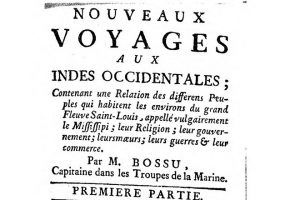
Front page of book written in French
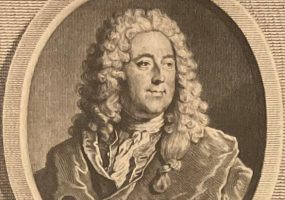
Jean Bernard Bossu (1720–1792)
Jean Bernard Bossu was a French captain and adventurer who explored the region of the Mississippi River while ...
Group of indigenous women in traditional clothing lined in rows some singing as four men hold drum
Caddo Nation
Caddo Indians enter written history in chronicles of the Hernando de Soto expedition, which describe encounter...
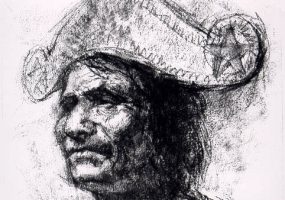
Casqui (1491?–?)
Casqui was a Native American chief who ruled over a province in northeastern Arkansas in the 1500s. He was the...
Charcoal portrait drawing of Native American man wearing necklaces and a wide antique hat decorated with stars.
Cherokee
The Europeans named the Cherokee as one of the Five Civilized Tribes. (The other four were the Chickasaw, Choc...
Native American man with short gray hair smiling in hat and suit
Chickasaw
Heading east, the ancestral Chickasaw crossed Arkansas looking for a new homeland at some point in prehistory....
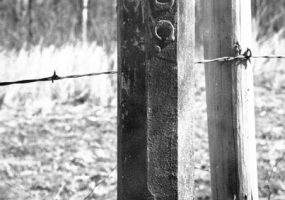
Barbed wire fence post with "Choc." written on it
Choctaw
The Choctaw are of the Western Muskogean language stock, which is also the same stock as the Chickasaw. When f...
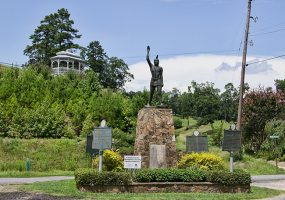
Colbert Raid
On April 17, 1783, British-sympathizing Native Americans and British nationals carried out an attack upon the ...
Statue of Native American man on stone pedestal in flower bed with historical markers surrounding it and gazebo on hill in the background
Route of the De Soto Expedition
When the Spanish expedition of Hernando de Soto crossed the Mississippi River on June 28, 1541 (June 18 on the...
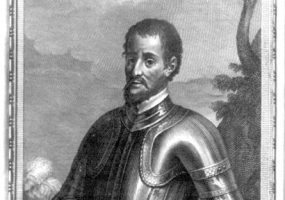
White man wearing a suit of armor with a sword
Hernando de Soto (1500?–1542)
Hernando de Soto was a Spanish explorer who led an expedition into the southern United States. He and his sold...
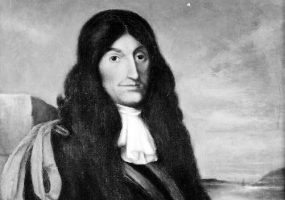
White man with long hair in military uniform and cravat
Henri de Tonti (1649–1704)
aka: Henry de Tonty
Henri de Tonti helped establish the first permanent European settle...
White man wearing a suit of armor with a sword
European Exploration and Settlement, 1541 through 1802
The region that became Arkansas was unknown to Europeans until the 1540s. Fifty years after Christopher Columb...
Don Juan Filhiol (1740–1821)
aka: Jean de Filhiol
aka: Baptiste Filhiol
aka: Jean Baptiste Filhiol
Present-day Camden (Ouachita County) has its origins in a 1782 sett...
Fort St. Francis
Fort St. Francis was erected by the French near the St. Francis River in 1738 during a military campaign again...
Nicolas Foucault (1664?–1702)
Nicolas Foucault was the first Christian missionary to serve among the Quapaw Indians of Arkansas. Nicolas Fou...
White man with long hair in military uniform and cravat
French Explorers and Settlers
The French settlers’ experience in colonial Arkansas was vital to the history of the French presence in the ...
Guedetonguay (?–?)
aka: Guedelonguay
aka: Quedetongue
Guedetonguay was a Quapaw Indian leader in the mid-eighteenth centu...
Two-story wood frame building with dark shutters and  "Confederate State Capitol" on the front with rectangular stone monument and barbed wire fence
Historic Washington State Park
Historic Washington State Park, originally called Old Washington Historic State Park, is one of fifty-two stat...
Portrait of white man with wig with name reading "Jean Law"
John Law’s Concession
aka: John Law's Colony
aka: Mississippi Bubble
John Law’s concession was established in August 1721 and was loca...
Henri Joutel (1643?–1735?)
Henri Joutel was a French soldier and explorer who served in the last expedition commanded by French explorer ...
Koroa
The Koroa are one of many “small tribes” of the southeastern United States that are mentioned briefly in h...
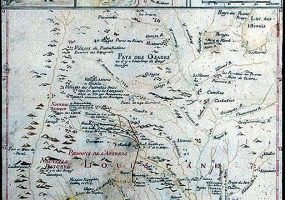
Map of the mid-South, in color
Jean-Baptiste Bénard de La Harpe (1683–1765)
Jean-Baptiste Bénard de La Harpe was a French officer, trader, and explorer. He was the first European explor...
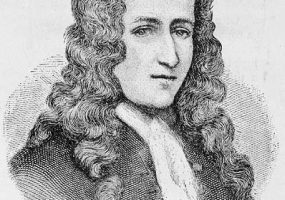
Engraving of white man with long hair in button up coat
René-Robert Cavelier, Sieur de La Salle (1643–1687)
In 1682, French explorer René-Robert Cavelier, Sieur de La Salle journeyed down the Mississippi River in sear...
Pierre Laclède (1729–1778)
Frenchman Pierre Laclède, credited with co-founding the city of St. Louis, Missouri, died aboard his trading ...
Mallet Expeditions
French-Canadian brothers Pierre (1704–1751?) and Paul Mallet (1706?–1753?) participated in three expeditio...
Statue of man in robes standing on a pedestal with plaque on street corner in residential neighborhood
Marquette-Joliet Expedition
In 1673, Father Jacques Marquette, a Jesuit missionary, and Louis Joliet (or Jolliet), a fur trader, undertook...
Pacaha (?–?)
Pacaha was a Native American chief who lived in northeastern Arkansas during the 1500s. He is known solely fro...
Plaque about a grave and a grave inside a fence
Legend of Petit Jean
The Legend of Petit Jean is a romantic Arkansas tale that purports to explain the origin of the name of Petit ...
Native American men and women standing in clearing surrounded by mound buildings and trees
Quapaw
The Quapaw are members of the Dhegiha Siouan language group, which also includes the Osage, the Omaha, the Pon...
Robes of Splendor
aka: Robes of the Three Villages
aka: Three Villages Robe
aka: Buffalo Dancers Robe
The “Robes of Splendor” are a pair of mid-eighteenth-century an...
White man wearing a suit of armor with a sword
Spanish Explorers and Settlers
The only Spanish expedition into present-day Arkansas began when Hernando de Soto led his party across the Mis...
Spanish Land Grants
Arkansas inherited a complex legacy of land grants from its time as part of Spanish Louisiana. Beginning in 17...
Tinhiouen
There were actually two men with the name of Tinhiouen, a father and son, who were hereditary chiefs, or caddi...