
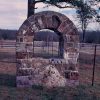

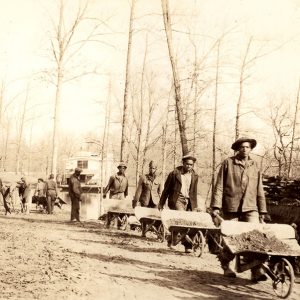
 CCC Enrollees
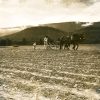
 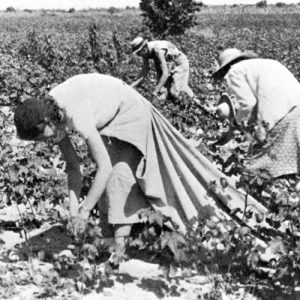 Cotton Pickers
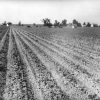
 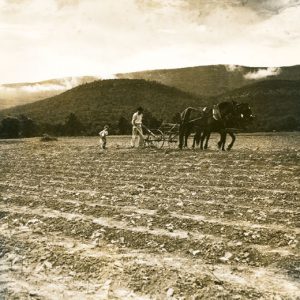 Plowing a Cotton Field
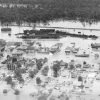
 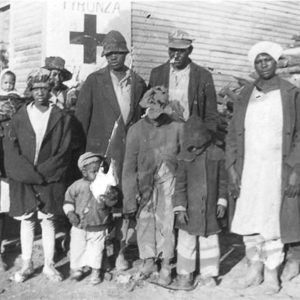 Flood Victims
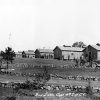
 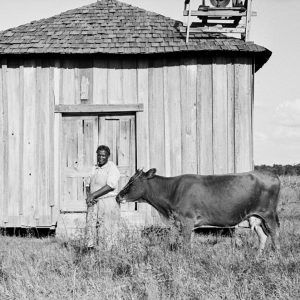 Sharecropper House
 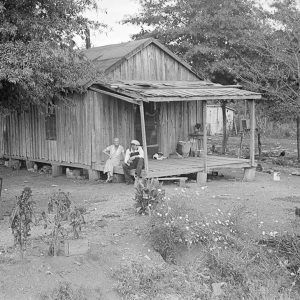 Sharecropper House
501-918-3025
calsfoundation@cals.org
calsfoundation@cals.org
Students will analyze various causes and effects of a specific event during the Great Depression using secondary sources.
Students’ writing utensils, lined paper for students’ notes, printed or online copy of the CALS Encyclopedia of Arkansas entry England Food Riot of 1931 for each student
Images of dust-filled skies and fields smothered by the Dust Bowl storms in Oklahoma stand out vividly when the Great Depression is remembered. But the damage and suffering in Arkansas were equally brutal, were just as widespread, and had been occurring for a longer time. In the Flood of 1927 in the spring of that, fully one-quarter of the state’s land was under water in the huge flood of the Mississippi and Arkansas Rivers. Then the Drought of 1930–1931 scorched the same ground and shriveled farmers’ crops. On top of these natural calamities, the U.S. economy was collapsing and the prices offered farmers were falling.
So bad was the economic hardship that the governor of Arkansas, Harvey Parnell, during a national radio interview, asked listeners for donations to the state’s American Red Cross chapters, whose funds were depleted after the Flood of 1927. This appeal for charity from a private organization embarrassed some of Governor Parnell’s more conservative supporters who had not yet recognized the severity of the crisis, but there was little else he could do. At the time, the idea of the government providing relief—much less funding the huge number of jobs that were needed for any long-term solution—was a radical notion. Conservative politicians strongly resisted such an idea. (Ironically, backlash to this stubbornness would lead to the 1932 election of President Franklin D. Roosevelt, who ushered in large-scale federal “relief, recovery, and reforms” with his New Deal programs, such as the Civilian Conservation Corps.)
Another measure of the desperation of Arkansas’s farm families came in the Delta town of England (Lonoke County), thirty miles southeast of Little Rock, in January 1931. Some 300 farmers and townspeople, most depending on Red Cross emergency rations to eat, were told that the Red Cross shipments had been stalled due to clerical errors. The group threatened to break into the town stores to get food for their children, but local merchants gave them food and averted the worst of what became known as the England Food Riot of 1931. The problem of hunger, however, did not go away. Within the year, 25% of all Arkansas families were forced to turn to the Red Cross for help, and in one Delta county over 90% of families were trying to get by on the Red Cross’s 60 cents worth of food per person per week.
Students will write down their answers to the following prompt:
The school cafeteria has raised the prices for the food, so much so that students are unable to pay for lunch throughout the week. Unfortunately, students also have no food at home to bring for lunch. How will students obtain the food that they need? Whose responsibility is it to ensure that the students have food for lunch (i.e., government, teachers, parents, etc.)?
Students’ answers should come to a decision of some kind; ensure all students participate. This critical thinking gets students into the headspace of those citizens in England during the 1931 Food Riot, creating an empathetic connection to their struggle, and encourages students to draw their own conclusions regarding the events they will soon learn about.
Ensure all students give a definitive answer. “I don’t know,” should not be accepted; ask students what would they do if they went hungry despite food being present for purchase? What would they do to get that food? Reiterate the importance of “whose responsibility” it is to feed them.
Follow up this quick-write bellringer with an open discussion about students’ answers. This should act as a segue into direct instruction.
Direct instruction should scaffold and develop students’ knowledge on Arkansas during the Great Depression. End direct instruction with a reminder to students that the Depression was both a global event and a local one. Make sure by the end of direct instruction that students know the following:

Students will read a printed handout or online version of the CALS Encyclopedia of Arkansas entry on the England Food Riot of 1931. While reading, students should utilize marking the text strategies to note the causes and effects of event. Students should be able to answer the following questions:
These questions could also be answered directly on paper, at the teacher’s discretion. Students’ answers should refer to 1) the exacerbating effect the drought had due to extra strain on resources, 2) the lack of power the governor actually had to assist the situation, and 3) the demands of the farmers and the fear the country felt at this time.
After reading about these events from England, AR, students should have identified key details from direct instruction and prepared notes for class discussion. Class discussion should primarily be student-led. Students should discuss:
Tie discussion back into the bellringer: whose responsibility was it to feed those farmers? Whose responsibility would it be today? Allow plenty of space for students to discuss other aspects of instruction and this reading. Smaller classes may prefer tables or pairs to discuss rather than whole-class discussion.

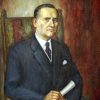
Have students look at the following portrait of Harvey Parnell from the CALS Encyclopedia of Arkansas.

Then have them analyze the portrait. How did Parnell choose to present himself? What does the portrait convey? What did the artist choose to include? Students should write their thoughts on paper.
Then, have students compare what they’ve learned about Parnell to their assessment of the portrait. Are Parnell’s actions consistent with how he hoped to present himself? Why or why not? Encourage students to expand and explain their reasoning.
Possible student responses include Parnell’s composure or professionalism, the calm or steadfastness of his posture, the paper in Parnell’s hand perhaps denoting legislature, and his steady gaze. Compare these things to Parnell’s efforts to downplay the severity of the situation. By the end of the activity, students should recognize Parnell’s desire to appear in control, whether he was or not. Encourage students to decide for themselves the success of the governor’s actions.
Students should look back at their answers to the bellringer and add to, change, or explain their answers after learning about the England Food Riot. Would they do anything differently than they first thought? What worked for the farmers? Do the students think that could work for themselves as well?
This evaluation involves students re-engaging with their own thinking after participating in the learning. By doing this, students should demonstrate an understanding of the struggle during the Great Depression, the effectiveness of collective action, and the importance of accountability during times of hardship. Reintroduce the question, “Who or what is responsible for ensuring they [the students/the citizens] are fed?”
A possible follow-up project would be students researching food insecurity today in America or other parts of the world. They should identify the causes and effects of food insecurity in whatever area they choose and explain how it is similar or different to the hardships described during the England Food Riot.
This extension could be a short or long writing assignment, a poster, or a slideshow.


"*" indicates required fields