


501-918-3025
calsfoundation@cals.org
calsfoundation@cals.org
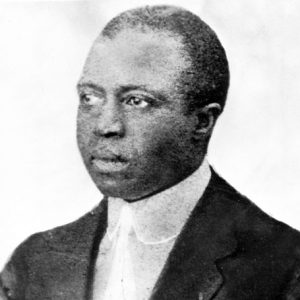
Scott Joplin composed the music and wrote the libretto for the opera Treemonisha, which he published in 1911. According to vocalist and professor Darian Clonts, “Treemonisha has the honor of being one of the first truly authentically American operas written and set in America.” Joplin was successful and well known as a published composer of ragtime compositions such as “The Entertainer” and “Maple Leaf Rag.” Born in northeastern Texas, Joplin spent his formative years in Texarkana (Miller County), and Treemonisha is set in the plantation area of Rondo (Miller County) north of Texarkana. In his compositions, Joplin drew upon African American traditions in addition to lessons in classical music.
Joplin wrote the opera Guest of Honor (1903) about Booker T. Washington’s 1901 invitation to have dinner at the White House with President Theodore Roosevelt, but the score of this opera is lost. After he spent time in Missouri, in June 1904, he married his second wife, Freddie Alexander, in Little Rock (Pulaski County). She died ten weeks later of pneumonia.
In his preface to Treemonisha, Joplin explained: “The scene of the Opera is laid on a plantation somewhere in the State of Arkansas, Northeast of the Town of Texarkana and three or four miles from the Red River. The plantation being surrounded by a dense forest. There were several Negro families living on the plantation and other families back in the woods.” After the white people had left the plantation, Ned was left in charge. He and his wife Monisha prayed that they would have a child, one who would become educated. One day, Monisha found a baby under a tree and they named her Treemonisha. When Treemonisha was seven, a white woman agreed to educate her in exchange for Ned and Monisha’s labor.
The opera takes place on one day in 1884 when Treemonisha is eighteen years old. The three acts represent morning, afternoon, and evening. It begins with the appearance of the conjurer Zodzetrick at the home of Ned and Monisha. He is trying to sell Monisha a bag of luck. Treemonisha, the only educated member of the community, calls him out. Treemonisha is a threat to the conjurers who profit from superstition.
The conjurers kidnap Treemonisha and plan to throw her into a wasp’s nest. She is rescued by her friend Remus, who brings her home. Although the conjurers are captured, she does not seek revenge. The song “Wrong Is Never Right” reinforces this. In the end, Treemonisha is recognized as the leader of her community.
Historian John Dizikes described the opera as “an odd, finally compelling opera, fragile in its charm, moving in its appeal, in its naive mingling of old forms and new spirit. Its music, formal and syncopated, has the grave stateliness and classical dignity of a sung ballet.”
Joplin, who was poor and in failing health, had invested in the 1911 publication of Treemonisha and did not find financial support for staging the opera. He suffered mental decline due to syphilis and died on April 1, 1917, at Manhattan State Hospital.
According to conductor and music scholar Rick Benjamin, Joplin’s manuscripts for Treemonisha were thrown away in 1962. The documents were part of the estate of a musician who sometimes stayed at the same address as Joplin in New York. A lawyer involved in the case told Benjamin that “there were three or four boxes marked ‘Treemonisha’ and that these struck his interest because ‘Treemonisha’ was such a strange word.’ Thumbing through these he found crumbling music paper written on with ink; parts for instruments—cornet, drums, violin, and other things he could not remember; bits of paper; odds and ends….It all seemed like rubbish, and after a few more minutes of aimless perusal, he carried all of the boxes out to the trash.”
In the first part of the twentieth century, ragtime was replaced in popularity by jazz and other genres. After decades of relative obscurity, Joplin’s music suddenly became popular and widely known after being featured in the motion picture The Sting starring Paul Newman and Robert Redford in 1973.
On January 28, 1972, there was a premiere performance of Treemonisha at the Atlanta Symphony Hall’s Memorial Arts Center. The fully staged opera featured the Atlanta Symphony Orchestra and was followed by a second performance the next evening. Treemonisha was performed on a larger scale by the Houston Grand Opera in 1975. This was broadcast on public television.
Scott Joplin was awarded a special Pulitzer Prize in 1976 and was inducted into the Arkansas Jazz Hall of Fame in 2004.
For additional information:
Berlin, Edward A. King of Ragtime: Scott Joplin and His Era. 2nd ed. New York: Oxford University Press, 2016.
Caplan, Lucy. Dreaming in Ensemble: How Black Artists Transformed American Opera. Cambridge, MA: Harvard University Press, 2025.
Haskins, James, and Kathleen Benson. Scott Joplin. New York: Stein and Day, 1978.
Joplin, Scott. Treemonisha: Opera in Three Acts. New York: 1911. Online at https://www.loc.gov/resource/music.musihas-200033526/ (accessed July 17, 2025).
Westby, Alan. “Scott Joplin, Treemonisha and American Opera.” Los Angeles Public Library Blog, February 21, 2017. https://www.lapl.org/collections-resources/blogs/lapl/scott-joplin-treemonisha-and-american-opera (accessed July 17, 2025).
Allen McMillan
Little Rock, Arkansas


Comments
No comments on this entry yet.