501-918-3025
calsfoundation@cals.org
calsfoundation@cals.org
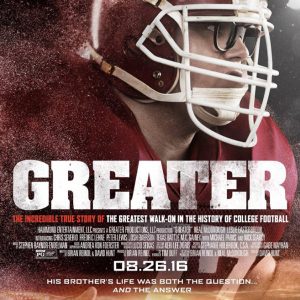
Brandon Burlsworth was a lineman for the University of Arkansas (UA) Razorbacks football team from 1995 to 1999. He joined the team as a walk-on, meaning he had not been awarded an athletic scholarship. Eventually, Burlsworth became a college All-American before being drafted by the National Football League’s Indianapolis Colts. After Burlsworth’s death at age twenty-two, his jersey number was retired by the Razorbacks, one of only three in the team’s history to be so honored. In 2001, Jeff Kinley’s book Through the Eyes of a Champion: The Brandon Burlsworth Story was released (later re-titled Greater: The Brandon Burlsworth Story). The book includes a foreword by former UA athletic director Frank Broyles and was the inspiration for the 2016 movie Greater.
Brandon Vaughn Burlsworth was born on September 20, 1976, in Harrison (Boone County) to Barbara Ann Long Burlsworth, who was a real estate agent, and Leo Burlsworth, a professional musician. In 1994, Brandon graduated from Harrison High School, where he was an All-State football selection. Despite receiving scholarship offers from smaller schools, he tried out as a walk-on for the Razorback football team at UA in Fayetteville (Washington County). At the time, he was 6’2″ and weighed 245 pounds but was told that it was necessary for linemen to be more than 300 pounds. To earn a spot, Burlsworth began eating heavily and working out to bulk up and build muscle.
During his first year at UA in 1994, Burlsworth “redshirted,” a term used in college sports to indicate an athlete who chooses not to compete for a season in order to extend eligibility for future seasons. During the redshirt year, players can practice with their team and maintain eligibility for athletic scholarships or other financial aid. During his redshirt year, Burlsworth continued weight training to build muscle. In his sophomore season, he earned a scholarship and a starting position on the offensive line for the Razorbacks as right guard. Before Burlsworth’s junior season in 1997, he was selected to be one of the team captains. Other honors followed, including winning a first-team All-SEC spot in 1997 and 1998 from football’s Southeastern Conference and being selected for the 1998 Associated Press and Football News All-America team. He was UA’s first All-American player since 1993 and was their first player selected to a first-team squad since 1989. Burlsworth was named to the All-SEC Academic Honor Roll every year from 1995 to 1998 and played on two SEC Western Division championship Razorback football teams, in 1995 and 1998.
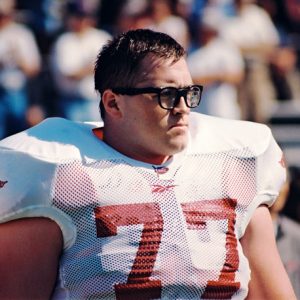
Burlsworth was especially known for his insistence on wearing unfashionable, black-rimmed glasses with thick lenses. They became his trademark after he decided he did not want to wear contact lenses when he played in case they started hurting his eyes in the middle of a game. He also liked that glasses were easy to take on and off, and he bought the least expensive, most basic pair of glasses he could find. The look caught on as fans began sporting their own replicas. It was not uncommon for opposing players to laugh when they faced him on the line of scrimmage, mocking him by calling him “Drew Carey” or “Clark Kent.” In Burlsworth’s final year of eligibility, the Razorbacks went 9–2, earning a spot at the 1999 Citrus Bowl against Michigan. The Razorbacks were defeated by a Michigan team that was led by future NFL great Tom Brady.
Burlsworth graduated in 1998 from UA with a bachelor’s degree in business administration and completed an MBA the following year, becoming the first Razorback football player to complete a master’s degree. He played in his final game, which was the Citrus Bowl, on January 1, 1999.
Burlsworth was invited to the scouting combine for the NFL, a week-long event in which college athletes have the chance to be chosen to play on a professional football team. At the combine, Burlsworth topped all linemen with his speed in the forty-yard dash and by bench-pressing 225 pounds twenty-eight times. In the third round of the 1999 NFL draft, the Indianapolis Colts selected Burlsworth. He was projected to be a starting offensive lineman for the Colts’ 1999 season that would start the following fall.
On April 28, 1999, eleven days after being drafted by the Colts, Burlsworth was driving home to Harrison to attend church with his mother after a workout in Fayetteville. He was fifteen minutes from home when he was killed in an auto accident near Alpena (Boone and Carroll counties) involving two tractor trailers. The official report stated that Burlsworth crossed the center line in his small car, clipping the front fender of a big rig. His car returned briefly to its lane, then crossed the center line again and hit a second tractor trailer head-on “for unknown reasons.”
After his death, Burlsworth’s jersey with the number 77 was permanently retired in a ceremony at UA’s first home game of the 1999 season. It was only the second number ever retired by UA, the other being number 12 in honor of Clyde Luther “Smackover” Scott (1924–2018). The Indianapolis Colts wore his initials “BB” on their helmets for the 1999 season. The Colts also honored him by making a donation to family members and to UA at the halftime of the first Colts game after Brandon died.
Burlsworth’s locker is enclosed in a glass case in the Razorback locker room, preserved in his honor. He was posthumously elected to the Arkansas Sports Hall of Fame in 2002 and the University of Arkansas Sports Hall of Honor in 2004. In 2013, Bleacher Report named Burlsworth the No. 1 Greatest Walk-On Player of the Bowl Championship Series (BCS) era. Since 2010, the Burlsworth Trophy has been awarded to the most outstanding player to have started as a walk-on in the NCAA Division I Football Bowl Subdivision (FBS). The Burlsworth Trophy belongs to the National College Football Awards Association (NCFAA), joining the Broyles Award as the only members of the NCFAA originating in Arkansas. The Brandon Burlsworth Foundation was founded by family members after his death, with a mission to support the physical and spiritual needs of children, in particular those with limited opportunities.
For additional information:
Brandon Burlsworth Foundation. https://www.brandonburlsworth.org/ (accessed February 12, 2026).
Higgins, Ron. “Burlsworth Makes Laughter Stop Quickly.” Lakeland Ledger, December 29, 1998. https://www.theledger.com/story/news/1998/12/29/burlsworth-makes-laughter-stop-quickly/26526886007/ (accessed February 12, 2026).
Kinley, Jeff. Through the Eyes of a Champion: The Brandon Burlsworth Story. Green Forest, AR: New Leaf Press, 2001.
McDanal, Jonathan. “25 Greatest Walk-Ons of the BCS Era.” Bleacher Report, June 21, 2013. https://bleacherreport.com/articles/1680129-25-greatest-walk-ons-of-the-bcs-era (accessed February 12, 2026).
Schroeder, George. Hogs! A History: The Story of Razorbacks Football. New York: Simon & Schuster, 2005.
Yount, Sheila. “Marty Burlsworth.” Arkansas Democrat-Gazette, July 30, 2023. https://www.nwaonline.com/news/2023/jul/30/marty-leo-burlsworth/ (accessed February 12, 2026).
Nancy Hendricks
Garland County Historical Society


Comments
No comments on this entry yet.