
501-918-3025
calsfoundation@cals.org
calsfoundation@cals.org
Arkansas played a part in the international drama of 1980, when 125,000 Cubans left their homeland for a new life in the United States. Roughly 25,000 of these Cuban refugees—called Marielitos because they had departed Cuba from the port of Mariel—were housed for a time at Fort Chaffee in Sebastian County. Their presence in Arkansas created social and political tension widely thought to have had an impact on the Arkansas governor’s race of 1980.
Cuba and the Boatlift
The crisis of 1980 began April 11 of that year, when Hector Sanyustiz, accompanied by five friends, drove a Havana city bus through a gate onto the grounds of the Peruvian Embassy to Cuba. The six intended to seek political asylum. By the following Saturday, 10,000 other Cubans had entered the embassy grounds through the damaged gate, also seeking escape from Cuba. The government of Peru sought international help to find homes for the refugees. As other countries offered to receive dozens or hundreds of refugees, the U.S. government pledged to accept up to 3,500.
At this point, the Cuban government announced that American boats were welcome to come to the port of Mariel to transport refugees directly to the United States. Although the State Department asked American citizens not to become involved, by April 25, more than 300 American boats were in the Mariel harbor, awaiting passengers.
Over the following weeks, thousands of Cubans boarded American boats in Mariel and were taken to southern Florida. Pro-Castro protesters became violent to those leaving the island, throwing rocks at them. Some Marielitos reported protestors shouting, “Go away, scum!” and “Go away, delinquents!” Many of these tensions were fueled by Fidel Castro’s assertion that these people were queer or anti-revolutionary.
Estimates of the number of Marielitos brought to the United States range from 124,776 to 125,344. Even as the U.S. government tried to discourage citizens from transporting Cubans, President Jimmy Carter promised to receive the Cubans fleeing Castro’s communist government “with open arms.”
Cubans Come to Arkansas
The first refugees were processed at Eglin Air Force Base in southern Florida. Of the 6,400 Marielitos received before May 2, fifty-five were found to have criminal records. (This counters frequently reported rumors of the time, persisting to the present, that the Cuban government forced thousands of criminals and insane persons onto the boats in Mariel harbor. Popular belief in this rumor may explain the negative reaction of many Arkansans to the presence of Cuban refugees in northwestern Arkansas.) Overwhelmed by the effort to handle thousands of refugees in one location, the U.S. government announced plans to use Fort Chaffee as a temporary center for housing and processing refugees.
Between May 9 and May 18, 1980, a total of 19,048 Cuban refugees were transported from Florida to Fort Chaffee. Some were quickly processed and released to family members, friends, or other sponsors. Others, lacking sponsors, were held for a longer period of time. With the refugees living there, Fort Chaffee had become the eleventh-largest city in Arkansas. The presence of the Marielitos there, though, was disturbing to many residents of Barling, the small town near the fort. A retired U.S. Marine, Kevin “Mac” McCarthy, gained access to the fort via an expired military ID card. McCarthy changed into the white robes of the Ku Klux Klan (KKK) and ran onto the tarmac. “Don’t let them in!” he shouted. “Hoodlums! They’re gonna come here and get welfare, and a free ride for everything.” Tensions of the past continued to show themselves as more refugees began to arrive at Fort Chaffee.
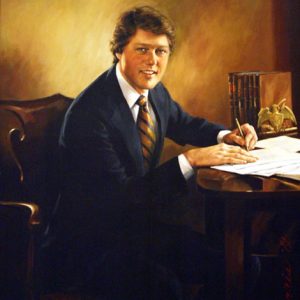
Because the Cubans were not prisoners, soldiers were told at various times that violence or threats of violence in order to keep them on government property were not permitted. By May 20, twenty-one Cubans had left the fort; on May 22, thirty more attempted to leave. The next week, more Marielitos (newspaper reports said 350) left the fort through an unguarded gate. Governor Bill Clinton ordered the National Guard to assist local, county, and state police to prevent refugees from leaving the fort.
On May 29, guards and police officers faced an advance of roughly 1,000 Marielitos out of the gate of the fort; all were stopped and returned. Some were halted on the state highway near the town of Barling. On June 1, between 2,000 and 3,000 Marielitos rioted on the fort property. Four buildings were set on fire; sixty-two injuries were reported (including five guards), but there were no deaths. Newspaper reports described the citizens of Barling and other area communities arming themselves for protection against an anticipated Cuban refugee invasion. Governor Clinton gave Gene Eidenberg—the White House official whom President Carter had placed in charge of the Cuban refugee issue—a tour of Barling the night of June 1–2, impressing upon him the danger of confrontation between Marielitos and local residents. On June 2, stronger security standards were issued, and a promise was made that no additional Cuban refugees would be sent to Arkansas. National Guard personnel swept through the base, searching refugees’ belongings for weapons or other contraband, increasing tensions significantly.
Life at Fort Chaffee
Following the protests and based on complaints from the community, base and government officials knew they needed to act. A protest of this scale could not happen again. Three Psychological Operations (PSYOPS) units were activated to try to monitor and control the refugee population. In addition to offering translation services for the National Guard stationed at Fort Chaffee, the units were also responsible for creating and censoring the only news outlets available to refugees at Fort Chaffee: La Vida Nueva (The New Life) and KNJB radio station 92.7 FM. Each outlet offered a chance for refugees to take photos, write stories, and highlight social events happening at Chaffee. Shortly after the protest, La Vida Nueva began publishing bilingually so refugees could practice language skills and higher-up PSYOPS officials could edit content at will. PSYOPS editors worked to make sure the information was not overly political and upheld “traditional American values.” By late June, La Vida Nueva was the sixth-largest newspaper publication in Arkansas. This outlet also shared Cuban cultural heritage throughout the fort.
Upset with the slowness of the screening and processing, Cuban groups staged hunger strikes and occasionally riots. In June, it was estimated that the federal government was spending $1 million each day on Fort Chaffee alone. Later that same month, Governor Clinton sent a bill to the federal government for $213,850 spent by the State of Arkansas due to the Marielitos. A $664,000 grant from the federal Office of Education provided English classes to the Cuban refugees temporarily housed in Arkansas. Clinton also said in a speech shortly after the June 1 riot that 650 to 2,000 National Guard troops would be sent to Fort Chaffee from neighboring states.
The Spanish American League Against Discrimination (SALAD) published a report in June 1980 that criticized Fort Chaffee for not offering sufficient food and entertainment for the refugees. In response, officials began offering cigarettes, Cuban coffee, musical instruments, and movie theaters. Inter-base sports leagues were started, which allowed refugees to compete in boxing, soccer, and baseball matches while interned. Community members offered workshops to help refugees find jobs locally to speed up the resettlement process. This included carpentry, flooring, HVAC, and upholstery. Even with extracurricular activities and English classes, refugees still did not have individual freedom.
In 1980, the Cuban Haitian Task Force published a report detailing concerns of the Marielito population. Officials had disposed of “rotting foods due to sanitary concerns,” directly interfering with worship rituals associated with Santería and Lucumí offerings. Evidence suggests that Marielitos circumvented this censorship through musical performances. Groups like Los Sublimes formed across the base practicing Latin fusion standards with batá and conga drums.
Cuban Refugee Crisis in the Press
Beyond religion, Cubans were discriminated against because of their health conditions, sexuality, and gender identity. An article from the Arkansas Democrat insulted marginalized Cubans at Chaffee through exaggerated language: “The insane who huddle under blankets are sedated lest they cut their wrists to get attention. Homosexuals swish along dusty streets in drag. Single young women bear children conceived in the American resettlement camp. These are the unwanted Cubans at Fort Chaffee.” While many in the Barling community and Volunteer Agency sponsors found these people to be undesirable, the Cuban refugees insisted on expressing themselves freely even in the face of discrimination. Historian of sexuality Susana Peña pointed out that LGBTQ+ Cubans were rarely given representation in national news outlets despite the fact that internal Cuban Haitian Task Force records show approximately 250 to 500 queer-identifying Cubans housed at Fort Chaffee during the operation. In 1980, 60% to 70% of all Americans disapproved of the Cuban refugees for two reasons: supposed criminal activities and homosexuality.
LGBTQ+ refugees were housed in separate dormitories, segregated from the general population of Fort Chaffee. Transformistas (gender nonconforming Cubans), who often dressed in drag, were photographed for La Vida Nueva, showing a network of cooperation among refugees. Marielitos were only issued clothes based on their sex, so refugees traded with one another, and transformistas trimmed their eyebrows, wore lipstick, and dressed femininely for events on base such as discos.
Some soldiers held malice toward the refugees they were tasked with containing. On June 5, 1980, the National Guard newspaper Crossroads published interviews with Fort Chaffee soldiers, asking: “Do you think the Cubans should be sent back?” A first lieutenant answered, “I sure do! I don’t think it’s right for the people to put up with this….It’s costing too much money.” Many, however, felt that the refugees who behaved should get a chance at citizenship. Allegations of brutality or torture by U.S. soldiers and guards were occasionally published as well; although five Fort Chaffee guards were indicted over charges of beating refugees, no one was ever convicted based on these allegations. At the end of July, twelve government workers were removed from their responsibilities at Fort Chaffee after evidence was shown that they were using their contact with the refugees to draw them into The Way, an organization widely regarded as a religious cult.
Fallout and Aftermath
By the middle of September 1980, fewer than 3,000 Marielitos remained at Fort Chaffee. On September 20, the federal government announced plans to consolidate unprocessed refugees at Fort Chaffee to spare them the cold winters of Wisconsin and Pennsylvania. The American government transferred 643 Marielitos from Eglin Air Force Base in Florida to Fort Chaffee and began moving what would total 3,236 refugees from Camp McCoy in Wisconsin. By October 10, Marielitos had also been moved from Pennsylvania to Arkansas, raising the Cuban population of Fort Chaffee to over 8,300.
That month, a political commercial for Frank White, Republican candidate for governor of Arkansas, suggested that Governor Clinton had failed to protect the citizens of Arkansas from having dangerous Cubans in the state; the TV commercial included footage of the 1,000 Marielitos leaving Fort Chaffee on May 29. Though it is impossible to measure all the factors that determine the outcome of an election, Clinton is among those who felt that the association of the Cuban refugee problem with Clinton’s term as governor led to White’s victory.
On January 4, 1981, 5,893 Marielitos remained at Fort Chaffee, 97.6% of whom were male and 75% of whom were mixed race or Black. The last twenty-three Cubans left the fort on February 4, 1982. Records show that a total of 25,390 Cubans had been housed at the fort after arriving in Florida, around 20% of the total boatlift population.
Overall, of the roughly 125,000 Cubans who entered the United States in the 1980 boatlift, 103,000 were released into American society relatively quickly. Those detained for a longer time included 1,200 suspected of serious crimes in Cuba and 600 diagnosed as severely mentally ill; the rest were suspected only of political crimes in Cuba or other minor offenses. Over time, 98% of the Marielitos joined the United States population. Most made their homes in southern Florida or in New York City or northern New Jersey. Few, if any, of the Marielitos chose to live in Arkansas.
For additional information:
Carter, Jimmy. Keeping Faith: Memoirs of a President. Fayetteville: University of Arkansas Press, 1995.
Capo, Julia. “Queering Mariel: Mediating Cold War Foreign Policy and U.S. Citizenship Among Cuba’s Homosexual Exile Community, 1978–1994.” Journal of American Ethnic History 29, no. 4 (2010).
Clinton, Bill. My Life. New York: Alfred A. Knopf, 2004.
Fort Chaffee Refugee Research Guide. Boreham Library, University of Arkansas at Fort Smith. https://library.uafs.edu/c.php?g=682350&p=4818325 (accessed May 14, 2026).
Garcia, José Manuel. Voices from Mariel: Oral Histories of the 1980 Cuban Boatlift. Gainesville: University Press of Florida, 2018.
Guerrero, Perla M. “Impacting Arkansas: Vietnamese and Cuban Refugees and Latina/o Immigrants, 1975–2005.” PhD diss., University of Southern California, 2010.
Larzelere, Alex. Castro’s Ploy—America’s Dilemma: The 1980 Cuban Boatlift. Washington DC: National Defense University Press, 1988.
Lipman, Jana K. “A Refugee Camp in America: Fort Chaffee and Vietnamese and Cuban Refugees, 1975–1982.” Journal of American Ethnic History 33 (Winter 2014): 57–87.
Moyer, Justin Wm. “The Forgotten Story of how Refugees Almost Ended Bill Clinton’s Career.” Washington Post, November 17, 2015. Online at https://www.washingtonpost.com/news/morning-mix/wp/2015/11/17/the-forgotten-story-of-how-refugees-almost-ended-bill-clintons-career/ (accessed February 18, 2026).
Ojito, Mirta. Finding Manana: A Memoir of a Cuban Exodus. New York: The Penguin Press, 2005.
Peña, Susana. “‘Obvious Gays’ and the State Gaze: Cuban Gay Visibility and U.S. Immigration Policy during the 1980 Mariel Boatlift.” Journal of the History of Sexuality 16, no. 3 (2007).
Plunkett, Bob. “The New Arkansans: The Cuban Refugees Revisited.” Arkansas Times, September 1981, pp. 22, 24, 26–29.
———. “What Went Wrong at Fort Chaffee: Behind the Cuban Refugee Crisis.” Arkansas Times, September 1980, pp. 34–36, 38–39, 41–48, 53.
Rieff, David. The Exile: Cuba in the Heart of Miami. New York: Simon & Schuster, 1993.
Rogers, Blair Austin. “La Vida Nueva: Detainees, Arkansans, and Libertad during the Cuban Refugee Crisis of 1980–1983.” MA thesis, University of Nevada, Reno, 2023.
Spears, Judge Jim. Yearning to Breathe Free: A Judicial History of the Cuban Relocation Project Fort Chaffee, Arkansas 1980–1982. N.p.: Judge Jim Spears, 2019.
Speir, Caroline. “From Cuba to Fort Chaffee.” Journal of the Fort Smith Historical Society 44 (Fall 2020): 30–45.
Steven Teske
North Little Rock, Arkansas
Blair Rogers
Washington State University


Hello all–
I am one of the authors cited at the end of this entry. My research is expanding to include and go beyond this military base in terms of scope. If you have comments, historical documents, or histories you’d like to share about the Cuban Refugee Crisis, please reach out to me at bl************@*su.edu
There is no mention of 2/36 Field Artillery from Fort Sill being there, which is sad! Our unit was one of the first to deploy there–actually went there twice!
There was a second riot there in early 1981. I was an MP there from Fort Hood, Texas. It started when a guard inside the encampment shot a Cuban who was trying to stab another Cuban. There were many MPs that were injured. I can’t find news about the riot. I wonder why.
I was a first lieutenant assigned to General “Bulldog” Drummond’s staff as the assistant adjutant. The summer of 1980 was brutally hot, and we worked seven days a week, ten- and twelve-hour days. One of my duties was to oversee and facilitate the refugees’ publishing of their weekly newspaper. Not being bilingual at the time, communication would have been a problem had it not been for the fact that several of the Cuban newspaper staff spoke almost perfect English. Now, I was told that English wasnt even taught in Cuban schools at that time; amazingly, they had learned the language by listening to outlawed/forbidden radio stations from southern Florida. Not surprisingly, they were also well versed in American music, especially rock music. We didn’t have a lot of time off that summer, but I remember going to the pool on Post to cool off on a rare Sunday afternoon that we didnt have to work. Shortly after I got there, I noticed smoke rising above a row of barracks down the street. Soon after, a general alarm sounded and we were told to vacate the pool and report to our duty stations. We learned later that some of the Cubans had rioted and set fire to their barracks. Not long after that, Bill Clinton (governor at the time) visited. I got his autograph on a sheet of General Drummond’s stationery. The general’s secretary (I wish I could remember her name–she was stately, wore her gray hair in a bun, and was very nice but was also no-nonsense) told me to be sure and save that autograph because rumor had it that he would be president someday. I’m proud to say I still have it.
Part 1: In 1980, my first assignment was with the 258th Military Police Company based at Fort Polk, LA. In May 1980, we received orders to deploy to Ft. Chaffee, AR. Upon arriving, we were immediately assigned to guard the containment area housing Cuban refugees. The only thing separating them from us were saw horses and rope. The intelligence obtained was that the refugees were getting disgruntled by the process and conditions. We were the only military unit providing security for the base and refugees. We were issued only riot gear and three-foot wood batons. On June 1, it seemed like all hell broke loose. I was on patrol with my supervisor (checking on the guard shacks) when we received a radio call of a military jeep that was on fire and heading for the main gate. We arrived at the north end east of the gate when the jeep drove up. The two MPs from my company were told to “get down” by the law enforcement (state troopers, county sheriffs, and some local officers) lined up on the other side of Highway 22. The two MPs were on the ground behind the three-foot rock wall when the jeep arrived with approximately fifty rioting refugees right behind it. I did not see or smell any tear gas fired by the state troopers, and there were no National Guard soldiers there either. When the jeep got within a few feet of the gate, the civilian law enforcement opened fire, hitting several Cubans. They turned the jeep around and dispersed the crowd. Dozens of refugees were killed and thrown into burning dining facilities. [Editor’s note: This account conflicts with published reports of the incident, which state that no refugees were killed in the rioting.]
Part 2: After the rioting calmed down, they put up an eight-to-ten-foot fence with wire on top. They separated the population as far as a family area, female area, male area, etc. We still had contact with the refugees through the fence and found out that most of the refugees were excited and thankful to be there. But there was a group of refugees that didn’t want to be there and was trying to get sent back to Cuba. During the riots, the refugees were trying to police themselves, and any “trouble makers” were being killed and tossed into the burning dining facilities. I know that this is hearsay from them to me, but they explained how they made weapons from the metal bunk bed adapters that were obtained before we (military) realized what they were doing. So, between those and knives they got from the dining facilities, they were well armed. We left around September and were replaced by another Military Police Company out of Ft. Riley, KS. We did hear stories about ranchers sponsoring out Cuban refugees and basically putting them in a bunkhouse using them as “cattle hands” to the point of almost slavery. It was said that you could get $500 per refugee. Other stories include that the refugees would get sponsored out and then run away to Miami to be with family. I remember how friendly the local civilians were, bringing baked desserts and food to the gates and thanking us for keep them safe. [Editor’s note: This account conflicts with published reports of the incident, which state that no refugees were killed in the rioting.]
Talk to the people who were actually there. Ask the Sebastian County Deputies who were assigned to patrol the perimeters of Chaffee and find the escapees. What did we do with them? Were there deaths? Hundreds. Why hide what actually happened? This was a planned and well-executed event by the Cuban government to empty their prisons of some of the most vicious criminals they had…leave, you’re free, return and die. What a screw up by the Carter administration.
Respectfully, Ron Thomas, Boone County Sheriff’s Department, BN 55
[Editor’s note: This account conflicts with published reports of the incident, which state that no refugees were killed in the rioting.]
It’s been close to 40 years ago that I stood with 41 other various law enforcement officers in front of Fort Chaffee while the Cubans burned the barracks and cars and fired shots at us as we were lined up in the middle of Highway 22 near the main gate. We watched as different groups of rioters got “fired up,” and we noticed that there were instigators moving among the general group of Cubans. It should also be noted that there were a number of Haitians mixed in with the population and there seemed to be no love between the two groups. Approximately 250 refugees set out on the road to Jenny Lind directly south of Chaffee. At that time, another Sebastian County deputy and myself were dispatched to that area in order to stop any refugees from leaving the base. Local armed citizens patrolled the back roads searching for any Cubans who left the base. We did not stop them from protecting their property. There is so much information concerning all of this I could write a book–some of which I participated in and other information shared to me by my Brother Law Enforcement Officers. It was a complete governmental screw up.